Iran Says It Would Reopen Strait of Hormuz in 2 Days as Part of U.S. Deal
Iran is prepared to reopen the Strait of Hormuz in two days if the United States agrees to a set of demands, its foreign ministry said on Monday, after a week of intensified negotiations to avert a return to war.
But those demands, which include the Trump administration lifting sanctions on Iran and releasing billions of dollars in frozen Iranian assets, appear difficult for Washington to accept.
The foreign ministry’s spokesman, Esmail Baghaei, made the comments hours after President Trump had said at a campaign rally that he might eventually decide to give Iran “the hammer” if the two sides could not reach a deal to end the war.
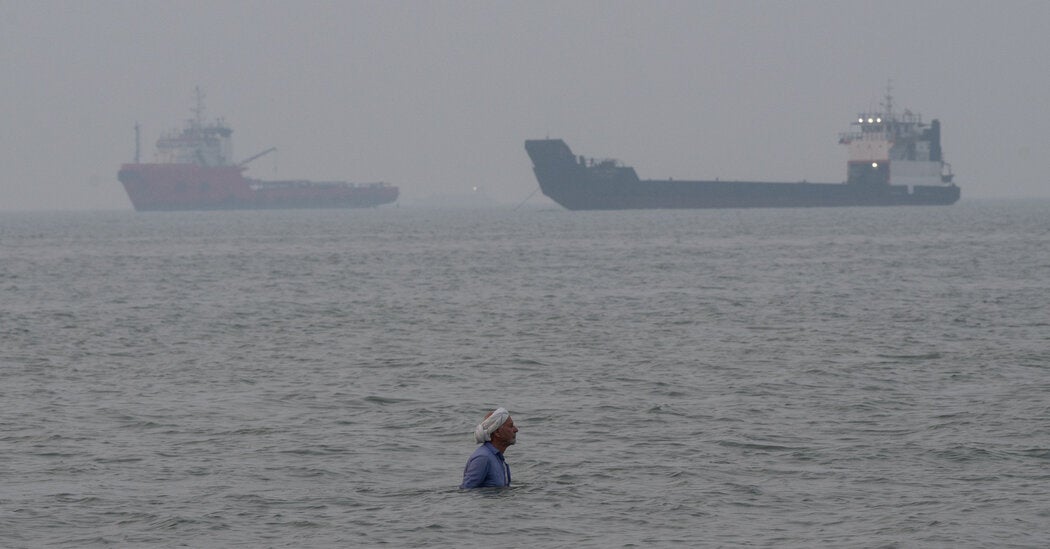
Iran effectively closed the Strait of Hormuz, a vital waterway for oil and gas shipping in the Persian Gulf, after U.S. and Israeli forces attacked the country in February. That move roiled energy markets, and continues to shake the global economy.
American and Israeli military officials have been drawing up plans for renewed strikes on Iran after this week’s U.S. midterm elections. Iranian leaders have warned that, if the country were attacked again, its forces would expand their range of targets, and are they are now publicly considering a withdrawal from the Nuclear Nonproliferation Treaty, which prohibits the development of a nuclear weapon.
Propelled by increasingly bellicose rhetoric from both Iran and the United States, Qatari mediators have been pushing to broker a last-ditch deal between the two countries.
In recent days, Iranian officials have signaled that those negotiations have made some progress, though Mr. Baghaei stressed that they were not at a point where Iranian negotiators were prepared to hold direct talks with their U.S. counterparts.
“If Iran’s legitimate demands are accepted and implemented, it would be possible to put the entire plan into operation within two days, restore security to the Strait of Hormuz, and initiate the negotiation process,” Mr. Baghaei told reporters on Monday. “The realization of this depends entirely on Washington’s will and decision.”
The global benchmark oil price, apparently responding to potential progress in the talks, declined 4 percent on Monday to about $109 a barrel.
Still, conditions around the Strait of Hormuz remain extremely dangerous. More than 35 ships were attacked in October, more than in any other month since the start of the war.
In September, Iran proposed a phased deal to reopen the strait, in which the warring countries would take turns to make concessions, culminating in Tehran ensuring safe passage through the strait, while Washington would lift a naval blockade on Iran’s ports.
After that initial phase, Iran proposed that the two sides could begin negotiating a comprehensive peace deal that would restart talks over its nuclear enrichment program. U.S. officials rejected this proposal, saying Iran should commit to nuclear concessions earlier.
Qatari mediators have managed to revive negotiations over the past few weeks, initially accelerating the implementation of the initial phase to five days, and more recently condensing that to two days, Iran’s foreign minister, Abbas Araghchi, told the broadcaster Al Jazeera on Saturday.
Mr. Araghchi made no mention of nuclear concessions. In a televised interview on Saturday, one of the officials overseeing the talks, Mohsen Rezaei, Iran’s national security adviser, said nuclear negotiations could begin only after Washington had met Iranian conditions.
Alongside the demands related to sanctions and frozen assets, Mr. Araghchi said in his interview that the U.S. would also have to recognize a deal between Oman and Iran for administering passage through the strait in the future.
At the same time, Mr. Rezaei said that a recent letter sent to him about negotiations from Vice President JD Vance had shown a changed tone toward Iran, which the Iranian official called a “good sign.”
Even as Gulf leaders pin their hopes on a diplomatic solution, they are “braced for the worst,” said Anwar Gargash, the diplomatic adviser to the president of the United Arab Emirates, at the Manama Dialogue security conference over the weekend. The stakes of the negotiations are particularly high for Gulf Arab countries, which were battered by Iranian drone and missile attacks in retaliation for U.S.-Israeli strikes.
“The rules of logic tell us that the Iranian stand and U.S. stand are far apart,” Mr. Gargash said at the conference in Bahrain. “If these positions are not bridged, then we have to worry about the worst.”
Iranian officials have repeatedly stressed that they are suspicious the talks could unravel. In his news conference on Monday, Mr. Baghaei said that the United States and Israel had attacked Iran in June 2025 shortly after Iranian officials had held negotiations with Washington.
Mr. Trump’s current stance remains ambiguous. On Sunday, he told journalists that he had had a “good talk” with President Benjamin Netanyahu of Israel over the weekend, which included a discussion of the war.
“The only reason we’re not finished with Iran is I want to be nice — I want to try and save all those lives if I can,” he told a campaign rally in Iowa later on Sunday. “But at some point we’re going to have to give them the hammer.”
Ismaeel Naar contributed reporting.