‘NAZA’ documentary gets free screening at Riverdale 10 on Nov. 7
“NAZA,” an acclaimed 2026 documentary that won the Special Jury Prize at the Venice Film Festival, is showing for free at Riverdale 10 VIP Cinema on Saturday, Nov. 7 at noon. The 100-seat screening is open to the public and no advance tickets are required. The directors, Yuval Abraham and Rachel Szor, are the Israeli half of the four-person Israeli-Palestinian team behind the 2024 film “No Other Land,” which won an Academy Award for Best Documentary.
Abraham, an investigative journalist for +972 magazine, has reported extensively on the technology behind Israel’s widespread, systemic destruction of Gaza in the wake of the Oct. 7 attacks in 2023. With “NAZA,” he and Szor focus their investigation on documenting the tactical use of automated machine learning systems, which have allowed the Israeli military to generate virtually as many targets as they like — whether individuals or buildings — by using extensive data collected on the entire population of Gaza to train algorithms. The existence of such systems makes the staggering death toll and scale of destruction in Gaza over the last several years both more comprehensible and also more disturbing and indefensible.
Israel’s policy of mass killing and maximal destruction in Gaza is in many ways embedded, and reified, in computer models and the ways those models have been used in military operations, most notably with the concept of NAZA, Hebrew for “collateral damage.” For every possible target, the “amount” (you can see the dehumanizing language at work) of NAZA — the number of civilians killed in the process — is estimated. Different thresholds of allowable NAZA are tolerated at different times for different purposes (at one point, the default NAZA was set to 20, meaning that at least 20 civilians could be killed in any given strike).
Such systems would not be possible without the unprecedented level of technological surveillance and physical control that Israel has maintained over Gaza for decades. Through interviews with Abraham’s sources, current and former Israeli soldiers, the film lays all of this bare — plus more. While this scalable and automatable technology may provide the means for and plausible deniability of what can be thought of as a kind of algorithmic genocide, the film shows that humans were still very much involved in every military strike and in every casualty.
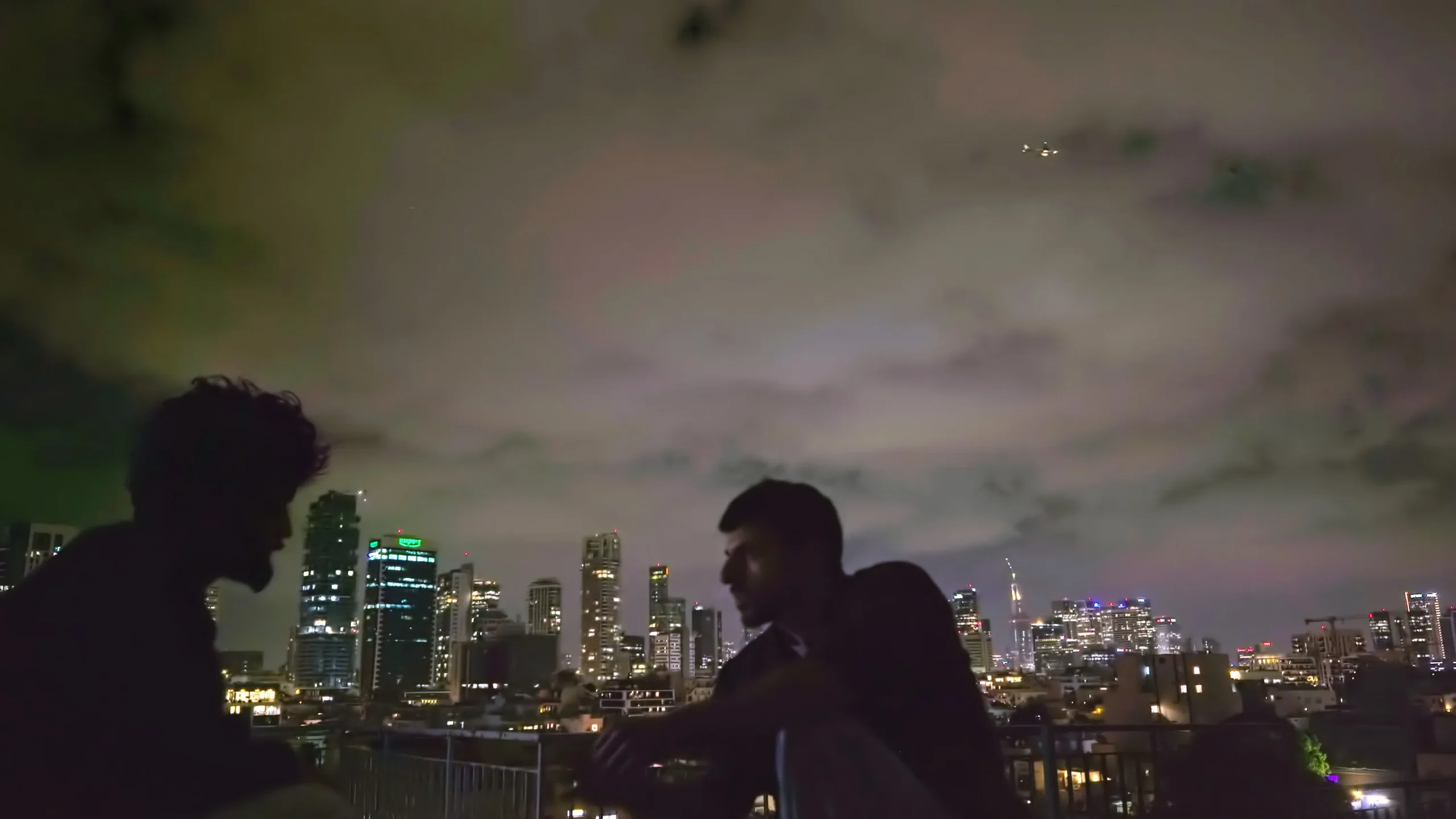
“NAZA” finds its voice not through narration but through the language of film. Interleaved with chilling testimonies of what often amounts to war crimes, sometimes relayed with contrition and sometimes with pride, we hear the quiet, eerie drumming of Tel Aviv at night, with voyeuristic shots into people’s modern high-rise apartments, as they lounge, make dinner and watch TV (often with Israel’s prime minister, Benjamin Netanyahu, on the screen).
On a deeper level, the film asks how individual people can and do make sense of their participation in horrendous acts, and how a society can remain complacent about such acts. Though the film can be read as an indictment of the Israeli state, and even to a certain extent large swathes of civil society, these are questions for all of us to grapple with, especially in the United States.
Source link