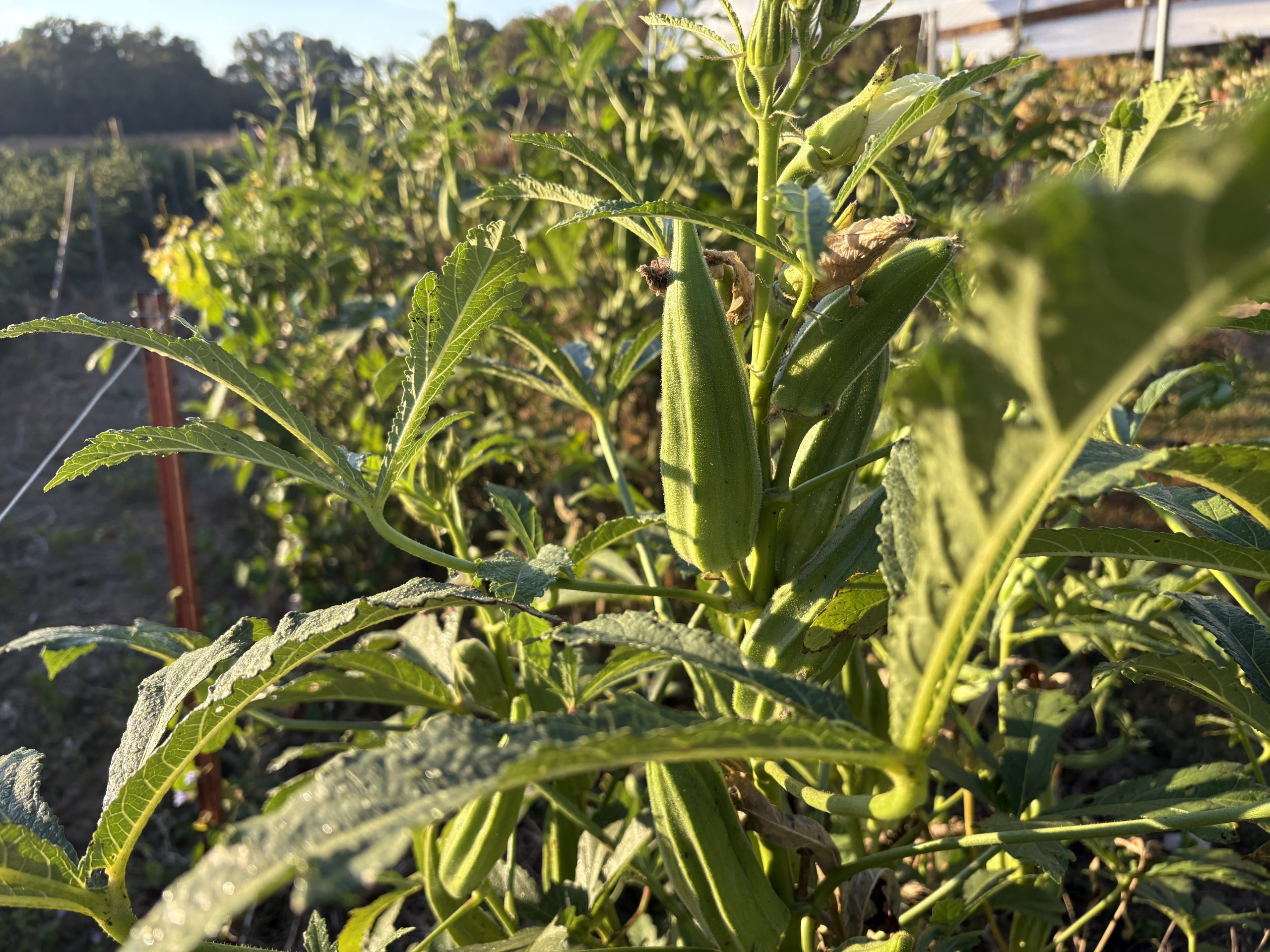
Dreaded okra crop brings visions of the afterlife
When I die, this is how I will know I’ve gone to hell.
It will be August in hell. So hot. I will awake in the middle of 10 acres of okra, naked as a jaybird. Every movement embeds thousands of tiny, microscopic needles from the pods and leaves into my skin. That is when I understand my punishment. I am going to itch for all eternity. Off in the distance I can hear old Satan laughing on his tractor, tilling up a new okra field to greet the damned.
Such was my state of mind picking okra in the goddamned heat this summer. I was smart enough to wear surgical gloves, but so stupid as to wear a T-shirt. Halfway down the first row I could no longer hold my picking box. The itching was so bad I couldn’t finish.
I truly hate okra and I blame my mother. An otherwise fine human being, she insisted on making her children eat boiled okra which was akin to sucking on a dog’s tongue.
She wasn’t one of these mothers who says, “Eat everything on your plate and you can go out and play.” No, she would say, “Eat everything on your plate and then you can do your homework.” Okra night was lose and lose.
As an adult, she would beseech me every summer to plant her a stand of okra. I seldom got around to it, and on the rare season I did, I seldom got around to picking it. She is gone now and I really feel guilty about that. I believe all those years of boiled okra had something to do with my misbehavior.
I think picking okra was the highpoint of my farm season this year. It’s been pretty awful.
The season started in late January with an ice storm and temperatures in the teens and low 20s for a week. The ice crushed a $12,000 hoop house and five of my doe rabbits gave birth that first night, with all 36 newborns frozen by morning.
If I am known for anything in the small-time farming world, it is for my heirloom tomatoes. I can’t keep them. If I could grow them year-round, I’d be hanging with bankers and bond daddies. So out of misplaced ambition I spent an obscene amount of money this season converting two of my unheated hydroponic hoop houses into heated and cooled greenhouses with a goal of year-round production.
I was forced to convert to hydroponic production several years ago when a disease called bacterial wilt infected my otherwise beautiful soil. That was thanks to my lack of crop rotation.
I sent dead tomato plants to the University of Arkansas Extension Service and pretty much received a death sentence. It would be a decade before I could plant tomatoes in that soil again. Out of desperation, I switched to hydroponic, which I have come to love. There is virtually no disease because the plants are in sterile perlite, a lightweight volcanic material, and nutrition is measured and exact.
It was this last February when I put in a 500-gallon propane tank and hung two, 250,000-BTU propane heaters in each house. Within a couple of weeks I had 440, 2-foot-tall heirloom tomato plants tucked into their perlite buckets. Inside the newly converted hoop houses, it felt like south Florida. I was on my way to year-round heirloom tomato production. Then three weeks later, on a 21-degree night, I ran out of propane and everything froze to death. A guy who thinks he knows about propane had told me the tank would last for three months. I was devastated.
I spent the next week pulling dead tomato plants from the buckets, but then I began to notice volunteer tomato plants coming up around the buckets. Seeds from last year’s crop were germinating in the soil. It felt like a miracle. I dug up 440 of them, planted them in the buckets, and I was back in business.
In theory a tomato can live for two or three years, particularly in a sterile growing medium. Just keep the nutrition coming and the heat steady. In the past I have had 9-foot-tall tomato plants putting on tomatoes in November only to freeze when winter set in. This season I harvested beautiful tomatoes from my volunteers through mid-July, but then I began to notice the plants starting to die late in the month, and by August all of them were dead.
Once again I packed up the corpses and sent them to the extension service in Fayetteville for autopsy. I was shocked to learn bacterial wilt had completely infected my hydroponic system. The volunteers I had transplanted from the soil to the buckets were full of bacterial wilt spores. The wilt loves water so when my pumps would kick in every afternoon, the water spread the disease everywhere. Plants, pumps, waterlines, buckets … everything was infected.
My helper and I have spent the last month pulling dead plants, emptying the perlite, scrubbing the buckets, disinfecting them in bleach and finally rinsing away the bleach. Tedious and expensive. Next we will disinfect the 25-gallon totes inside the green houses as well as the water lines. Then everything has to be reassembled. My neighbor has germinated 440 heirloom tomato seedlings for me that will be ready in just a few weeks. I have to be ready as well.
It has been a year. But there have been successes. The University of Arkansas Ouachita and Sweet-Ark Immaculate blackberry bushes I planted this spring are lush, dark green and full of life. I have about 300 bushes, and I have until June to figure out where to sell all the surplus. I can’t say enough about the University of Arkansas small fruit breeding program at Clarksville.
I also planted 10 Black Loomis muscadine vines this spring and they are beautiful – except the nursery down in Georgia didn’t tell me they are all female and need another variety to pollinate them. I am hoping to find a supply of the new UA Mighty Fine variety to plant next to my Loomis row next spring and hopefully I’ll have fruit in two years. The table grapes are healthy, the purple Irish potatoes were plentiful and the purple hull peas were amazing and prolific. They sell almost as well as heirloom tomatoes.
And yes, there is the damn okra. I brought okra to the farmers market for several weeks and sales were so-so. I learned that no one boils okra anymore, they just fry it. But the plants are six feet tall in late October, their lovely yellow flowers are abundant as are their pods. They are simply beautiful. I don’t pick them anymore, but I think of my mother every time I pass.
Source link