Pink Film Veteran Zeze Takahisa Champions Original Stories
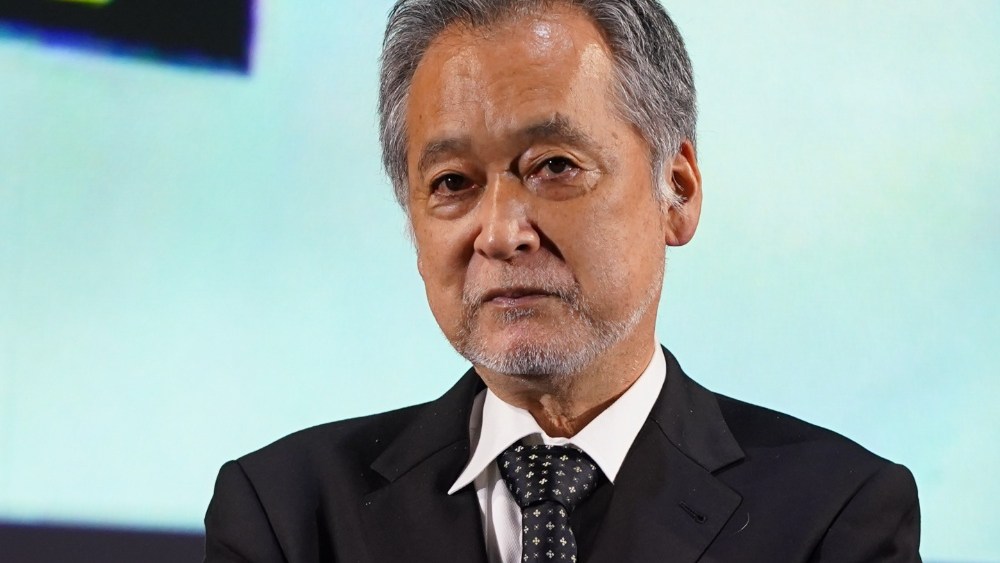
The Tokyo International Film Festival’s Tokyo Talk program presented a masterclass with Zeze Takahisa, director of the festival’s opening film, “Sukiyaki.”
Held before a full-house crowd at Tokyo Midtown Hibiya, the talk focused on Zeze’s early “pink” (softcore porn) and indie films, followed by questions about his more recent work.
Born in 1960 in Oita Prefecture, Zeze joined a pink film production company in 1986 and worked as an assistant director. He made his directorial debut in 1989 with “Extracurricular Activity: Rape,” for which he won the Pink Grand Prix Award for Best New Director. Together with Sano Kazuhiro, Sato Toshiki and Sato Hisayasu, Zeze was hailed as one of the “Four Heavenly Kings of Pink.”
Pink films screened in specialized theaters for an exclusively male audience, and directors had to insert a bed scene every 10 minutes or so. “I’ve always been pretty firm in my convictions,” said Zeze. “Starting from the early 1990s the culture shifted and I had more freedom to say what I wanted. That kind of thing was important to me.”
At the time, Zeze was interested in stories about female criminals. “It’s just different from the male perspective,” he said. “The motives behind the crimes and so on. I found it fascinating.”
Scripted by Zeze, “Extracurricular Activity: Rape” was about delinquent high school girls who hang out at Tokyo’s Haneda Airport and battle the yakuza. Zeze gave it the “private” title “Go to Haneda and You Will See Kids Dressed Like Pirates Ready to Attack.”
Asked about a 1994 pink, “Genuine Lesbians: Embarrassing Positions” (Zeze’s own title: “Fallen Angels in September”), Zeze said the film, which was about female soulmates, reflected the interest he described as “this whole mysticism thing” shared by many young people then. “Searching for past lives became a sort of trend, and people started seeking connections to this different world,” he added. “I thought that maybe I could make a movie centered around something like that.”
Zeze said the “Four Heavenly Kings” moniker came from a pink theater “in Toyama – or maybe Ishikawa – I can’t remember.” It reminded Zeze and the other “kings” of “Nouvelle Vague” – a tag that gave critical and commercial cachet to its members. “So we figured that, rather than work as individuals, we should debut under a group name,” he said. “We decided to use the ‘Four Heavenly Kings’ label to our advantage.”
The “kings” films were also shown in retrospectives at the Rotterdam festival and elsewhere abroad. “Actually, the overseas reception came first, and then it was sort of re-imported” back to Japan, Zeze said.
Meanwhile, in Japan, the “kings” and other pink film directors still had to incorporate a certain amount of eros. “No one was telling us to stop doing these politically sensitive things,” said Zeze. “It was just wonderful… there really was a lot of freedom back then.”
Also, pink film directors were not confined to a porn ghetto. “Things weren’t standardized back then,” Zeze said. “I worked with directors from my generation who had diverse backgrounds, like Aoyama Shinji and Suzuki Takuji. We’d get together either because we’d met by chance or because we wanted to create something interesting.”
In 1997 Zeze made his mainstream debut with the teen horror “Kokkuri-san” but continued to alternate between pink and mainstream films for the next decade.
In 2010 he released his most ambitious film to date, “Heaven’s Story,” a 278-minute revenge drama that screened in the Forum section of the Berlin Film Festival, where it won the FIPRESCI Prize.
“It was different from a so-called ‘ordinary movie,’” Zeze said. “I’d been working on commercial films until then, but I realized I had to do something else. Personally, I felt a sense of urgency – or maybe a sense of crisis – that things weren’t going well, and that’s what pushed me to take on this challenge.”
There’s a lot of talk, Zeze said, about how difficult it is to make a film unless it’s adapted from source material. “But the movies we actually found interesting or the ones I personally found entertaining were all originals.”
Zeze himself has made commercial films with stories sourced from existing IP, such as the hit 2016 two-part mystery/suspense “64,” which was based on a bestselling novel, but said, “The industry is too focused on the ‘source material market.’ They think that if the source material is selling well, they should adapt it.”
“So I feel that pursuing original concepts and making original films is incredibly important right now,” he added. “They have a unique, compelling strength.”