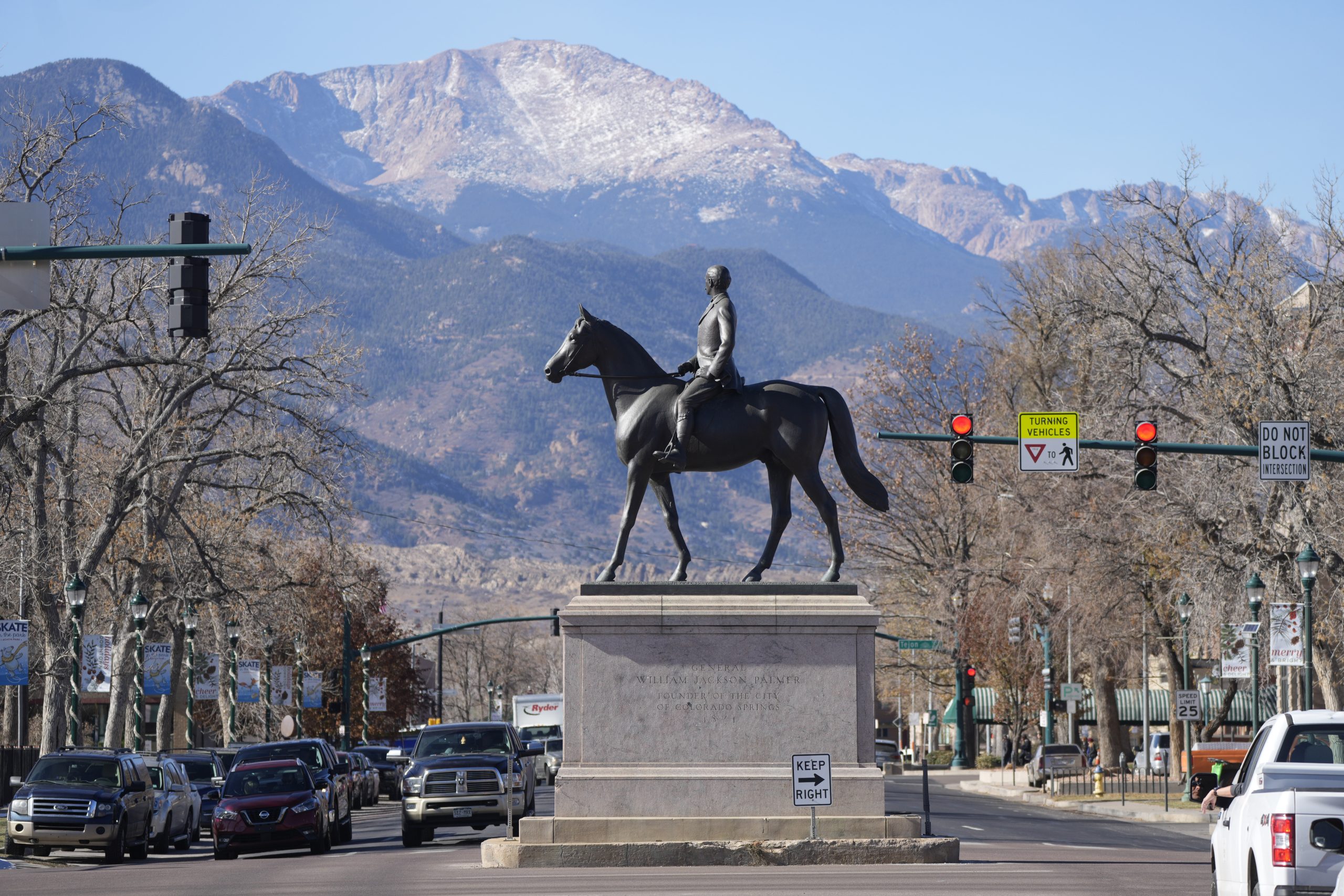
Pikes Peak economy heads up after some challenging years
Quick links: Pikes Peak economic stats | Gas prices and inflation | Inflation poll results | Amazon’s needs 6,500 seasonal workers in Colorado | State recovers $15.8M from insurers | Big Pikes Peak job fair
The way Mayor Yemi Mobolade made it sound, Colorado Springs’ economy is booming — or at least it’s doing better than the rest of the state.
“People are choosing Colorado Springs. While several major Colorado cities lost population, Colorado Springs continues to attract new residents,” said Mobolade, kicking off the 30th annual UCCS Economic Forum on Thursday. “About six new residents a day.”
He ticked off a number of recent economic coups, including Swire Coca-Cola investing $475 million to build a plant south of the airport and Weidner Apartment Homes investing millions to develop 1,200 new apartment units downtown. The city was recently named the best city in the U.S. for small businesses by the online business bank Bluevine (Denver was second). And last year, visitors to the Pikes Peak region spent a record $3.1 billion.
But Mobolade, who operated a small business in town before becoming mayor in 2023, clarified one thing: This isn’t a victory lap. “These are evidence that we are moving in the right direction,” he said, “and a reminder of what’s possible when a community takes responsibility for its future.”
The annual event this week seemed to be playing defense, after a few post-pandemic years of seeing a decline in residential building permits, fewer home sales and slowing workforce growth. It’s like there was something larger blocking its path as a panel of area economic-development officials discussed some wins and challenges.
“We’re the sixth most regulated state in the country,” Johnna Reeder Kleymeyer, president and CEO of the Colorado Springs Chamber & EDC, citing a statistic from the Colorado Chamber of Commerce’s regulatory report.
Reeder Kleymeyer served on Gov. Jared Polis’ Competitiveness Council, which wrapped up a report this month about how Colorado has lost its competitive edge. Overlapping state, federal and local regulations are confusing and discouraging prospective companies.
The rules are “all well intentioned I’m sure. But if a business has choices,” she said, “they don’t have to be here.”
Crystal LaTier, executive director of Economic and Workforce Development for El Paso County, said regulations also impact small businesses more than larger ones.
“We want to ensure that our small businesses are also thriving,” LaTier said. “With these compliance responsibilities, that often falls to each owner or a small team doing a lot of work related to operations. Keeping small business operations in mind as we look at regulations, I think is crucially important as well.”
The perception that something isn’t working and there are risks and barriers, however, needs to be addressed, said Shawna Lippert, economic development manager for the city of Colorado Springs.
“What is our reputation in the community? What is our reputation of what kinds of things go out in the media? And what’s the risk if we don’t tackle some of these challenges,” she said. The answer, she said, is that the region will lose talent because, “talent can live anywhere.”
The city has an employee dedicated to helping small businesses demystify the processes. City officials also set up a Rapid Response program for key employers and developers. It’s like a concierge who helps “expedite and prioritize certain projects. Not that we’re cutting any steps, but people can move to the top of the queue,” Lippert said.
Pikes Peak economy
The Pikes Peak region’s $55.1 billion economy is larger than that of two states, Vermont and Wyoming, said economist Bill Craighead, UCCS Economic Forum’s program director. The region, which includes El Paso and Teller counties, has a ways to go to catch up to Alaska.
“But I bet we can do it,” Craighead said, during his economic update where he presented the 2026 economic report. “Our median household income is more than 10% higher than the national median and that is tied to a high level of (government) agencies in our population and veterans.”
Craighead said he saw a lot of data pointing to a reversal of post-pandemic trends showing economic decline.
Federal civilian employment in the Pikes Peak region is down by 1,400 jobs since January 2025, according to the UCCS report. But while job growth has slowed, much like the rest of the state, the state added 367 workers a month in the first half of the year, compared with a loss of 308 a month last year.
Population growth has also slowed, but the region is projected to add 76,000 people in the next decade, according to data from the State Demography Office.
After a few down years following the pandemic, residential building permits were up in the region last year, though Craighead attributed it to an end-of-the-year surge in a large number of apartment permits that probably won’t happen this year. City sales and use tax collections are up 6.4% year to date from a year ago, when inflation flattened out gains from the pandemic shopping boom.
“Most of the activity measures that I track have been looking better,” Craighead said.
Pikes Peak benefits from being part of the larger state economy. Colorado had the 17th-largest GDP or $574.9 billion last year. On a per capita basis, the state ranked 11th.
“We are productive,” Craighead said. “As of 2024, we have the eighth-highest median household income. We are the highest for a state that doesn’t touch an ocean.”
Up and down the Front Range, the median income in every metro community is above the national average, except for Pueblo.
“We are much better off by being part of this $500 billion Front Range economy than as a midsized city on our own, and there’s already a considerable extent of economic integration along the Front Range,” Craighead said. “There are more than 60,000 people living here and working in metro Denver. And more than 37,000 people live in metro Denver with job locations here in the Pikes Peak region.”
Colorado gas prices average $4.40 a gallon. Then there’s diesel.
While most consumers with gas-guzzling vehicles have seen regular unleaded gas shoot up nearly 50% from a year ago, truck drivers and others who fuel up on diesel in Colorado are paying much more, with average diesel prices at $6.48 a gallon on Friday, up $2.87 or 80% from a year ago, according to AAA gas data.
That’s much higher than the local inflation rate of 29% for gas, according to the latest consumer price index for the Denver area. CPI is a good gauge but it leaves out diesel, said Skyler McKinley, AAA’s regional spokesperson.
“Across Colorado, AAA’s data shows regular (gas) up 35% from last September and diesel up 66%. Overall prices in the Denver area rose 4% over that stretch, so we’re paying far more for fuel than just about anything else. Diesel’s still climbing. Last week it was 93% higher than the same week a year ago,” McKinley said in an email.
He added that electric vehicle drivers may not be noticing the increase since they don’t have to fuel up. But they should think about diesel’s cost to better understand their family budgets.
“Diesel moves freight and runs the equipment on farms and construction sites, so when it gets more expensive, nearly everything else costs more, too. Even if you never buy a gallon of fuel, you’re paying for diesel every time you check out at the grocery store,” he said. >> See AAA gas prices
Poll results: Lots of EV drivers
While many of us are watching the fuel gauge closely these days, a surprising number of What’s Working readers who took last week’s poll don’t seem to be — 44% are electric vehicle drivers.
Still, more than a handful are still concerned about higher prices overall. “We had to replace a car and went with an EV due to high gas prices,” one person said.
Wheat Ridge resident Lee Recca, who drives less these days, shared that the cost of pet care and the vet for their cat has increased so much, “I am having to sacrifice some of my own needs in order to keep providing for my cat.”
Lots of folks have cut way back on red meat. And eating out. One self-described “unmarried tech worker” said they make a good income but decided to boycott restaurant-delivery apps in October because prices were getting so much higher. And instead of a monthly meetup with friends to try a new restaurant, “We all prepared meals at home and ate together at someone’s home.”
But likely, for most of us, we’re probably like Rick Ottman in Montrose, who said, “I’m retired and aware of increased food prices and the cost of gas. Not everyone can purchase an electric vehicle.”
Thank you, everyone who took the survey and shared a comment. If you missed the earlier story about inflation, here it is:
➔ Why Denver’s 4% inflation may feel much higher. The cost of a new or used car, gas, meat, vegetables and alcoholic beverages are counted in the inflation rate, whether you buy them or not. >> Read story
Sun economy stories you may have missed
➔ Pipeline to share water between Parker, Castle Rock and northeastern Colorado farms OK’d in water court. The $1.1 billion Platte Valley Water Partnership project calls for a new reservoir and a 125-mile pipeline to Douglas County cities from near Sterling >> Read story
➔ Arapahoe Basin snags first-to-open distinction, kicking off Colorado ski season. A friendly rivalry among Arapahoe Basin, Loveland and Keystone keeps skiers and snowboarders on their toes, waiting to hear that the first lifts in the state are spinning >> Read story
➔ Judge rules Ridgway hotel can’t house workers building Telluride’s Four Seasons resort. The developer of the $1 billion Four Seasons project in Mountain Village has acquired and leased area hotels far from the resort. Local groups are pushing back. >> Read story
➔ Answers to your questions about Amendment 87, Colorado’s graduated income tax ballot measure. We answered readers’ top questions >> Read story
➔ Denver Water wants to hire lawn patrol staff to enforce restrictions next summer. Colorado’s largest water utility will vote today on a dedicated drought patrol staff, expecting watering limits for much of 2027 >> Read story
➔ Last-minute Election 2026 coverage right HERE
Other working bits
➔ Amazon has 1,640 seasonal job openings in Colorado Springs. For the entire state, the company’s trying to fill 6,500 positions that include full-time, part-time and seasonal gigs. That’s just 2% of 300,000 openings nationwide. Seasonal workers who stay on in the new year will be eligible for healthcare coverage even if the new employee is a seasonal hire (full-time hires can opt for coverage on day one). Minimum pay starts at $20 an hour.
Colorado Springs dominates hiring this season, with 1,640 openings, according to an Amazon spokesperson. The company has opened a number of new warehouses and sorting centers around the state, from Grand Junction and Montrose to at least two in Colorado Springs in the last three years. Jobs are also being added through November.
Statewide, Amazon employs about 20,000 people and has 11 fulfillment and sortation centers, one pharmacy, 13 delivery stations and 23 Whole Foods Market locations. >> Check out the openings at amazon.com/localjobs
➔ Colorado recovers $15.8 million from insurers’ mistakes and wrongly denied claims. In a new report from the state’s Division of Insurance, the agency said it recovered $15,803,329 from insurance companies after following through on customer complaints. About $9.9 million were from complaints about homeowners or auto insurance, while $5.5 million dealt with health or life insurance.
In a news release, Colorado Insurance Commissioner Michael Conway said issues involved communication errors, missed insurer payments and wrongly denied claims. The division’s consumer service team fielded 17,283 calls from consumers last year and helped many people submit formal complaints.
Have an insurance question or complaint? Call 303-894-7490, email DORA_Insurance@state.co.us or visit doi.colorado.gov and click on “File a Complaint.” >> View report
➔ Pikes Peak’s largest job fair of the year is Nov. 10. The Community & Veterans Job Fair is aimed at those transitioning out of military service but it’s open to anyone looking for a new career opportunity.
“We have job fairs every month but this one is pretty important and special for us (and) will be our largest job fair of the year,” said Crystal LaTier, executive director of Economic & Workforce Development for El Paso County, during Thursday’s UCCS Economic Forum. “We’re expecting 150 employers.”
Hosted by the local Workforce Center, the event runs from 10 a.m. to 2 p.m. on Nov. 10 at the Colorado Springs Event Center (3960 Palmer Park Blvd.). >> Register
Got some economic news or business bits Coloradans should know? Tell us: cosun.co/heyww
Thanks for sticking with me for this week’s report. Don’t get too spooked this weekend! ~ tamara
Miss a column? Catch up:
What’s Working is a Colorado Sun column about surviving in today’s economy. Email tamara@coloradosun.com with stories, tips or questions. Read the archive, ask a question at cosun.co/heyww and don’t miss the next one by signing up at coloradosun.com/getww.
Support this free newsletter and become a Colorado Sun member: coloradosun.com/join
Corrections & Clarifications
Notice something wrong? The Colorado Sun has an ethical responsibility to fix all factual errors. Request a correction by emailing corrections@coloradosun.com.