On a tour in Denver, ethical questions arise from the dead
The 50 or so cyclists hovering around the Cheesman Park Memorial Pavilion on Tuesday shivered with excited energy.
Among them were a skeleton, an alligator and a dead World War I pilot. Someone in charge — pink vest, fluorescent accents — handed out glowsticks. The rowdies were ready for their two-wheel tour through Denver.
The group organizer appeared to be Bike + Brew Denver, a social club that advertised a “bikes and boos” Halloween ride through two cemeteries on Instagram. From Cheesman, the pedalers would roll past purportedly haunted houses on the historic East 7th Avenue Parkway, through the Fairmount Cemetery on Quebec Street and along the Highline Canal and Cherry Creek trails, according to their itinerary. Then they’d grab a drink at the horror- and punk-themed Crypt Bar in Uptown, hit the saddle and make the late-night ride home.
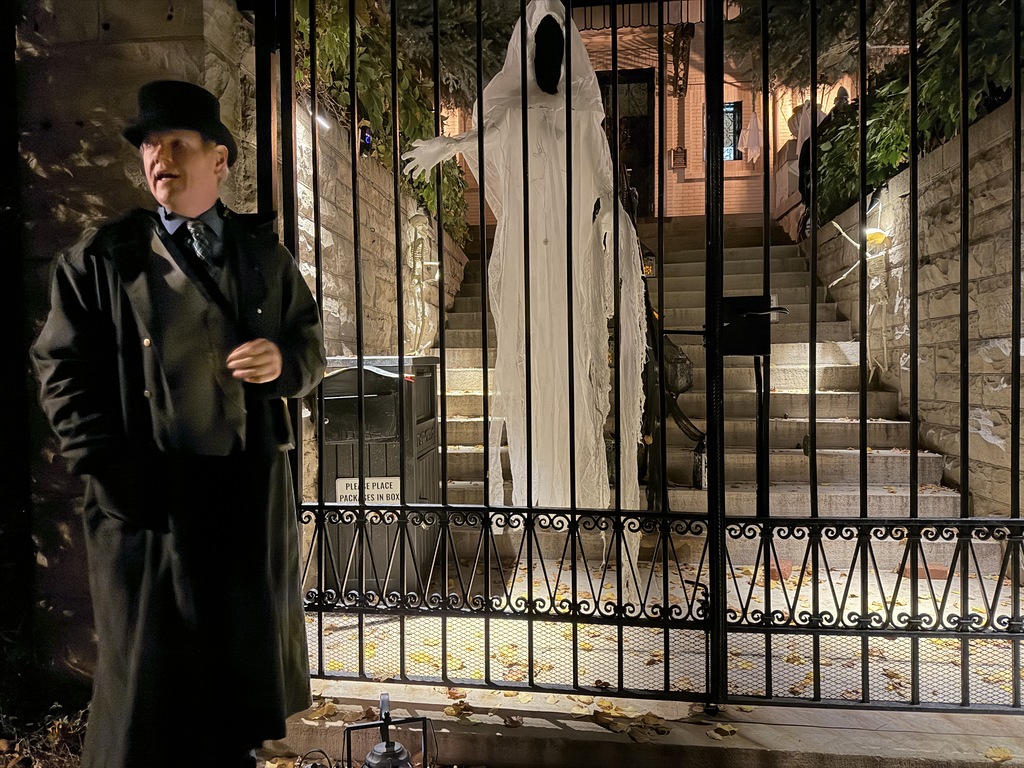
Another group, wee in comparison, stood in the shadows. These were walkers. No costumes. But they were also excited. They were staying put, because Cheesman Park is known as one of the most haunted places in Denver. And their tour guide, Will Olson, was going to take them into spots where the air turns cold with “no explanation,” where they could see sunken rectangles in the grass the shape of coffins and where the smell of roses wafted through the air even though roses stopped blooming weeks earlier — he swore it!
Colorado is full of places to visit the dead, and Americans’ interest in the paranormal is never higher than during Halloween. A 1.5-hour tour with Olson ran $28 and the cyclists on the Bike + Brew tour could quench their thirst at Crypt.
But some archivists and even graveyard tour proprietors pause when they consider a question. Interred beneath dirt, the dead are powerless. So is it OK for cemetery tour operators and associated businesses to profit off them, or is something wrong with the commodification of the dearly departed?
A stroll in the park, atop corpses
Ask Olson what he thinks of profiting off the dead and he’ll waffle a bit because he makes part of his living from “graveyard” tours in Cheesman.
Olson is the founder of Denver Local Tours, not to be confused with Denver Walking Tours or the Dark Side of Denver Ghost Tours, all of which offer walks focused on the paranormal and history. Olson said he has “walked through Cheesman like 10,000 times,” experiencing unexplainable things like seeing his breath when it’s 70 degrees outside. He started his haunted tour business in 2020.
You might be scratching your head if you’ve been to Cheesman, because there isn’t a single headstone in the 80-acre green space, nor a marker denoting the macabre mayhem that existed here in the 1800s.
Olson, dressed in a Victorian waistcoat and lighting the way with an LED-powered old-timey lantern, serves as a gatekeeper to the park’s dark history.
The area that’s now Cheesman was once an Arapaho burial ground, but in 1858, Denver’s founder, Gen. William Larimer Jr., claimed a 160-acre chunk as a cemetery for a population bursting at the seams as tens of thousands of people moved in during the Gold Rush.
Mount Prospect Cemetery, later to become Denver City Cemetery, opened in 1858, and people started burying their loved ones. But Larimer soon discovered “this was not the beautiful park-like cemetery (he’d) once envisioned,” Olson said. “There’s no access to running water.” The few trees there were dead or dying. “Prairie dogs, tumbleweeds, cows grazing amongst the broken headstones,” Olson continued. “No one wants to bury their loved ones in the Denver City Cemetery anymore.”
Within a decade the city of Denver was pleading with Congress to change the status of the land from cemetery to park, which it did in 1890. But what to do with all of those bodies?
Estimates vary for the number already buried. Some say 11,000 or 12,000. The city hired an undertaker named E.P. McGovern in 1893 to move the caskets and bodies from the Denver City Cemetery to Riverside Cemetery, 6 miles away. But McGovern was fired when the city discovered he was defrauding it by breaking bodies apart and putting pieces into multiple caskets to collect more money per coffin.
Outrage erupted over the desecration of the graves after The Denver Republican published an exposé (which the Rocky Mountain News refuted, according to Rocky Mountain PBS). The city immediately canceled McGovern’s contract and stopped the exhumations, leaving 1,500 to 3,000 bodies underground before bulldozing and leveling the rest of the site into what would become Cheesman Park.
And the ghastly story of Denver’s first cemetery is benefitting Olson, who urged the group on with promises of “tales of eternal residents still buried beneath your feet, and the paranormal that has been reported for over 160 years.”
Ghost tours as “economic activation”
For decades, ghost tour operators have been blending their stories of history and the paranormal across the country.
American Ghost Walks, which organizes haunted tours in cities across the U.S. and in the Caribbean, not including Denver, in a 2025 article cited research estimating that the niche sector including haunted hotels and ghost-themed pub crawls is now part of the broader dark tourism market worldwide was valued at $31.89 billion in 2023, projected to reach $40.82 billion by 2034.
The same industry extends beyond Halloween with “eager capitalists literally ‘scaring up’ profits globally and year-round by feeding the public’s enduring infatuation with the supernatural,” says a Cornell University study that also estimated the value of the U.S. dark tourism market at about $100 million in 2020.
Colorado’s dark tourism industry is a healthy market of its own, with attractions like the Halloween tour of the truly creepy Stanley Hotel in Estes Park regularly selling out, cemetery tours strongly attended everywhere from Boulder to Black Hawk to Aspen to Cripple Creek and newer events like the bikes and boos ride popping up around Denver.
Bikes and boos appears to be free, but the Crypt Bar and other nearby establishments benefit from the Halloween riders guzzling their spirits. Brook Lee, who owns Dark Side of Denver Ghost Tours, said they just had their biggest Halloween season in their 10-year history. And Phil Goodstein, a haunted-walking-tour guide since 1986 and author of several books including “The Ghosts of Denver: Capitol Hill,” said national operators of ghost tour companies began coming into the Denver at the end of COVID, snatching up business in the competitive market from local operators like him.
“For the most part, they end up hiring desperate people that want to pretend they are tour guides, and most of the guides are miserably paid, receiving maybe $20 for conducting a tour, hoping that they can generate some tips at the end to make it work,” he said. “Meanwhile, a lot of the history on all of this stuff is extremely dubious, if not highly questionable or inaccurate.”
Which gets under the skin of Anna Lookabill, archivist for the Aspen Historical Society.
History vs. lore and why the distinction matters
Lookabill said the Aspen Historical Society holds summer cemetery tours, including a twilight tour in which characters tell researched stories in the first person. The event is often held around the full moon in late August or early September, she said, when conditions are warmer and sunnier than in October.
Key to those tours is the truth, Lookabill insisted.
“We’ll do a cemetery tour, but we’re going to give you the historical facts and information about different people,” she said. “Sure, people can speculate all they want, they can believe in ghosts, but we don’t specifically encourage those stories. In fact, there are stories about things that happen at the Hotel Jerome (in Aspen). I’m not going to say they haven’t seen them.”
But if they’re bunk, she’s more than happy to debunk them.
Goodstein said every so-called haunted place has the same vague stories barely rooted in history. There’s a famous one, based on supposed events, at the now-demolished Henry Treat Rogers Mansion on East 13th Avenue that inspired the 1980 classic horror flick, “The Changeling.”
Someone hears a bouncing ball but there’s no one bouncing it, Goodstein said. “But the theme is this bounce, bounce, bounce, bounce is haunting the place,” and that same bounce, bounce is in others around Colorado.
“Go up to Glenwood Springs. There’s ‘bouncing’ in the Hotel Colorado,” he added. “Or look at the severed heads (story) of the Espinosa brothers in the San Luis Valley — there’s a half-dozen versions of similar stories, including one of floating heads in the (former Colorado Gov.) James H. Peabody mansion consulting with the governor and the legislature.” (It has since been renovated into apartments. RIP, ghosts.)
But what makes his tours different, he says, is that he goes beyond vague ghost stories to connect stories of the supernatural at Cheesman to actual historical and political events.
“I can talk about the gay presence in Cheesman, the scandals surrounding the pavilion, the different social uses or the space where an inorganic stone body does not cast a shadow at high noon and how that reflects on the death penalty,” he said.
Olson, the tour guide, respects the area’s history, but he said he doesn’t mind profiting off the ghosts, even though they were once people.
“The dead are commodified anyway,” he said after his tour ended on Tuesday. “The city already commodified them. They turned the cemetery into a public park, and they build freeways over dead people all the time.”