Trump invokes 9/11 in urging Michigan voters to oppose El-Sayed
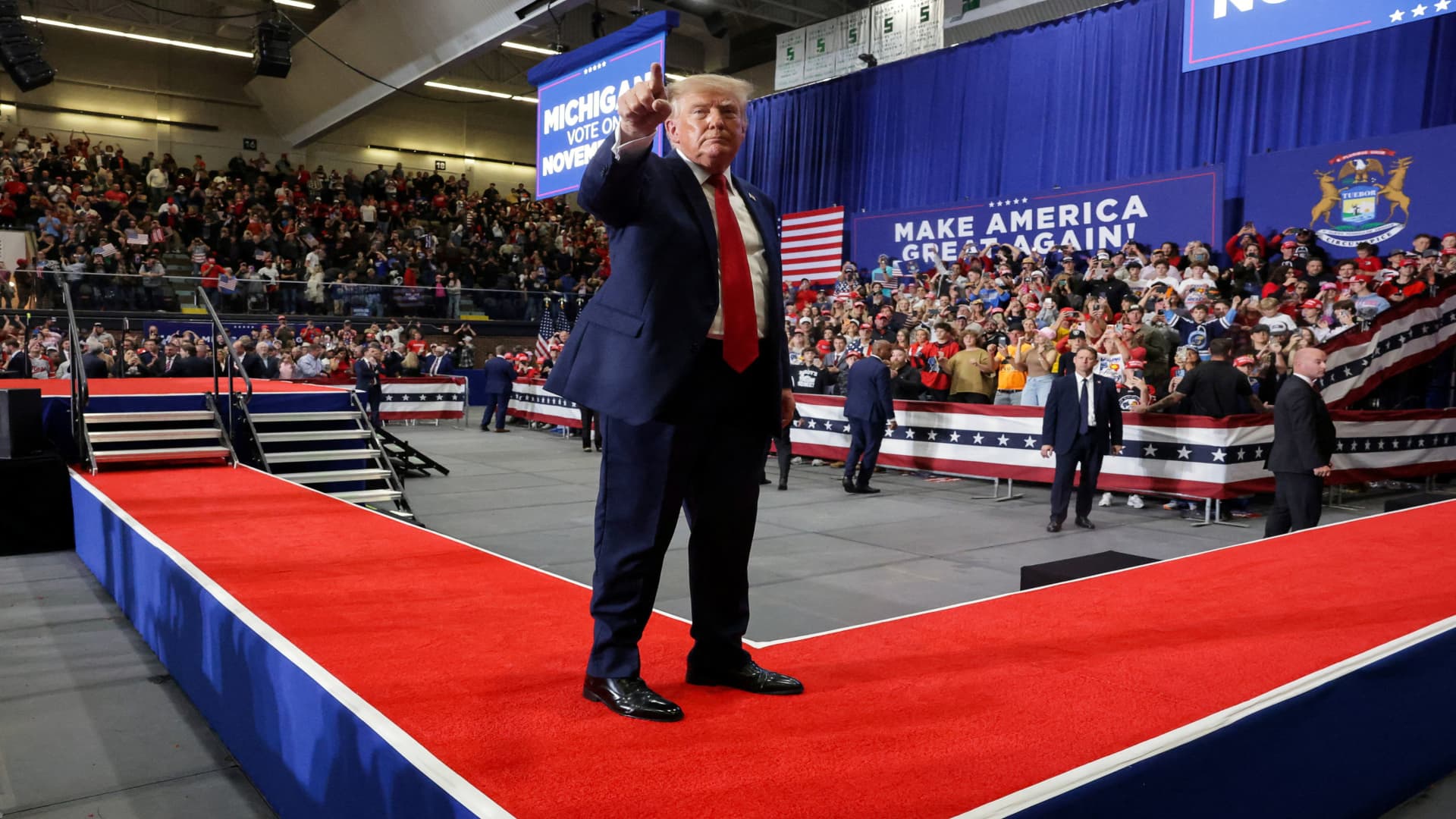
U.S. President Donald Trump attends a rally, in support of Republican Senate candidate, former U.S. Representative Mike Rogers, ahead of the midterm elections, at an entertainment complex in Port Huron, Michigan on Oct. 25, 2026.
Jonathan Ernst | Reuters
President Donald Trump at a Sunday campaign rally ratcheted up his push to link US Senate candidate Abdul El-Sayed to Muslim extremists, comparing him to the 9/11 attackers while saying Democrats would let violent anti-American terrorists into the United States.
“I’m here to keep a jihadist, Muslim Brotherhood member from becoming a United States senator,” Trump told a receptive audience in Port Huron, Michigan.
If he wins, El-Sayed would be the first Muslim elected to the US Senate. Trump has sought to paint him as an anti-American Muslim radical, and on Sunday he took the rhetoric to a new level, likening El-Sayed to the attackers who took over United Flight 93 during the Sept. 11, 2001 attacks.
Michigan has one of the nation’s most competitive U.S. Senate races heading into the Nov. 3 midterm elections, with former U.S. Representative Mike Rogers, a Republican, and El-Sayed vying for an open seat that will help decide control of the chamber.
The president on Sunday compared voting against El-Sayed to the actions of Michigan native Todd Beamer and others who fought back against the Flight 93 hijackers.
“Twenty-five years later, Michigan needs to stand up and fight, just like Todd did, to stop a jihadist from walking into the Capitol,” Trump said.
If El-Sayed wins, “he would be the only senator that will have to go through a metal detector before he’s allowed to go in the Senate,” Trump said.
El-Sayed said questioning his loyalty is ‘shameful’
El-Sayed has dismissed the accusations against him and, in a recent advertisement, defended his religion, saying, “Faith is a thing there’s just too little of in Washington.”
Rogers has alleged without evidence that El-Sayed has ties to the Muslim Brotherhood, one of the Arab world’s oldest and most influential Islamist groups.
El-Sayed has denied affiliation with the group, calling it “shameful” that Rogers would question his allegiance to the United States.
Rogers said in an interview on NBC’s “Meet the Press” on Sunday, before the Port Huron rally, that El-Sayed had not responded sufficiently to questions about the allegations.
“He’s a Democrat Socialist of America-aligned candidate who has these pretty radical support groups that don’t like America,” he said.
Trump’s speech in eastern Michigan on Sunday came a day after former President Barack Obama campaigned for Democrats in the state, underscoring its importance in next week’s elections.
At Saturday’s rally in Detroit, Obama framed the attacks by El-Sayed’s opponents as an attempt to make him look “less patriotic and less American than they are.”
The former president compared them to his experience of being targeted by false claims that he was born in Kenya.
“We have seen this movie before,” Obama said. “I starred in it … This stuff didn’t work on me. Not in Michigan. It’s not going to work on Abdul.”
Manufacturing investments
Port Huron is part of an area of Michigan that Trump won in the 2024 presidential election with more than 66% of the vote.
One issue that dominated the state’s campaign was the U.S.-Canada tariff standoff, which has affected the Detroit-based U.S. auto industry and prompted Rogers to distance himself from the president’s policy.
Rogers on Sunday hailed Trump’s tariffs for securing manufacturing investments for Michigan by Chevrolet and Detroit Diesel, but said, “The automobile portion of these Canadian tariffs worries me a little bit.”
“There’s some good and there’s some things we have to work on,” he told “Meet the Press.”
In a Fox News interview ahead of Sunday’s rally, Trump praised Rogers as someone who shares Michigan voters’ beliefs.
“He’s going to be an amazing senator,” Trump told the “Sunday Briefing” program. “Solid as a rock. Apple pie.”
Democrats need just a handful of seats each in the US Senate and House of Representatives to overturn Republicans’ narrow 53-47 and 218-214 majorities.