Review: “Haas Brothers, Uncanny Valley” at the Blanton Museum of Art
I can’t say that I blame my generation for not collecting art. If you graduated around the time of Barack Obama’s recession it’s pretty hard to believe that the economy isn’t seconds away from collapse at any given time. You can talk about a “Great Wealth Transfer” but a recent report in Bloomberg found that this handover is also going to come with a lot of art, so much in fact that most of it is going to have to be sold. To whom remains an open question. One area where Millennials seem to be insatiable, however, is design—they did name a shade of pink after us—and the most successful artists have been the ones like KAWS, whose vinyl sculpture wouldn’t be out of place at a coffee shop upstate.
Nikolai and Simon Haas are twin brothers who walk a similar line between art and design, and are the subject of “Haas Brothers: Uncanny Valley,” the first mid-career survey of their work, which has just arrived in their native Austin. Organized by Cranbrook Art Museum and curated by Laura Mott, the show is now on view at the Blanton Museum of Art at the University of Texas at Austin and gathers more than 80 works from 15 years of a studio that started out fabricating props for Lady Gaga videos and furniture for Donatella Versace. The title, familiar to all millennial gamers, emerges from roboticist Masahiro Mori’s 1970 graph of our affection for humanoid machines, but might just as well describe their blending of art and design—though when it comes to making an entity that is equally strange or cute Simon Haas has stated his preferred solution is cuteness.
|
“Haas Brothers: Uncanny Valley“ |
In that regard King Dong (2016) seems an appropriate place to start. It is eight feet tall and 10 feet wide, draped in Icelandic sheepskin. Though hulking this beast is more friendly than scary, despite his fangs, which are cast in bronze like the, er, body part that represents “a self-critique by Niki of his own oversized ego,” according to the catalogue. It is soft on all the places that Louise Bourgeois is hard, a cuddle monster suited for an era where the nightmares mostly occur during the day.
Contrast this cast member with Bruce Willis Beyonclé (2016) which isn’t a signature creature but a five-and-a-half-inch-tall experiment that reminds me of the great Ron Nagle, although his stuff usually reminds me of mugs or dioramas. Bruce Willis still has plenty of genitalia to it, labia in this case, with accretions made by brushing porcelain slip onto a thrown form and letting it dry unevenly. After enough times the surface sprouts protrusions like fungus or petals, an organic process that reminds one of how caves are created. If not a creature it does have their usual vibe of organic and structured.
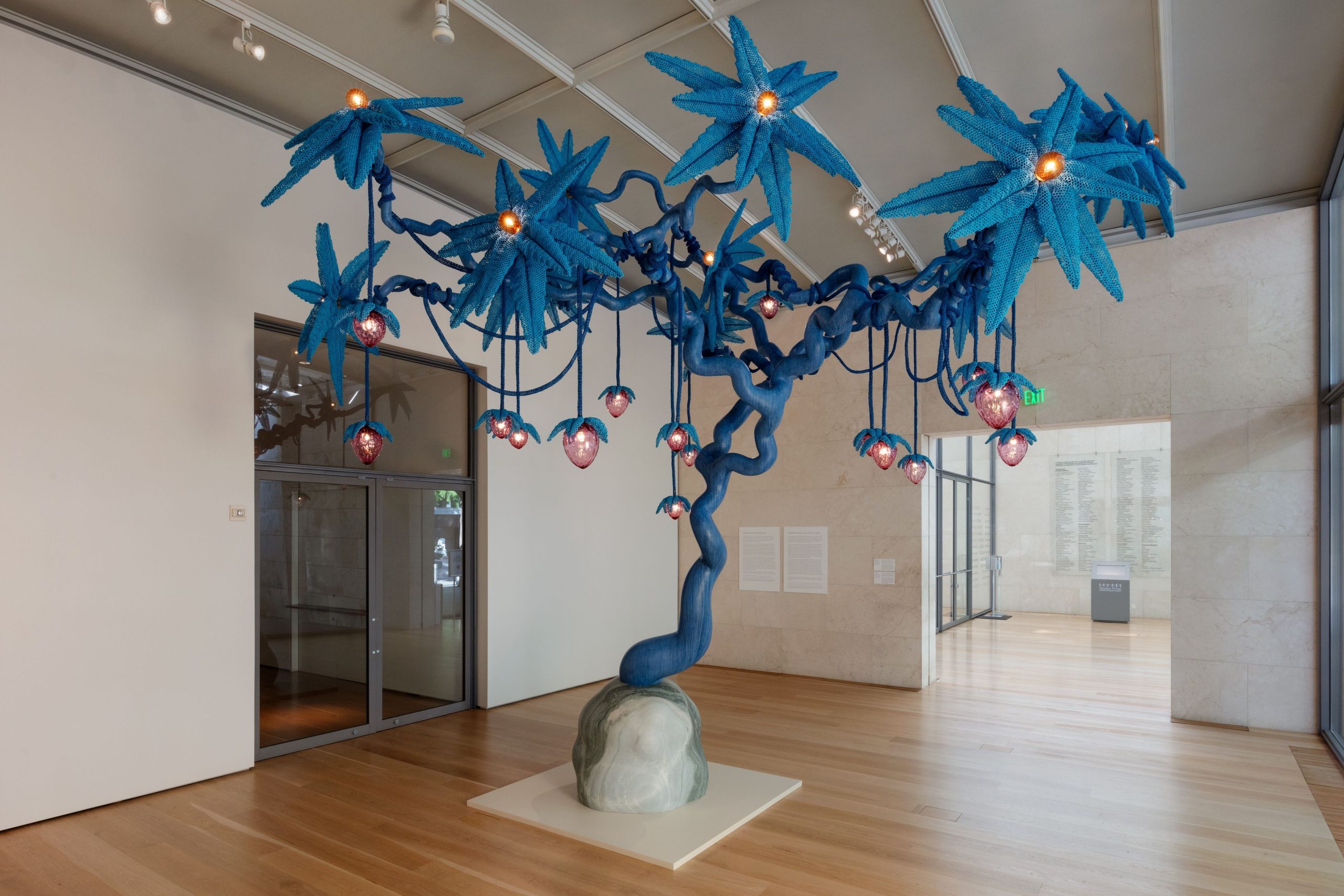
The Strawberry Tree (2024) is 15 feet tall and nearly 18 across, made for a show at the Nasher Sculpture Center. The trunk is bronze patinated a dusky blue, but what’s charming about it is what is not so apparent. The leaves and vines are glass beads strung in accordance with a 26-rule “alphabet” Simon spent five years devising after the brothers worked with the Monkeybiz collective of beaders in Cape Town. Apparently they create a Fibonacci sequence, but this is the kind of Easter egg that only a pair of twins could appreciate, a secret detail that emerges from the unexpected fusion of a single consciousness that pretends to have two individual parts.