Quicker cross-border cooperation needed to disrupt scams and crimes: S’pore, international police
SINGAPORE – The German authorities were monitoring a ransomware group in 2024 when they realised that the perpetrators were about to encrypt the systems of a company in Singapore.
Instead of relaying the information through official channels, which would have taken much longer, the officers sent a message on WhatsApp to their contacts in the Singapore Police Force.
Within 15 minutes of receiving the text, a group of Singaporean officers contacted the Bavarian officers to discuss the next step and then went to the company’s premises to disrupt the encryption and prevent damage to its servers.
Four Russian nationals were later arrested over their involvement in the incident. They were suspected of releasing a variant of ransomware to extort high-value payments from victims across Europe and other countries.
Twenty-seven servers linked to the criminal network were also taken down.
Countries including Singapore, Thailand and the UK took part in the investigation.
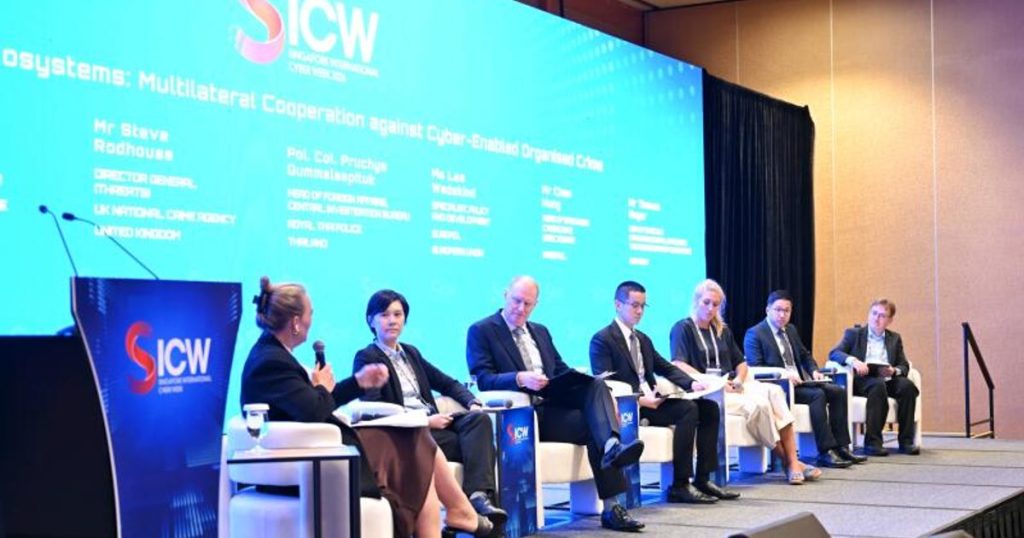
The incident underscored the importance of international cooperation in disrupting scam syndicates and tackling cross-border crime, which was the theme of an event on Oct 15 at Singapore International Cyber Week 2026.
“Information and intel sharing sounds highly sophisticated but in many instances, it’s very easy,” said Thomas Goger, deputy director of Germany’s Bavarian Central Office for the Prosecution of Cybercrime, during the session where he was a panellist.
He added that authorities should be willing to move more quickly.
The session also featured Manon Le Blanc, deputy head of the European External Action Service’s hybrid threats and cyber division; Chee Ching Yuin, assistant director from the investigations division at Singapore Police Force; Steve Rodhouse, director-general (threats) at the UK National Crime Agency; Pruchya Gummalaspituk, head of foreign affairs at the Central Investigation Bureau in the Royal Thai Police; Chan Hung, head of cybercrime operations at Interpol; and Lea Wedekind, a policy and development specialist at Europol.
Interpol, headquartered in France, helps police forces worldwide cooperate and fight crime. Europol, based in The Hague, supports EU law enforcement agencies in tackling serious crime, cybercrime and terrorism, but has no direct arrest powers.
An estimated US$442 billion (S$567 billion) has been lost to scams across 42 countries, according to Global Anti-Scam Alliance’s global scams’ report.
In Singapore, more than $4 billion has been lost to scams since 2019.
In the first six months of 2026, victims lost $410.6 million, down from $500.2 million during the same period in 2025. In total, $913.1 million were lost to scammers in 2025.
In their mid-year statistics on Aug 26, Singapore police said that in the first half of 2026, they disrupted over 47,000 scam-related mobile lines, 37,500 WhatsApp lines, 31,600 online monikers and 52,200 malicious websites.
Over 2,900 suspected money mules and scammers have been investigated, and at least 470 were charged in the first half of 2026.
On Oct 6, Senior Minister K. Shanmugam signalled that the Government will introduce tougher laws for young scam mules, saying it is “not the time to go soft”, following a High Court ruling that allowed appeals seeking rehabilitation for young offenders.
Shanmugam, who is also Coordinating Minister for National Security, argued that lenient sentences could embolden scam syndicates to recruit more youth to facilitate their crimes.
The police noted that elderly victims aged 65 and above had the highest average losses across all age groups. Most of them fell prey to government official impersonation and investment scams.
Singapore has taken efforts to tackle this specific problem.
On Sept 3, 2025, Goh Pei Ming, Senior Minister of State for Home Affairs, first announced that the police and tech company Meta would work together to tackle the scam scourge here.
Goh, who was speaking at the Global Anti-Scam Summit Asia 2025, said the police would be able to issue an order to Meta to implement measures to address scam advertisements, accounts, profiles and business pages impersonating key government office-holders on Facebook.
In the first half of 2026, Meta in collaboration with Singapore authorities took action against 113,000 scam-linked accounts and pages on Facebook and Instagram, 33,600 e-commerce fraud entities and 3.6 million shell pages before they could be deployed, it said in September.
Chee on Oct 15 reiterated the importance of cooperation between the Republic and other law enforcement agencies and industry partners.
She said: “The exchanging of information is very important. Each of us has got a small piece of the puzzle. (In Singapore), we amass all the reports and intelligence that we have, and we try to work with the industry partners and come up with solutions that can help Singaporeans. If we can, this can be scaled to other jurisdictions, and this would then be able to benefit everyone in terms of prevention.”