The Delhi of October 9 and 10
Manish Kumar, 22, had managed to evade that particular round of detentions. He too had taken a 15-hour train from Bihar to reach Delhi on the morning of the protest. “I told my family I’m going to Patna,” he said.
Asked whether anger over SIR irregularities had brought him all the way to the capital, Manish said no. It was no longer just about elections.
During the NEET protests, he had watched the revolution from home, through reels. “I could not believe they made him resign. So this time I came because it feels like people like me can finally ask for their rights,” he said.
Manish was also “tired of hearing the BJP talk only about Hindu-Muslim, about India-Pakistan issues.” “Is there nothing beyond religion in their governance?” he asked.
Because of the internet clampdown, he had not known the CJP leaders had been detained. He kept wondering where they were and why the protest hadn’t begun. “They’re not even letting us protest today. And chasing us like we’re dogs,” he said.
Harshit Chauhan, a 20-year-old student in Delhi, said he was a first-time voter who had found his name struck off the voter list because of “some confusion of address.”
“Aren’t governments supposed to want to add more people to the voter list? Here they’re just deleting,” said Harshit, who had also attended the NEET protests. He had arrived early at the protest area and managed to slip in, but had no internet to pay his cab driver. “He didn’t take money from me because he said I was fighting the good fight. But this time it’s looking difficult to even stand here.”
Down the street, 52-year-old Dhinasur had climbed onto a small ledge, taken out his steel tiffin box and laid out his home-made lunch. From this vantage point, he watched the cat-and-mouse chase between police and protesters.
Dhinasur lives in Delhi and works as a gardener, while his wife and three children are back in Uttar Pradesh. His two sons wrote the police exam twice. “Then the paper got leaked. They had worked so hard, and they have given up now,” he said, tears filling his eyes.
“Okay, I was born poor. But in this country, even if I work hard, even if I make sure my children study, even if they write exams, there seems to be no way out of this rotten life. Why?” he said.
Dhinasur had attended the anti-NEET protests as well. He escaped the lathi-charge but faced a lot of tear gas. The resignation of Dharmendra Pradhan sparked hope, so he came again.
For him too, the protest was less about the SIR than about the sheer frustration of being treated poorly by the system. “I’m angry about corruption, I’m angry about the paper leak, I’m just angry and sick of it,” he said.
Among the few who made it to central Delhi, anger at not being allowed to protest was louder than the demand for Gyanesh Kumar’s resignation.
A violent turn
By 1 pm, AISA had put out a call to change the protest site. “Dilli Haat becomes Jantar Mantar today,” Neha Bora, AISA president, announced on X.
Almost immediately, security personnel, the media, and a few protesters began making their way to the Safdarjung flyover. Bora, advocate Prashant Bhushan, and CPI(ML) Liberation general secretary Dipankar Bhattacharya, among others, made their way there too.
Neha became the only leader of the protest who managed to step onto the streets. A reflection of AISA’s history of protest, mobilisation, and grassroots movements was on clear display as they managed to evade preventive police detention.
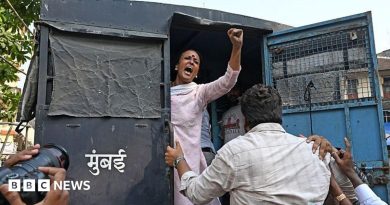
As soon as the group crossed the flyover, security forces chased down Neha and her comrades, and violently detained them.
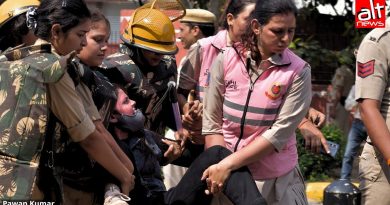
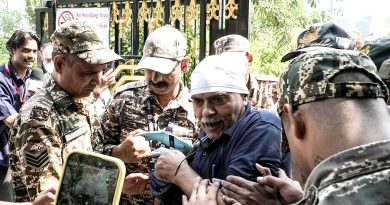
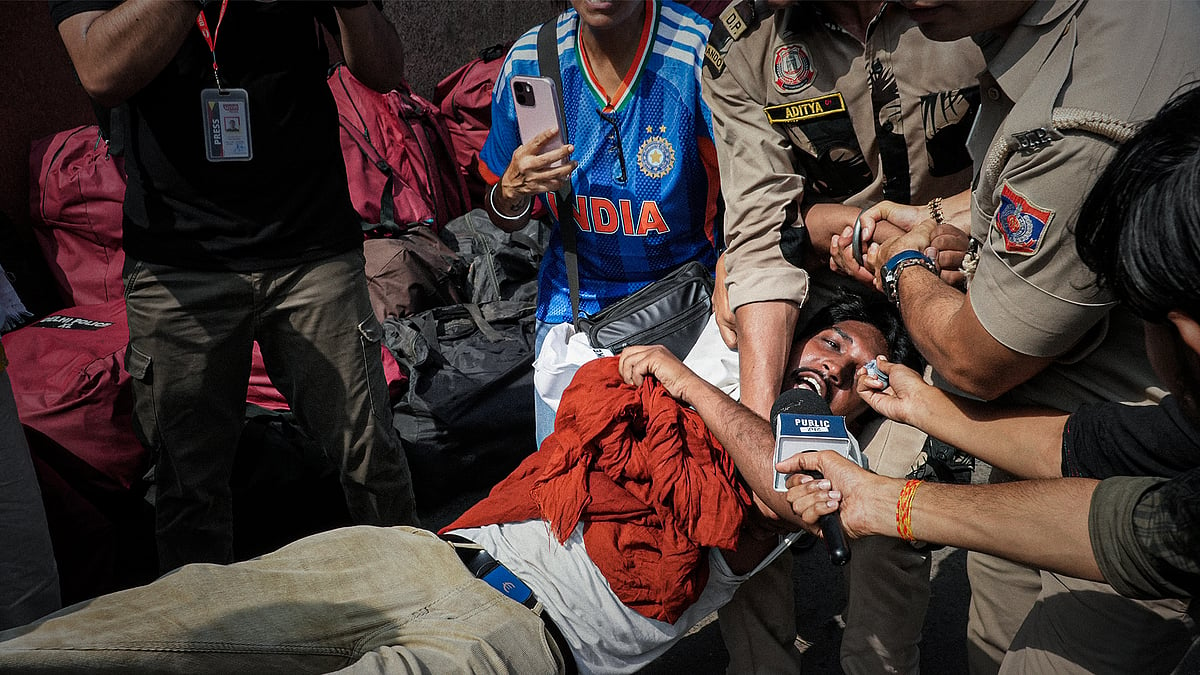
Protesters tried to stop the buses carrying detainees by sitting in front of them, shouting slogans, and clinging to the sides. The situation quickly descended into aggression as the police’s playbook on dispersing protesters was implemented on the streets. Protesters were dragged, beaten, and forcefully pushed into buses. Most officers were not wearing name tags. Male officers also pushed and dragged women protesters.
A woman in a blue salwar, working alongside the police without a uniform, dragged protesters onto the bus by their pants.
A 19-year-old SFI protester, sitting in front of a bus with her face covered, said she and her friends had come to the flyover after being prevented from protesting at Jantar Mantar. “But here, they’re thrashing people. They’re pinching and dragging us. There is absolutely no humanity in them,” she said.
One protester began bleeding heavily inside a bus, but police neither let him off nor gave him any medical aid.
Several reporters were shoved into buses despite showing their ID cards. Saurabh Sharma, a journalist with Reuters, held up his badge from inside a detention bus. “I showed them my press card, gave all my credentials, and they’re only hurling abuses at me,” he said.
Activist Yogendra Yadav and social scientist Jean Drèze were also detained.
Several lawyers were picked up as well. Supreme Court advocate Shadan Farasat was lifted off his feet, his shirt torn, and shoved into a bus.
Another advocate, Trishnesh, argued with the police, but in vain. “The police should know him. He has represented Delhi Police in the past. It’s unbelievable!” he said. “This is entirely illegal. There’s no defence to what the police have done today.”
“No breach of peace”
As the sun set and the violence died down, protesters began to be released. Neha Bora walked out of the Maidan Garhi police station at around 6.45 pm.
CJP’s Ratna was released from house arrest. Mehr Pasricha was freed by 10 pm from the Saket police station, where she had been held for more than 12 hours. Only Abhijeet Dipke, Saurav Das, and Ashutosh Ranka remained in detention.
In a post on X, Ratna called the detentions illegal. “The Supreme Court must act when liberty is at stake. Midnight hearings have been held in urgent cases involving personal liberty. Why is that urgency not visible whenever State machinery curtails people’s freedom? Liberty cannot be selective. Justice must not sleep when freedom is at stake,” she wrote.
On Sunday morning, Dipke, Das, and Ranka were finally produced before the Delhi Special Executive Magistrate’s court. They were released on one condition: no breach of peace for one year.
Minutes after their release, Mehr Pasricha said, “We are reconvening and figuring out our next steps now.”
Even as the internet shutdown was lifted and traffic resumed, police and barricades remained lined up across central Delhi. At several points, officers stopped cars, demanded to check the boot, and asked for press cards. The tension remained palpable.
Deepak Thackrey, who had spent the previous night in a police bus before being detained later in the day, said his phone was returned and he was released only after 10 hours, from Surajmal Stadium on the outskirts of Delhi.
On Sunday morning, he said, he was making his way back to the protest site. “This is what I came all the way to Delhi for. So here I go again,” he said.
Complaining about the media is easy. Why not do something to make it better? Support independent media and to Newslaundry today.