Isuzu Develops Second-Generation AI Trucks
TOKYO –
Japan’s automotive industry is accelerating efforts to commercialize autonomous driving technology, with Toyota Motor developing a safety strategy that combines artificial intelligence with intelligent road infrastructure, Isuzu Motors advancing driverless trucks to address a looming logistics crisis, and technology company TIER IV pursuing an open-source platform supported by next-generation semiconductors.
The three approaches illustrate how Japanese companies are seeking to establish competitive positions in a rapidly expanding market, where advances in artificial intelligence, computing power and vehicle safety are reshaping the automotive industry.
Toyota is pursuing a distinctive strategy at Woven City, its experimental urban development in Susono, Shizuoka Prefecture, where the company is testing technologies designed to enable vehicles and surrounding infrastructure to work together to prevent accidents.
A central feature is the installation of smart poles equipped with sensors and traffic signals. These devices can detect pedestrians, vehicles and other potential hazards in locations that are difficult or impossible for a vehicle’s onboard cameras and sensors to monitor.
Information gathered by the infrastructure can then be transmitted to approaching vehicles, allowing them to respond to dangers before those hazards become visible to their own detection systems.
Toyota estimates that improvements in vehicle technology alone could prevent approximately 60% of current traffic accidents. The remaining 40%, including collisions involving pedestrians or vehicles suddenly emerging from blind spots, could potentially be addressed through improvements to roads and other infrastructure.
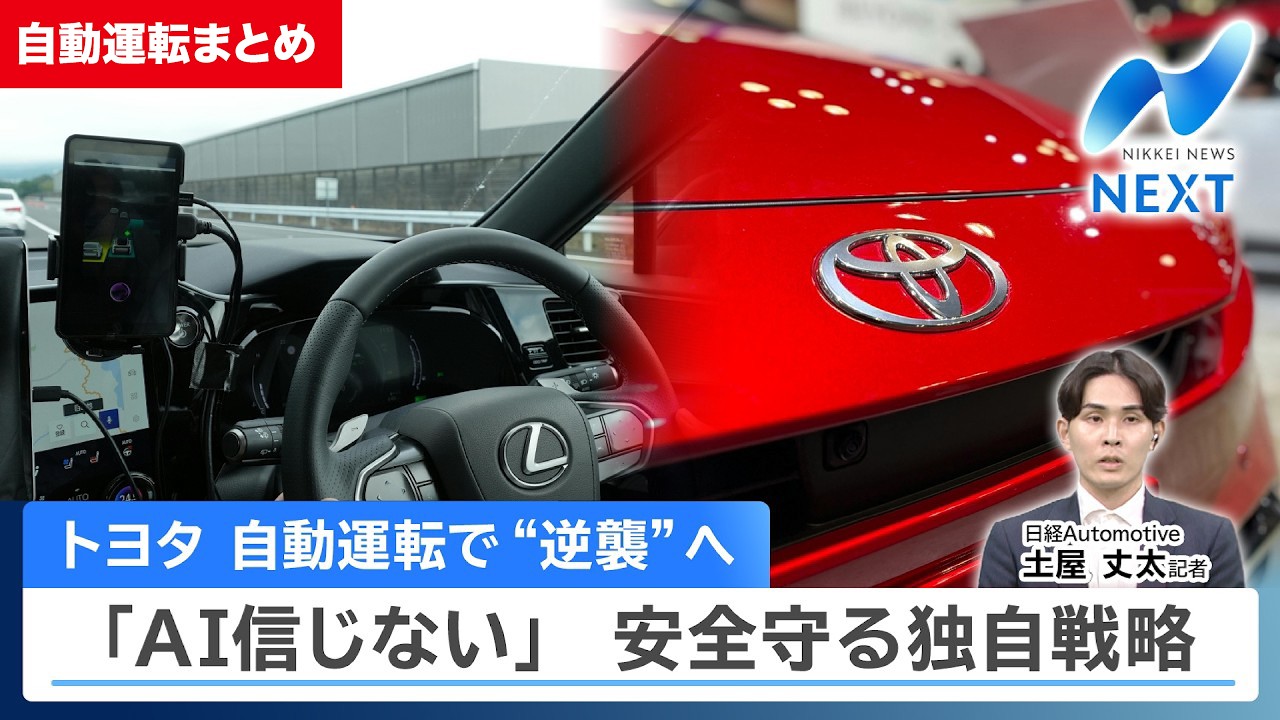
Rather than relying exclusively on increasingly sophisticated artificial intelligence inside individual vehicles, Toyota is seeking to create a broader traffic safety system in which vehicles and the surrounding environment share responsibility for detecting and preventing accidents.
The company’s ultimate objective is to eliminate traffic accidents by combining autonomous driving technology with intelligent infrastructure.
The approach highlights a fundamental question confronting developers worldwide: whether vehicles can achieve sufficiently high levels of safety through onboard intelligence alone, or whether broader investments in connected infrastructure will remain necessary.
Meanwhile, Isuzu Motors is developing its own autonomous driving technology with the goal of introducing fully driverless heavy-duty trucks on expressways.
The company has been conducting tests using large trucks capable of making decisions about lane changes, merging and avoiding obstacles without direct intervention from a human driver.
During one demonstration, an autonomous truck approached a highway merging point where two vehicles were traveling in the adjoining lane. The system assessed the surrounding traffic, allowed a nearby vehicle to pass and then successfully merged into the flow.
In another test, the truck detected an obstacle ahead and independently changed lanes to avoid it.
Isuzu calls the technology its AI Truck system, reflecting the increasing importance of artificial intelligence in enabling commercial vehicles to navigate complex traffic situations.
The company is working toward practical implementation during the next fiscal year, although achieving the level of reliability required for fully driverless commercial operations remains a significant challenge.
The development effort is motivated partly by Japan’s worsening shortage of truck drivers, which threatens the country’s distribution networks and broader economy.
Industry projections suggest Japan could face a shortage of up to 25% of the freight transport capacity required by 2030 as the number of available drivers declines.
Hiroshi Sato, who leads Isuzu’s autonomous driving development efforts, said improving transportation efficiency through automation was becoming increasingly urgent.
He emphasized that maintaining reliable logistics is essential not only for individual businesses and consumers but also for Japan’s ability to sustain economic activity.
The challenge extends beyond replacing drivers with automated systems. Autonomous trucks must be capable of responding to unpredictable situations, including sudden obstacles, unusual traffic behavior and circumstances that fall outside normal operating conditions.
Developers are particularly concerned about identifying and preparing for rare but potentially dangerous scenarios that autonomous systems may encounter only occasionally during testing.
To accelerate development, Isuzu has turned to expertise from Silicon Valley, where companies have made significant progress in commercializing autonomous trucking.
In the United States, commercial operations involving driverless trucks began in spring 2025, with vehicles transporting freight without human drivers and operators working to expand their services.
Japan remains at an earlier stage. In 2025, four domestic commercial vehicle manufacturers conducted joint autonomous driving experiments, while the government began strengthening support for development and commercialization.
The difference in progress has increased pressure on Japanese manufacturers to move more quickly while maintaining stringent safety standards.
Isuzu’s involvement also reflects the company’s long history as a commercial vehicle manufacturer.
Founded in 1916, the business developed domestic truck production during Japan’s early industrialization and subsequently became a major supplier of vehicles supporting the country’s logistics industry.
The company expanded into passenger vehicles during the postwar period, introducing models including the Gemini compact car and the Piazza, which was designed by an Italian automotive designer.
Financial difficulties resulting from excessive investment eventually forced Isuzu to withdraw from the passenger car business, leaving it increasingly focused on commercial vehicles.
Today, its principal products include the Elf light-duty truck and the Giga heavy-duty truck, manufactured through operations centered on its Fujisawa plant in Kanagawa Prefecture.
Isuzu generates annual revenue exceeding 3 trillion yen and employs more than 40,000 people across 21 countries.
Autonomous trucking represents an opportunity to strengthen its position in commercial transportation while responding to structural problems affecting Japan’s economy.
The global competition is also being shaped by technology companies developing the computing platforms required for autonomous vehicles.
At CES in Las Vegas in January 2026, Nvidia Chief Executive Jensen Huang introduced Alpamayo, an artificial intelligence system designed to help autonomous vehicles understand their surroundings, make decisions and operate independently.
The technology represents a broader shift toward AI systems capable of interpreting complex environments and determining appropriate actions rather than relying solely on predetermined operating rules.
Nvidia has presented the system as a means of improving the safety and reliability of autonomous driving, potentially accelerating progress toward commercial deployment.
Some industry estimates suggest the autonomous driving market could reach approximately 18 trillion yen within three years, underscoring the scale of the commercial opportunity.
For Japanese technology companies, however, competing directly with major American developers presents considerable financial and technological challenges.
TIER IV, a Japanese autonomous driving technology company led by Chief Executive Shinpei Kato, is attempting to overcome those obstacles through an open-source development strategy.
Rather than concentrating on manufacturing autonomous vehicles itself, TIER IV provides a software platform that enables other companies to develop their own self-driving systems.
The platform is built around open-source technology, allowing developers around the world to contribute improvements and share technical expertise.
Kato argues that this model can significantly reduce development costs and accelerate technological progress compared with an approach in which a single company attempts to develop every component independently.
By bringing together contributions from a global community, TIER IV aims to create sophisticated autonomous driving systems without matching the enormous research and development budgets of the industry’s largest companies.
Kato believes the ability to develop advanced technology more quickly and at lower cost could eventually allow open-source platforms to catch up with, and potentially surpass, established competitors.
The company’s revenue model is based on selling products, providing services and licensing technology built around its platform.
Although the underlying software is open source, TIER IV generates income by helping customers create operational autonomous vehicles and supporting the services they provide.
The strategy separates the collaborative development of foundational technology from the commercialization of products and services built upon it.
Kato said his interest in autonomous driving emerged from his background in research and university teaching, combined with the technological challenges presented by robotics and artificial intelligence.
He also views autonomous driving as particularly important because it connects technological innovation with Japan’s automotive industry and broader social problems.
Beyond reducing traffic accidents, autonomous vehicles could improve mobility for people who have difficulty accessing conventional transportation and provide alternatives in communities facing labor shortages.
Kato believes progress toward practical deployment differs considerably depending on the operating environment.
Autonomous systems used in public transportation, factory logistics, construction machinery and other industrial applications have already passed important technical milestones, he said.
In relatively controlled environments, the question is increasingly how to expand commercial services and achieve mass production rather than whether autonomous operation is technically possible.
Robotaxis occupy a more difficult position, with significant technological challenges remaining even as companies begin planning broader deployment.
Fully autonomous private passenger vehicles capable of operating almost anywhere present still greater difficulties because of the enormous variety of road conditions and situations they must navigate.
Kato said Level 4 autonomous driving, in which vehicles can operate without human intervention under specified conditions, has reached a stage where commercial deployment is technically feasible in certain environments.
For applications such as public transportation and transportation inside factories, he believes Level 4 systems can already be introduced at economically realistic costs.
TIER IV intends to strengthen its market position in these areas before expanding further into more complicated applications.
The company is taking a more cautious approach toward robotaxis, trucks and privately owned passenger vehicles, where expanding Level 4 capabilities requires additional investment, vehicle development and technological advances.
Kato noted that companies around the world are engaged in an increasingly expensive competition to develop autonomous driving systems capable of handling complex environments.
Rather than immediately joining that investment race on the same scale, TIER IV intends to identify the areas where its existing technology offers a competitive advantage and determine when further investment is most appropriate.
The company plans to expand into additional vehicle categories when improvements in technology and production costs make broader commercialization more practical.
Its timetable will depend partly on the readiness of automobile manufacturers to produce compatible vehicles at scale.
Japan’s government has set a target of deploying 10,000 autonomous vehicles during the 2030s, and TIER IV intends to contribute to that expansion.
The company’s plans are closely connected to its financing strategy.
Kato said TIER IV raised just under 20 billion yen through its initial public offering, with the proceeds intended primarily for research and development involving artificial intelligence and semiconductors.
The company expects to shift from a business focused largely on technology development toward mass production in cooperation with automobile manufacturers.
Semiconductors are becoming an increasingly important part of that transition because autonomous driving systems require substantial computing power to process information from cameras, sensors and other equipment in real time.
Kato said the range of semiconductor products currently capable of supporting Level 4 autonomous driving remains limited, making advanced chip technology a critical factor in the industry’s development.
TIER IV is pursuing semiconductor development in cooperation with Japanese chipmaker Renesas Electronics, while also examining how its open-source technology can work alongside Nvidia’s AI systems.
The company is developing prototype semiconductor technology and making its designs available through an open-source approach, extending the collaborative model already used in its software platform.
The effort raises the possibility that the competition for leadership in autonomous driving will be determined not only by the quality of AI software but also by access to efficient, affordable computing hardware.
For automakers, the challenge is to combine advanced artificial intelligence with systems that can operate safely, reliably and economically across different road environments.
Toyota’s infrastructure-based approach emphasizes the importance of detecting hazards beyond the vehicle itself, while Isuzu is concentrating on the immediate commercial need for autonomous freight transportation.
TIER IV, meanwhile, is seeking to provide the underlying technology that could enable a wider range of manufacturers and service operators to enter the market.
Together, their strategies demonstrate how Japan’s autonomous driving industry is evolving beyond conventional vehicle manufacturing into a broader competition involving artificial intelligence, semiconductor design, transportation infrastructure and industrial software.
The central challenge for all three is turning technological progress into commercially viable systems that can operate safely in the unpredictable conditions of everyday transportation.
Source: テレ東BIZ