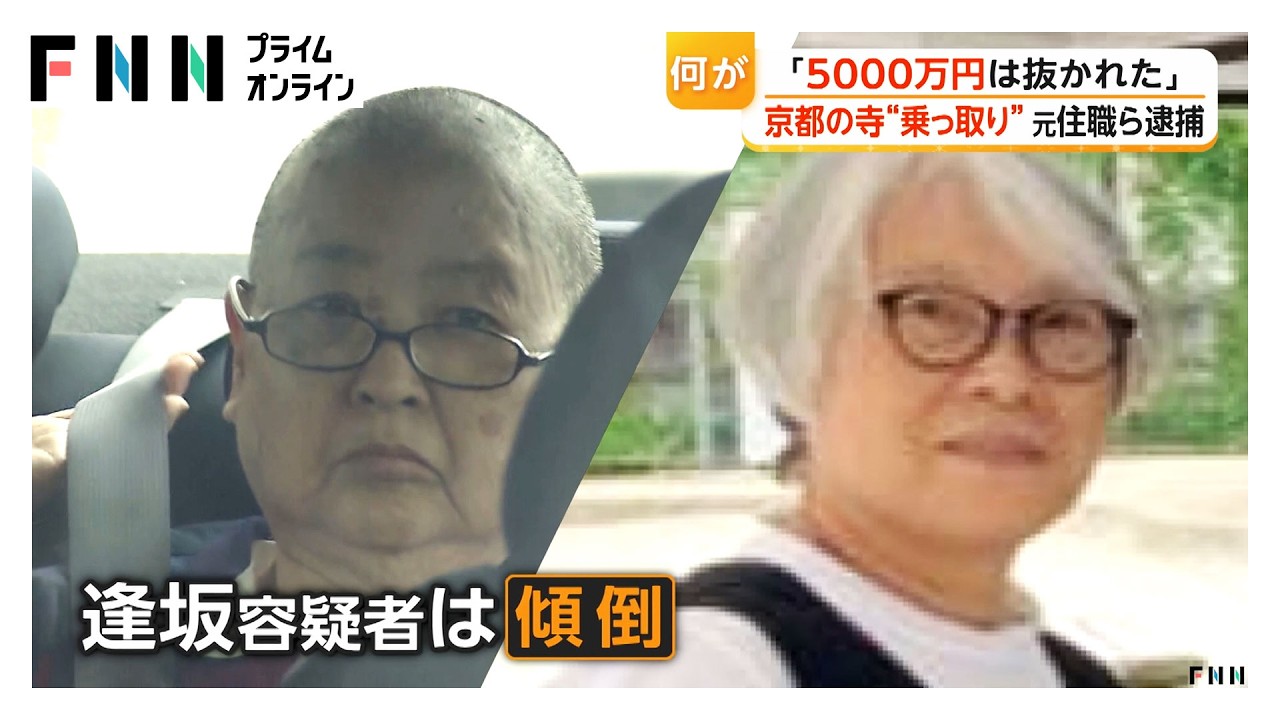
Former Priest Arrested Over Unauthorized Sale of Historic Kyoto Temple Property
KYOTO –
Three people, including a former chief priest, have been arrested over the alleged takeover of a historic Buddhist temple in central Kyoto, with investigators suspecting they sold temple-owned land and buildings without authorization for approximately 226 million yen, leaving the 300-year-old institution with almost none of its property beyond its main hall and grounds.
The case centers on Saiganji Temple, a Jodo Buddhist temple believed to have been founded during the Edo period. The arrests have exposed a series of financial dealings that reportedly began with a proposal to fund repairs to the temple’s leaking roof and eventually led to the unauthorized sale of valuable real estate.
Police arrested three suspects in September on suspicion of professional embezzlement and fraud: Hiroya Taguchi, 42; his mother, Jikun Suzuki, 72; and the temple’s former chief priest, Jikyo Osaka, 74.
Investigators believe the three conspired to sell land and buildings owned by Saiganji to a real estate company without obtaining approval from the religious corporation responsible for operating the temple. The properties were reportedly sold for approximately 226 million yen, but none of the proceeds reached the temple.
A senior temple official expressed disbelief at the alleged betrayal, saying, “It’s shocking. How could something like this happen?”
According to temple representatives, the events leading to the arrests began in 2022, when rainwater started leaking through the roof of the main hall. Officials considered repairs essential because the building could no longer be used safely in its deteriorating condition.
The estimated cost of repairs was as much as 50 million yen, prompting discussions about how to raise the necessary funds.
During those discussions, Osaka introduced Suzuki, whom he had reportedly met at an event organized by the temple. Suzuki presented what appeared to be an unusually lucrative investment opportunity, promising a substantial return in exchange for financial support.
“If you invest 10 million yen, I’ll pay you 6 million yen in dividends,” Suzuki reportedly told temple officials.
Two senior representatives were immediately suspicious of the proposal.
A lay representative of the temple said Suzuki’s manner and the extraordinary returns she promised convinced him that the arrangement was fraudulent.
“I thought she was clearly a fraudster. It was the way she spoke and carried herself. She calmly said she would pay dividends. You would never hear something like that in ordinary society, but she spoke as though it were perfectly normal,” he recalled.
Osaka, however, apparently regarded the proposal as attractive and gradually came to place increasing trust in Suzuki.
According to temple officials, Suzuki and her son Taguchi were eventually given responsibility for managing the temple’s finances. They allegedly began withdrawing money from its accounts, steadily depleting its financial reserves.
Asked how much money had disappeared, the lay representative estimated the losses at approximately 50 million yen.
“I think they took 50 million yen. There probably isn’t a single yen left,” he said.
Temple representatives said the suspects then turned their attention to the institution’s real estate holdings.
A senior official described the properties as extensive, covering approximately 100 tsubo, equivalent to about 330 square meters, or possibly more.
The land and buildings had generated rental income of approximately 1 million yen per month, providing the temple with a valuable source of regular revenue.
However, the properties were sold to a real estate company without the necessary authorization, allegedly with the involvement of Osaka, who was serving as chief priest at the time.
The sale left Saiganji without any of its real estate holdings apart from the main hall and temple grounds. Officials said the institution received none of the proceeds, despite losing assets that had generated substantial monthly income.
The revelations have deeply affected those involved in managing the temple, particularly because the alleged wrongdoing involved the priest entrusted with protecting its interests.
Asked about Osaka’s actions, one senior temple official struggled to express his feelings.
“I can’t find the right words,” he said.
The lay representative offered a more reflective assessment, suggesting that Osaka may have become increasingly entangled in the arrangement and eventually found himself unable to withdraw.
“He may be the one who regrets it the most. Once things started rolling, perhaps he couldn’t find a way to get off,” the representative said.
All three suspects have partially denied the allegations during police questioning, although they have acknowledged certain aspects of the property transactions.
Suzuki admitted that the real estate had been sold without following the required procedures but denied conspiring with the other suspects.
“It is true that the property was sold without completing the necessary procedures. However, I did not conspire with Taguchi and the others,” she reportedly told investigators.
Taguchi maintained that he believed approval had been obtained from the temple’s responsible officials.
“I thought we had the consent of the board members,” he said.
Osaka also acknowledged the property sales but sought to distance himself from responsibility for arranging them.
“It is true that the real estate was sold, but Suzuki and Taguchi were the ones handling the process,” he told police.
Osaka further admitted that, in retrospect, he should have insisted that the proposed sales be formally submitted for approval.
“Looking back now, I should have said that a resolution was necessary,” he reportedly told investigators.
Police are continuing their investigation into the alleged embezzlement and fraudulent property transactions, including the possibility of additional offenses connected to the temple’s finances.
The case has left Saiganji, an institution with approximately three centuries of history, facing the loss of valuable assets and rental income, while raising questions about financial oversight and governance within religious organizations.
Source: FNN