What happens after Delhi Police detains you? I saw it first hand
By 9 pm, lawyers from Dwarka were standing outside the gate — two lawyers in the group had reached out to the local Bar, PUCL had got involved, as had social media. By 9.30 pm, the group and the lawyers were shouting over the police to each other – and at the police. “One of us has a broken arm, and there is no medical treatment,” said the group. “Nor have we received food.” “Can you tell us why you have minors locked up inside?” shouted a lawyer from the gate. “Open this gate so that I can come inside to check how they are.” Negotiations started. To lift detention, could the group promise the police not to attend further protests, asked a lawyer negotiating with the cops. This was rejected by the lawyers in the group.
In the minutes that followed, , the police took a more conciliatory line. Medical aid came. Apart from ushering us inside the hall, they first said food was being arranged and that the phones would come soon. We were next told all minors could leave. Then they added that anyone who wanted to leave could do so. Their reasons were understandable. The brunt of the protests was falling on the ground staff. “Our shift starts at 6 am,” one guard told me. “And I live 90 minutes away.” Complicating matters, we were not at a police station but a panchayat building pressed into work as a detention centre. In other words, the police could not leave till the detainees did. The catch: without their phones, most of the group was unwilling to leave.
Three of us – a middle-aged man from North Delhi picked up by the cops as he went about his business a coder from Kerala who was photographing protests after lunch at Kerala House; and me – left at 10 pm. The rest stayed back, demanding their phones and insisting Delhi Police drop them back at Connaught Place. We initially got into a police minibus – then into a cab arranged by lawyers – to drop us at the nearest metro station. Inching out of the gate, we saw lawyers, both from Dwarka and elsewhere, berating the police. All of them had roused themselves to help strangers.
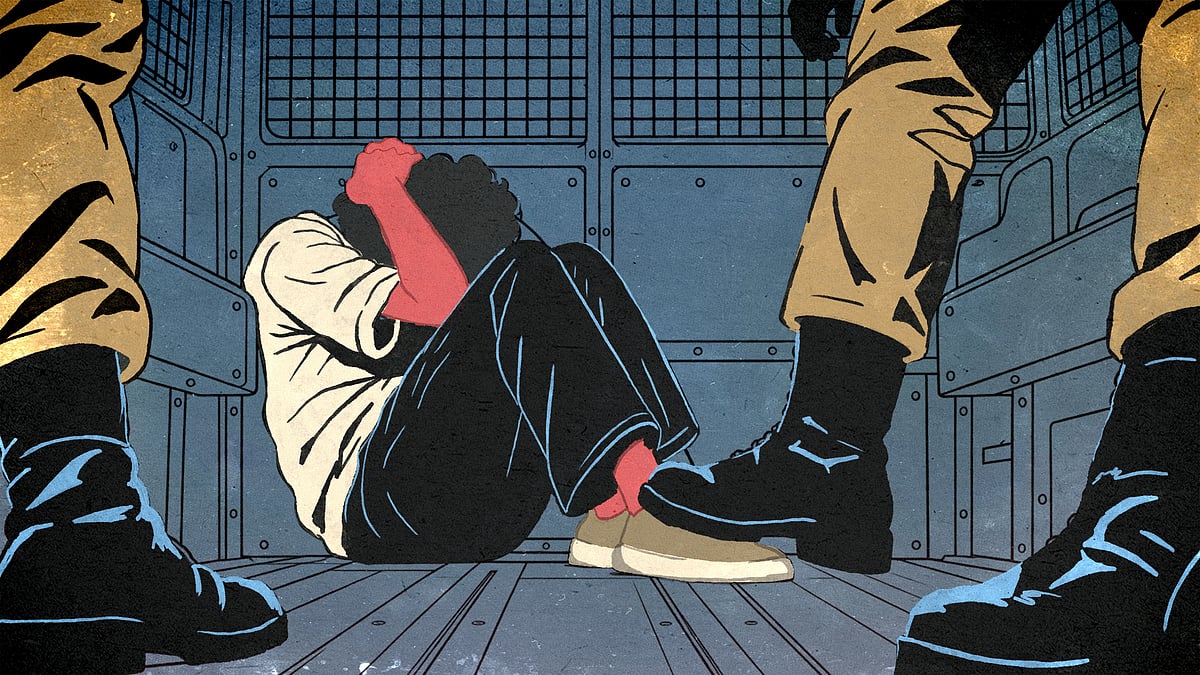
Few of us see State violence – it is too structural and too hidden. Even those of us who get to see overt State violence usually catch only its aftermath. That evening, though, the group saw it unfold and heard the justifications in sync. “Police ki maar ka bura nahin maante (you shouldn’t get upset over this beating),” said one of the policemen after the van had filled up. This was police beating for moral improvement.
Working on this report, we asked Delhi Police to comment on the principal charges raised in it – detainees being beaten; female protesters they were beaten as well; bystanders being detained; phones being taken without paperwork and thereafter not returned; despite the beatings, the group being taken to a remote part of Delhi where medical care was not easy to find. We also shared what police staff had said to us, seeking its comment.
Fear and loathing in Delhi
“Detention is a very old practice,” a legal scholar told me the next morning.
“They will take you very far away and keep you there for a while so that the day becomes futile.” What we have here, in essence, is an attempt at crowd dispersal and intimidation to discourage further civic action. This, after all, is the State flexing its muscle, showing you that it can, whenever it wishes, have your life dangling at its whim.
Last weekend, this wasn’t the only muscle the Modi Sarkar flexed. It also shuttered 45 metro stations, a climbdown from the 57 it had wanted to close; stopped all trains coming into two major train stations; and barred bus travel into Delhi. On Saturday morning, travelling down Mathura Road beyond Faridabad till KMP Expressway – a road chosen at random – I was struck by the absence of buses. That morning, over an hour and 50-odd kilometres, I saw a total of three buses heading towards Delhi.
“We drivers have a WhatsApp group,” said the cab driver who took me from Ballabhgarh to KMP. “That is how I know the police are stopping buses 50/70 kilometres well outside Delhi. They are also checking buses at barricades.”
Later that morning, employees of Haryana Roadways at Ballabhgarh also said they had been told not to sell tickets to Delhi. “This is astonishing,” said a Haryana Roadways employee. “People travel for many reasons, some of them very urgent. How can they stop people from moving around in their own country?” He then showed me the instructions they had received on WhatsApp.