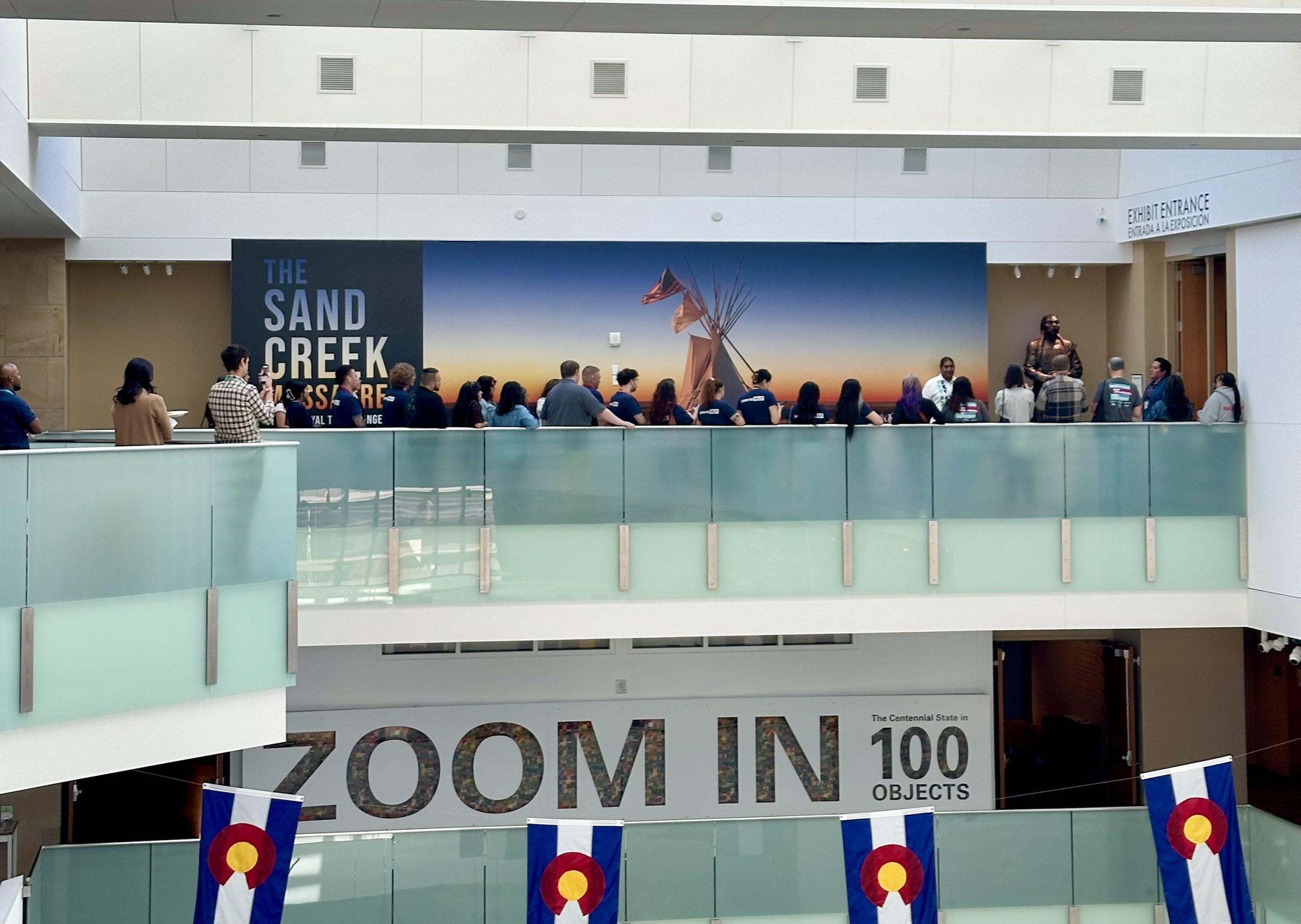
History Colorado displays Sand Creek Massacre memorial statue
The first statue of three that eventually will constitute the Peace Keepers memorial to the Sand Creek Massacre on the grounds of the Colorado State Capitol, a project that has been years in the making, was unveiled Monday — Indigenous Peoples Day — at the History Colorado Center in Denver.
The exhibit, featuring the Southern Cheyenne Chief Black Kettle, marks the first in a series of reveals as the display takes shape. Cast in bronze at a larger-than-life scale, the memorial will feature Black Kettle and Chief Left Hand, who oversaw the peaceful encampment at Sand Creek when Col. John Chivington and his soldiers attacked Nov. 29, 1864, killing more than 230 people, mostly women, children and the elderly.
The memorial also includes a statue titled Medicine Woman, holding a baby and standing before a tipi frame. The likeness of Chief Left Hand, a Southern Arapaho leader who was mortally wounded in the attack, is projected to be finished early 2027, and Medicine Woman sometime before next summer. Black Kettle survived Sand Creek but died in battle several years later.
The Chief Black Kettle statue is being displayed on the 4th floor of the History Colorado Center outside of the exhibition, “The Sand Creek Massacre: The Betrayal that Changed Cheyenne and Arapaho People Forever,” where visitors with general admission tickets or a History Colorado membership can view it.
Otto Braided Hair Jr., a Northern Cheyenne elder who has been an integral part of the effort to construct a memorial for about 30 years, said that after the initial statue of Black Kettle was finished, “we needed a place to put him while we waited for the others.”
“I suppose we could store it someplace behind closed doors,” he said from his home in Montana, “but why not put it on display? Up until a couple weeks ago, we didn’t know we needed to find a place for Black Kettle. But with History Colorado, there were no questions, ifs, ands or buts. There was an immediate ‘yes.’”
History Colorado President and CEO Dawn DiPrince said the museum has displayed the statue “in this nook that feels like it’s almost made for it.”
“I think they are excited to share their progress in this work,” she said of the tribal leaders. “They really see this as a gift toward our collective healing. To have this really tangible evidence of all of their efforts, and we get to unveil that, is pretty great.”
Braided Hair said that as long as there’s space at History Colorado, he’d prefer that Chief Left Hand join Black Kettle on display there until the final elements of the memorial are completed.
The concept of a memorial to the Sand Creek Massacre dates to 1999, when discussions about creating a National Historic Site began to gain traction. The process included negotiation and collaboration among both the tribes and the state, which ultimately settled on installing the memorial on the Capitol’s west plaza, where a controversial statue of a Union soldier stood until it was toppled by protesters in the wake of the George Floyd killing in 2020.
In consultation with tribal artists, the Sand Creek Massacre Memorial Committee produced a concept and design for the display, and then commissioned Gerald A. Shippen, a Wyoming-based sculptor known for his work celebrating Indigenous history, to complete the memorial.
Fabrication began in late 2024, with the design and placement approved by the legislature and Gov. Jared Polis the following year. Tribal input has driven the project, with support from the Sand Creek Massacre Foundation and PAX sapiens, formerly the One Earth Future Foundation.
The total fundraising effort for the memorial stands at $667,200, slightly more than the budget required, said Elleni Sclavenitis, executive director of the Sand Creek Massacre Foundation. That total included contributions from a half-dozen institutional donors and more than 165 individual donors. The foundation continues to raise funds to cover tribal travel for related events.
On Nov. 29, the anniversary of the massacre, representatives from the Cheyenne and Arapaho Tribes of Oklahoma, the Northern Arapaho Tribe and the Northern Cheyenne Tribe will dedicate the Capitol site. The 10 a.m. ceremony will be open to the public and coincides with the final day of the annual Sand Creek Massacre Spiritual Healing Run, a descendant-led relay that begins Nov. 26 at the National Historic Site near Eads.
“It’s long overdue,” Braided Hair said. “Long, long overdue. When you look at the date of the massacre, it was over a century and a half ago. It’s taken this long, but it will help solidify that it won’t be forgotten. It’s almost a reality.”