
Credit score after marriage: How can your spouse’s credit history affect joint home and personal loans?
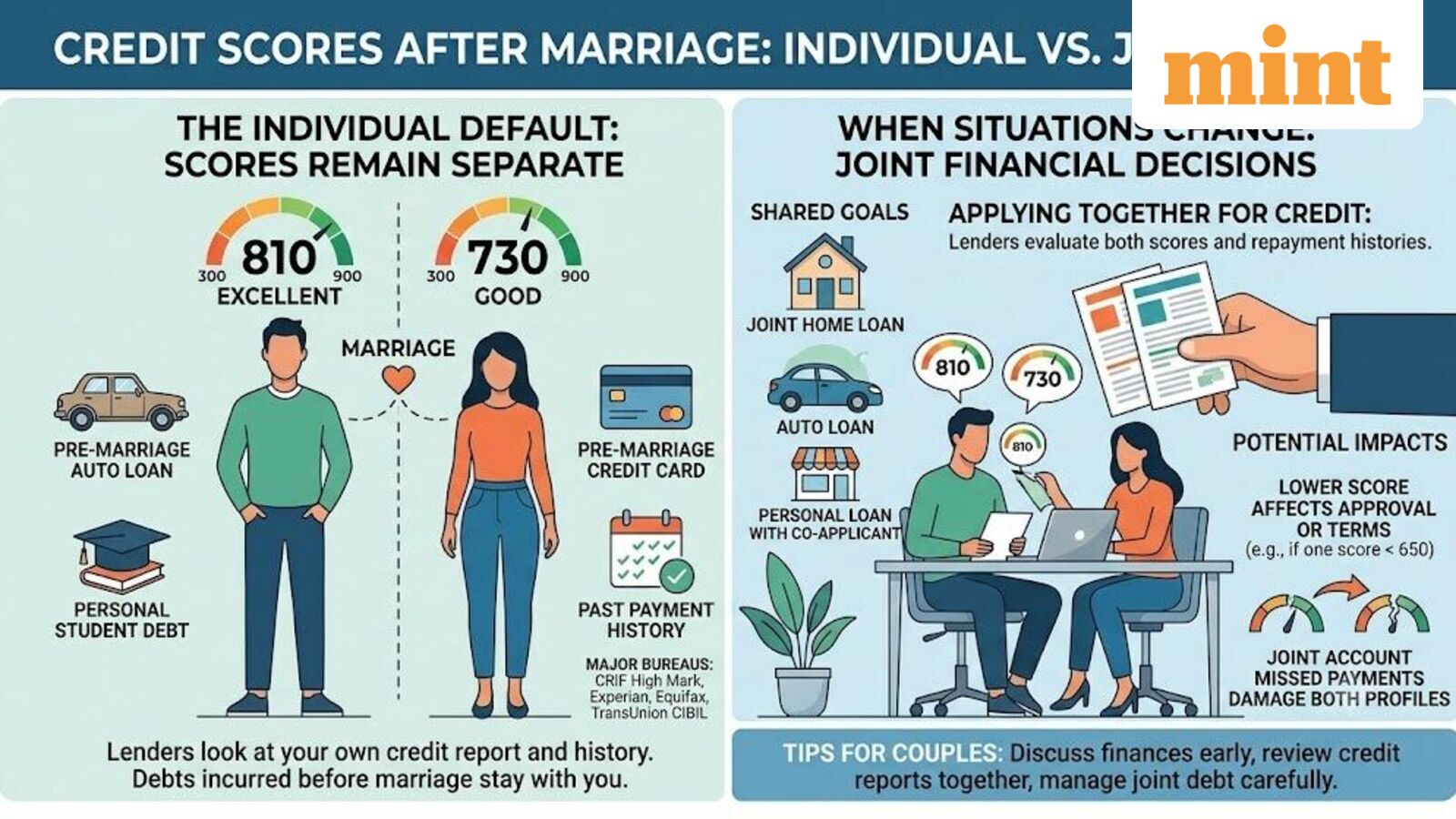
Marriage does not automatically merge spouses’ credit scores or credit histories. However, when couples apply for a joint personal loan or home loan, a lender may assess both applicants’ credit scores, repayment histories, incomes and existing debts. A spouse’s poor credit record could affect the loan application’s approval or terms, making it important to understand how creditworthiness influences joint borrowing.
This distinction is particularly important when couples plan to take on major financial commitments, such as a home loan, car loan or personal loan. Having a clear understanding of these concepts is essential for couples to plan their finances better.
Furthermore, a credit score is like an individual’s financial report card. This is a three-digit number provided by prominent credit bureaus such as CRIF High Mark, Experian, Equifax and TransUnion CIBIL. The basic range of credit scores is generally between 300 and 900. With any score over 750 usually considered excellent, though there is no fixed rule defining it.
When does your spouse’s credit history matter?
Credit scores are fundamentally based on an individual’s credit history. Marriage itself does not lower, modify or improve an individual’s credit score. Also, a spouse’s poor credit history, excessive debt levels, or past defaults do not automatically impact or influence an individual’s own credit score or credit profile in any way. Both partners, even after marriage, will continue to maintain separate credit reports.
Conditions when the situation changes
The situation changes when an individual applies for credit with their partner, i.e., their spouse. For example, if you and your spouse apply for a:
- Joint home loan.
- Personal loan with your spouse as a co-applicant.
- Any other form of debt that is applied together.
Then, in such cases, the lending institution may assess both applicants’ credit scores, repayment histories, incomes and existing financial obligations. Now, in such cases, a low credit score (i.e., any score below 650), a recent history of defaults, or substantial outstanding debt for one partner can adversely affect the lender’s assessment of the joint application, potentially influencing its approval or terms.
Along similar lines, if you co-borrow a loan or jointly hold a credit account, missed payments or due dates can hurt both partners’ credit profiles, especially when the account is reported against both. Co-signing a loan agreement can also create financial complications and repayment liability, and may affect credit scores if payments are delayed, depending on the agreement.
It is also vital to note that an individual’s spouse’s existing personal loans generally remain their own responsibility until and unless the other spouse steps in and assumes a legal obligation for them. Therefore, simply getting married does not make an individual responsible for every debt their spouse might have incurred before the marriage.
How can couples protect their credit scores?
To protect their financial well-being and future economic security, couples should sit together and discuss their existing loans, credit card balances, any pending debt obligations, and repayment commitments before applying for shared debt. Clearing credit card bills and paying EMIs on time is essential, as payment delays can damage the credit profiles associated with an account.
Furthermore, it is equally vital for couples to keep their overall credit utilisation in check. This is yet another important metric that showcases how much an individual relies on debt to meet day-to-day payments.
To accomplish this, the focus should be on avoiding unnecessary loan applications and checking credit reports on a consistent basis for unfamiliar entities, errors, omissions in data, or loans that are still marked as running.
Both partners should work as a team and review their own individual credit reports. They should not presume that one partner’s good credit history will compensate for the other’s weaker credit profile or borrowing capacity.
In summary, it is clear that credit scores remain individual metrics, even though shared borrowing can affect both applicants’ credit health. Hence, your spouse’s credit history has no direct impact on your own credit score or borrowing potential.
This remains consistent even after marriage. The real impact might come from shared borrowing, personal loans, or other forms of debt in which both partners are involved. Maintaining separate credit profiles and managing joint commitments responsibly can help couples protect their individual creditworthiness while planning their financial future together.