Ski Touring in Norway Makes the Climb Part of the Adventure
It was a perfect bluebird day in late April, with the bright Scandinavian sunshine sparkling off deep fields of snow blanketing the Romsdal Alps. While it was well past peak season in the U.S. and southern parts of Europe, here in Norway, it was still spring skiing at its finest. One catch? The fresh tracks that awaited me at the peak were only accessible the old-fashioned way.
Ski touring—the sport of skinning uphill with specialized alpine bindings before shifting to downhill mode for your hard-earned descent—has been popular in Norway for centuries, first practiced as a recreational sport by pioneering mountaineers in the 1800s. I gazed around at the clusters of Norwegians strapping skins on their skis for an early morning ascent to the top of Smørbotntind, a 3,898-foot peak that seemed impossibly far away at the moment. Some Scandi adventurers even brought their dogs along, as if this were truly a walk in the park. Is this why Norway is one of the happiest countries in the world?
There were no chairlifts in sight, and heli-skiing is strictly forbidden in the Sunnmøre Alps (and across all of mainland Norway). As an avid skier, I’d always considered myself fairly competent on the slopes, but my ascent that day taught me the meaning of “earn your turns.” What comes down, must trek up. Thrilling, a little terrifying and ultimately serene, ski touring is the ultimate way to experience a Norwegian winter.
Though I’d cat-skied in the mountains of Colorado and British Columbia and heli-skied in the Alaskan backcountry wilderness, this was my first time ski touring. To be honest, I hadn’t seen the appeal stateside—why spend all your time hiking up a mountain for one measly run?
Alas, I soon discovered that having the mountain all to yourself, with open alpine bowls leading to emerald fjords below, was well worth it—not to mention one of the most blissful runs of my life. (Plus, after all that effort spent hiking up—and the exertion required to navigate the off-piste terrain on your way back down—you won’t have any energy left for another trek uphill.)
The beauty of Norway is that its endless wilderness accommodates all skill levels. You don’t need to be an expert skier to set out for an afternoon in the mountains—which is lucky, because when it came to the art of ski touring, I was a complete beginner.
I began my trip by setting out into the Norwegian woods surrounding the Hjørundfjord on an expedition designed by UpNorway, a boutique travel company specializing in off-the-beaten-path adventures. After landing in Oslo, I transferred to Ålesund Airport, where my adventure began in earnest in the Sunnmøre Alps. It was my first time visiting, and I quickly discovered the best way to get a sense of this Nordic country was to venture into the great outdoors in these tiny towns and ancient villages scattered around the western Alps.
My initial ski touring adventure was a ski-and-sail excursion on the Hjørundfjord, which involved boating across its blue-green waters to Trandal for our inaugural alpine expedition. Ski touring is backcountry skiing stripped to its simplest form, without the luxury of chairlifts, snowcats or helicopters to assist you in pursuit of ungroomed terrain. To that end, there are no mountainside dining or ski rental shops, so a guide is crucial—not only will they share knowledge of the vagaries of this untamed wilderness (cliffs to avoid, dangerous tree-wells), but they also handle the equipment and provide necessary avalanche expertise.
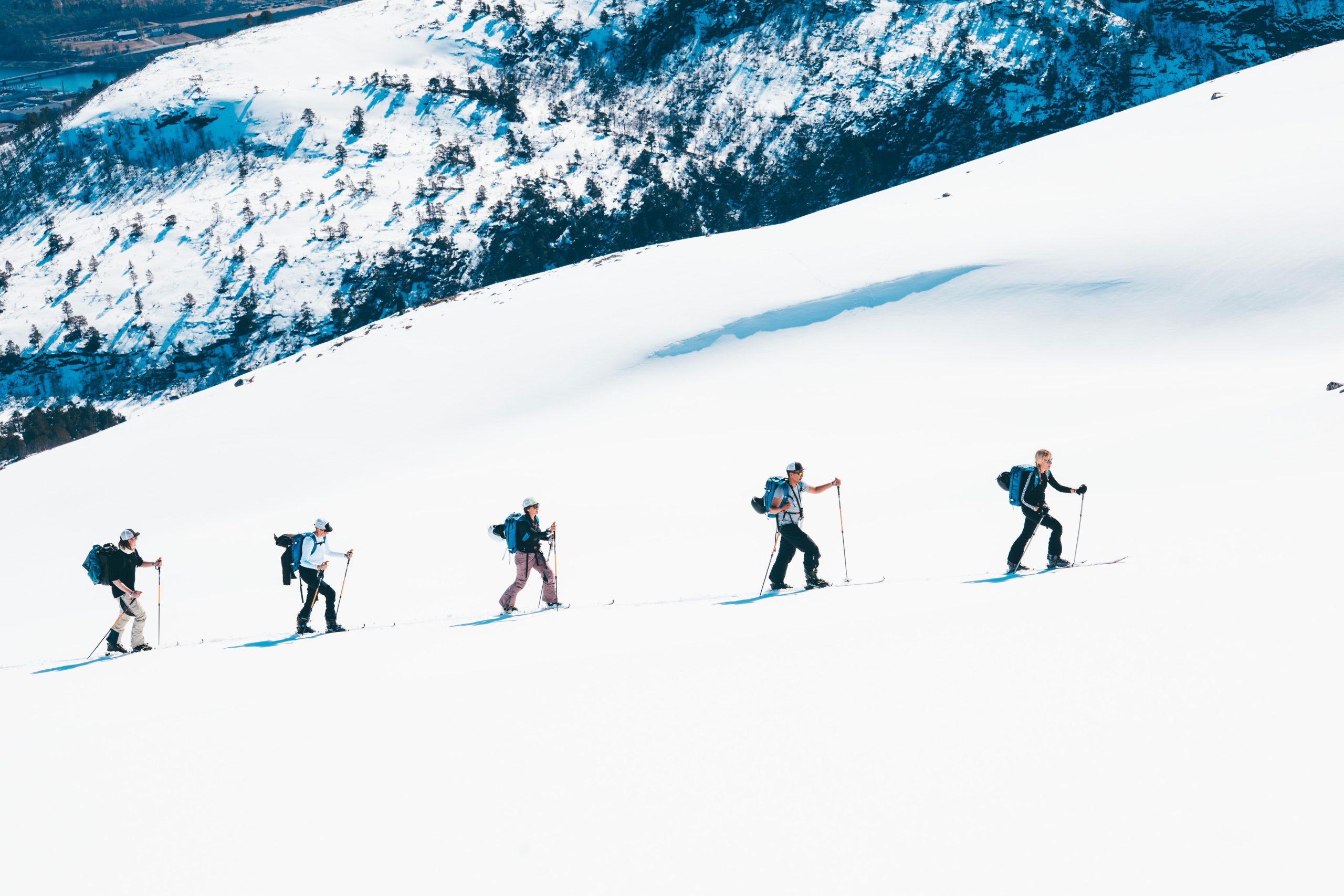
We set out for a full day with Uteguiden on a summit-to-sea ski touring expedition, where we skinned across the alpine bowls, ascending over 1,000 feet up to the summit ridge of Trandal valley. Before embarking, we were provided with the backcountry “Big Three”: a beacon, a shovel and a probe in case of emergency. I was familiar with this avalanche equipment from prior off-piste outings, but the high-tech ski gear still had a bit of a learning curve. First, we attached our climbing skins (specialized fabric with a sticky backing for trekking uphill without sliding backward) to the bottom of our skis and set our bindings to “walk mode,” so we had more range of movement for hiking uphill. Our touring boots were larger, lighter and more flexible than regular ski boots, with an adjustable lever to lock stiff for downhill mode.
Getting into a new rhythm for the ascent was challenging at first, but then became second nature—hiking up a hill on skis is, oddly enough, easier than it looks. The descent felt shaky initially, as I was unused to the oversized boots, but that, too, became more comfortable as the day went on. After the first hour, I settled into the slower, more melodic pace of ski touring, appreciating the surrounding nature and listening to the rustling trees and sounds of melting ice. Though it was late spring, we still experienced sporadic snowfall during our ascent, making it harder to chat with our guides and fellow skiers.
There were no distractions aside from my own breathing and the repetitive footfalls in the snow. Luckily, the weather cleared by the time we reached our final destination below: an après luncheon at Christian Gaard, a family-owned farmhouse restaurant built in 1505. “Since I was a child, I was told that trolls lived by the water here and under the bridges,” says Daniel Storeide, the farm’s current owner (the farm has remained in his family for over 500 years). Between the eccentric, centuries-old Norwegian decor and the massive wooden swing perched on a hillside overlooking the Hjørundfjord, it was easy to imagine the fairies and spirits of Nordic folklore calling this place home.
The ethereal magic of rural Scandinavia followed me that evening to the Hotel Union Øye in Norangsfjorden, a tributary of the Hjørundfjord, one of the most striking fjords in Norway. Located in the tiny town of Øye, the hotel is surrounded by snow-capped Alpine peaks. The last German emperor, Kaiser Wilhelm II, spent every July here. “We want everyone who comes here to feel like a king and queen,” Marius Stangeland, our vertskap (host), said during an evening storytelling session about the hotel’s 135-year-old history—and its spectral residents.
“Ghosts are a part of this hotel, but if you’re respectful, they will be respectful back.” Communicating with the dead is a nightly affair, especially in the Blue Room, which is apparently politely haunted by a servant girl named Linda, who drowned herself in the nearby fjord after a forbidden love affair with a visiting aristocrat. When checking in, the hotel provides a silver platter of garlic to place on your nightstand if you want a peaceful sleep, or out in the hallway if you want a brush with Linda’s ghost. (Guests have frequently reported the sound of weeping at night.)
Though the Norangsfjorden, a tributary of the Hjørundfjord, is one of the most striking fjords in Norway, it’s less crowded than nearby Geirangerfjord and the Nærøyfjord. The majestic, lesser-known Hjørundfjord is not on the traditional tourist routes and lends itself to a sense of serene tranquility. I spent the next afternoon on the shores of the Norangsfjord, kayaking upon the crystalline waters and enjoying the floating fjord sauna, partaking in the rotation of heating up in the sauna before jumping into the icy, salty water for some wild swimming—it was a relaxing reprieve before the second part of my ski touring journey.
My next adventure traded the deep pass of the Norangsdalen Valley for the jagged peaks of Åndalsnes, the mountaineering capital of the Romsdal Alps. Located at the northern end of Romsdalen Valley, Åndalsnes is at the mouth of the Rauma River along the shores of the Romsdalsfjord. I stayed in Villa Romsdalen, a design-forward Scandinavian rental villa conveniently located within walking distance of town; other accommodations include the historic Grand Hotel, built in 1890 at the base of the mountain, and Heinåli Hytta, a stylish alpine cabin in the nearby Isfjorden valley. To get my bearings, I spent the afternoon riding the Romsdals Gondola up the sheer flanks of Mount Nesaksla, ascending 2,323 feet above the valley floor. The mountain served as the backdrop for the season four Norway-centric episode of Succession, and offered a clear view of the snow-capped peaks I was to skin up the next day.
“We want to do things the old way here, but our way,” says Kristine Rønning, general manager of Hotel Aak, which served as our basecamp for ski touring the 3,901-foot Smørbotntind. “We want guests to enjoy the outdoors, make good memories, and have a good time.”
The peak looked exhaustingly far away from our starting point at the base of the mountain, but I was motivated by the surprising (to me) sight of so many Norwegians casually hiking up the mountain in the middle of the week, their dogs trotting happily alongside them. Here, mountain adventure isn’t merely a weekend hobby; it is a fundamental way of life.
And, as I realized that, to my utter surprise, the uphill wasn’t nearly as strenuous as I’d imagined, I decided this was a way of life that I could get used to. Having acquainted myself with the rhythms of skinning on my earlier adventure in the Sunnmøre Alps, I found the hike to the top to be much more relaxed than a 3,901-foot ascent would suggest. It was a brilliant blue day, with the sun shining overhead. I stripped down to just a long-sleeve base layer and was able to remove my knit hat and scarf—sunglasses and gloves were my only accessories in the Scandinavian wilderness.
Eighty percent of ski touring is the uphill ascent, and I found it to be far more enjoyable now that the weather conditions—and my personal skills—had improved. No longer muffled by goggles and neck warmers, I could comfortably chat with my fellow skiers, periodically posting up along the snowy cliffs for drinks, snacks and a music break. (To play Taylor Swift on portable speakers in the wilderness may feel like sacrilege, but it is my truth.) I found the adventure to be the ultimate bonding experience with my guides and fellow travelers, and more exciting and exhilarating than a traditional mountain hike in any other season. By the time we reached the peak six hours later, I was pleasantly tired, but not too exhausted to ski down. From the top, as we were rewarded with panoramic views of the mountains and fjords, I could see why ski touring is such a beloved activity across Scandinavia and, increasingly, around the world.
As climate change causes unpredictable, diminishing snowfall across the ski resorts of southern Europe and the Rockies of North America, Norway, which sits at the northern fringes of the continent, has naturally become a sanctuary for skiers seeking more reliable winter conditions. Skiing in Norway remains a more immersive and serene experience than you might find in the frantic lift lines of Chamonix or the Dolomites. I’ve spent years cat-skiing and heli-skiing across North America, but this journey marked my first time ever stepping into touring bindings, and I’m officially a convert. The quiet camaraderie of the skin up, the meditative rhythm of the climb, and the sheer satisfaction of earning your turns on the untracked face below—it was utterly invigorating and rewarding.
Beyond the mere adrenaline rush, ski touring offers an opportunity to slow down, to reflect on the natural beauty around you and to catch your breath. I bonded with my fellow skiers in a way I never would have in the frenetic repetitions of downhill skiing—racing to the bottom, waiting in a lift line for the next gondola up. And, perhaps most crucially for a wintry vacation, the après was phenomenal. There’s something about drinking mulled wine while gazing up at the jagged peak you traversed that afternoon that brings an immense satisfaction not even the sprayed champagne at Cloud Nine in Aspen could deliver. Maybe this is the secret to Norway’s happiness: spending time in nature and going nowhere fast. Regardless, I’ll be back next winter to test my theory once again. See you on the slopes.