Two poetry collections go on a date: A conversation with Arkansas poets Ellie Black and Acie Clark
A debut book always carries a buzz of excitement. It promises the introduction of a new literary voice, so much so that phrases like “the introduction of a new literary voice” have become a cliche. But like all cliches, there’s truth to it: With a debut book, you get to experience a new mind at work, encountering for the first time how someone so different from you views the world as well as what troubles them, what excites them, what keeps them up at night. In some ways, it’s not unlike a first date.
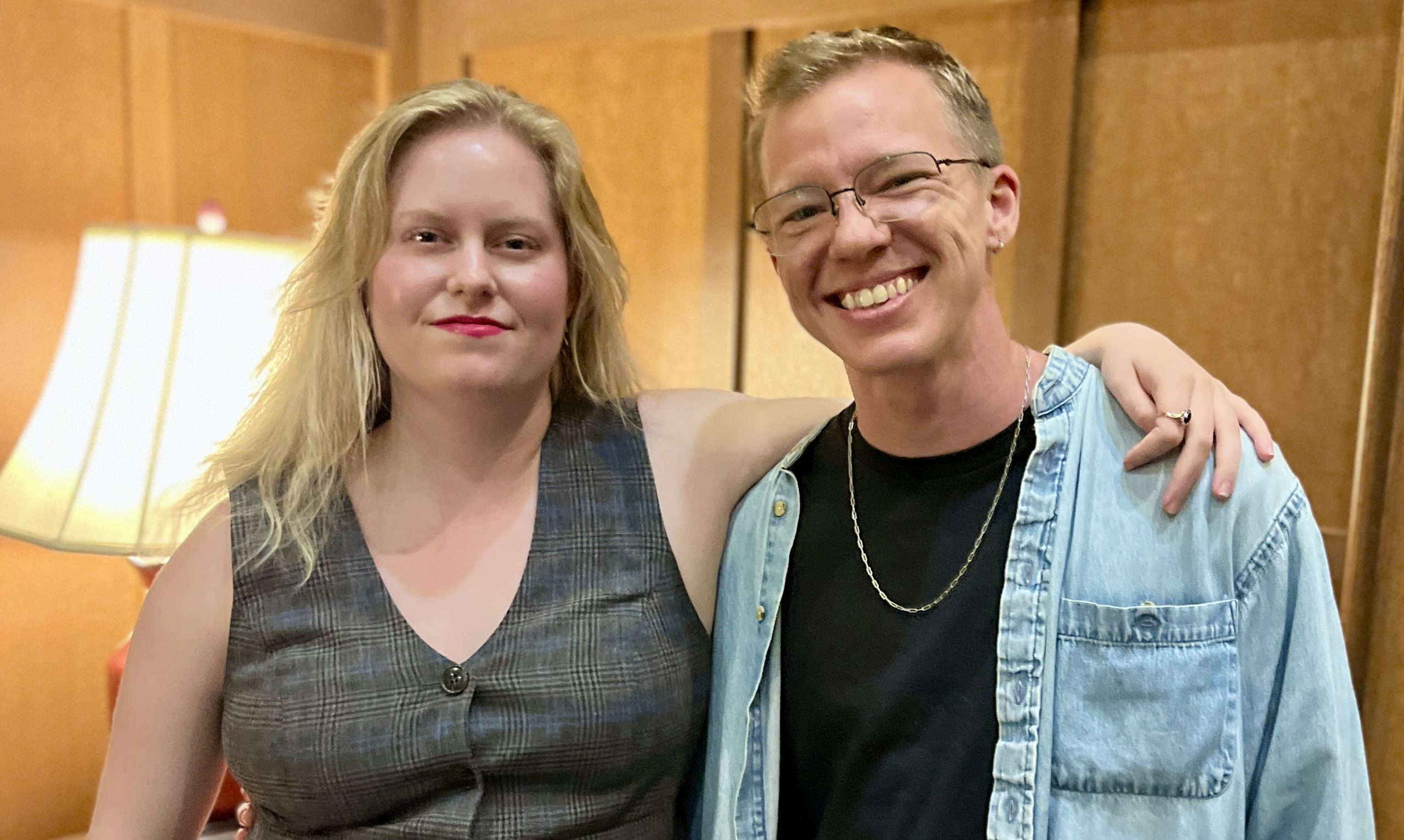
Southern poets Ellie Black and Acie Clark, both of whom are creative writing professors in Central Arkansas, made their debuts in September. Black’s “Revelator,” winner of the APR/Honickman First Book Prize, is an intense, electric exploration of what it means to be human in a multifaceted reality where you don’t always feel human. Clark’s “Small Talk,” winner of the New Southern Voices Poetry Book Prize, is a pensive, warmhearted collection of poems that dutifully tallies up the little moments that make up a life undergoing great change.
On a stormy August evening, I sat down with Black and Clark in Conway, where they both live and work, to discuss questions like whether they could imagine their two books of poetry kissing and much more.
Your debut poetry collections are about to come out. Congrats! In three words, how are you feeling in the lead up?
Acie Clark: Sweaty has to be one. I’m feeling grateful. And whatever word might encapsulate being like, “I’m about to learn a lot of things I couldn’t possibly know.”
Ellie Black: Anticipatory?
Teachable?
AC: I feel teachable.
EB: I don’t think I’m going to be able to stick to the three words. Though the book technically comes out on Sept. 1, my publisher started sending out pre-orders a couple months ago, so there’s not going to be a totally new object in the world. It’s more I’m finally going to be on the other side of actually having it published, and I don’t know what that will be like.
That’s more of a situation than a feeling.
EB: My therapist would like to speak to you.
In five words, what was going on in your life while you were writing these collections?
AC: Burning. Sobriety. Arkansas. Transition. Walking.
EB: Post-secondary education. Watching “Supernatural.” Sad.
In one sentence, what is your book about?
AC: My book is about the projects of figuring out a new way to approach conversations with myself and others, but also figuring out what those conversations needed to be.
EB: It’s a book about the concept of revealing.
If your books were people, like strangers one were to meet at a party, how would you describe them?
AC: One of the ways that I wanted to build the book was to think about all the little conversations that build up to feeling like you know somebody. So in a way, the first poems in the book I think are a bit more like, “Hey, what’s up? Nice to meet you.” And by the end of the book, it’s like, “Here is my familial trauma.”
EB: I am a person who people frequently feel comfortable making sort of radical assumptions about, so that is something that I think about a lot in my life and work. I have poems about celebrities who often have radical assumptions made about them. There’s a specific genre of a blonde celebrity who everybody’s like, “I know everything I need to know about her.” Like Taylor Swift or Courtney Love or Tonya Harding, all of whom appear in poems in my book. These are all people who we have strong feelings about culturally. So if you were to meet my book at a party, I think she would be like this kind of person whom it is very easy to project onto, who you meet and immediately make a lot of assumptions about and then either realize you’re wrong about a lot of them later or never realize that you’re wrong.
AC: I would say my book is like the guy who has a lot of hobbies and would really like to talk to you not at the party. He’s gonna be like, “Do you want to go for a walk?” And you’re gonna be like, “We just met.”
EB: And you think he’s trying to mack on you, but really he just wants to hang out.
AC: He’s probably not at the party, to be honest with you. If he’s at the party, he’s going to be like, “I’m trying to leave this party. So now’s not a good time.”
If your books were to go on a blind date, how do you think that would go?
AC: Because my book has a lot of frenetic energy and is thinking about what it means to reveal, what it means to be exposed, about assumptions that are made and what it means as a trans person to be somebody with an interiority that doesn’t always map onto cultural narratives of transness or masculinity, about the confusion of passing but also the confusion of not being perceived as a man when I was, and about being perceived in this incredibly invasive way that I feel like “Revelator” is also thinking about, I think our books would have a lot to talk about.
EB: I think so as well. And I think the inverse of that — and perhaps this goes back to the matter of assumption — is that though my book is obviously about modes of performance, I don’t think it’s even like, “Oh, but it has a secret heart.” I don’t think it’s a secret. I think it’s deeply an earnest book.
Yeah, the heart’s on the sleeve.
EB: It’s right there. There’s no pretending, no trying to hide the feelings. One of the assumptions is that what is being presented is a veneer that is hiding something. When actually this is the whole complex thing. Sometimes people have trouble with complexity, so they’re like, “It must be that there’s a surface thing and then there’s something underneath the surface.” And it’s like, no, in fact, the whole thing is one surface.
AC: Yeah, earnestness and sincerity feels really important. But also form. Both books are thinking about the lyric in ways that I think they would just be like,“Let’s talk about the lyric. We don’t need to kiss. We can talk about the lyric.”
EB: You don’t think our books would kiss?
AC: I don’t know. I think they could have a great night.
EB: We’ll never know.
AC: We’ll never know.
Both of your books are quite funny at moments. Both of you are playing with language, turning it around and inside out, being inventive and clever with turns of phrase. So there’s playfulness, but there’s also obviously great seriousness. How does playing with language help you say what is difficult to say or can’t be said otherwise?
AC: I sometimes call it my laboratory. It really is just experimenting. How does language truly break down? What happens when I’m willing to reside in the ridiculousness of this? In part because the other side of it is not saying it or reaching for the easier thing to say. What I wanted to keep in the poems was that play. And sometimes that would turn out more eloquent or interesting than I could have organically come up with. Sometimes, I was surprised by something I would say or the honesty of it when I was like almost writing without looking. I very rarely go into a poem like, “This is what I’m going to do.” Usually I’m five drafts in before I’m making craft-level decisions.
EB: My question when I’m writing a poem often is, “If I could say this in prose, why would I say it in a poem?” There needs to be something about the poem that can help me say something that I can’t say in any other way. Part of that does come down to the tools that the poem gives us access to, such as the line, which is the thing that I really harp on with my students. The line is the one thing that poets have that other writers don’t. That’s my favorite thing about poems. When we’re talking about the poem as a technology or mechanism, the line is the engine through which the poem runs. I want to make sure that it is well-oiled and running as efficiently as possible so that I can communicate as clearly as possible this thing that I don’t know how to communicate otherwise. A lot of that is also sound. Frequently what happens to incept a poem for me is I hear or think of a sentence that my brain latches onto and the rest of the poem grows from the seed of that one line or sentence or sound. It germinates from there.
You mentioned your students. Both of you are teachers, Ellie at Hendrix College and Acie at UCA. What is it like teaching poetry in 2026 and in Arkansas?
AC: I’m always like, “I can’t believe this is my job.” I’ll be sitting in a room of students talking about poetry and I just cannot believe this is my life. I very much share that one Roque Dalton poem that says “poetry, like bread, is for everyone.” I believe that so strongly, and it feels special to get to be in rooms where we get to say, “This matters.” Where you break your line matters. And whether you put a comma or a colon or a period there matters. This poem about socks or this poem about someone’s grandmother’s jar matters. It feels really profound and humbling to create those spaces.
I really can’t imagine being a poet without being a teacher. They are so incredibly in conversation. Poems I was taught in high school or college or grad school, I’m still teaching them and learning from them. We read a C.D. Wright poem today and I was like, “This person was from here. Y’all are the next Arkansas poets.” Getting to talk about lineage makes me feel more like an Arkansas writer, too.
EB: I think you’ve covered the Arkansas of it well, so I’ll cover the 2026 of it. I think some people would say that 2026 is a bad time to be teaching poetry. I think it’s the opposite. This is the best time to be teaching poetry, because what we can garner from the mass defunding of the arts and the prevalence of generative AI is that this is something you only have to do if you really want to. Who’s going to take a poetry class that doesn’t really want to write a poem? I think it’s important to impart on my students not only the inherent value of the poem, but the inherent value of the things that led them to want to write a poem in the first place. These are impulses that we should not quash. These impulses are the only way out.
Speaking of time and place, people don’t really talk about setting when it comes to poetry, but there are certainly settings in your work. Acie, your book is living in the space of the domestic, the rural, the natural world, sometimes the pastoral. Ellie, yours is more in the supernatural, the pop-cultural, the digital, the mythical. And then both of y’all are treading into the spiritual as well. What is the importance of setting to you when you’re writing a poem?
EB: A significant portion of “Revelator” takes place online or in a digital space. A joke that I frequently make is that I’m from Arkansas, but I’m also from Tumblr. There is no way to write from that ineffable, inexpressible place in myself that is not coming from Tumblr or from the computer. A lot of writers, especially poets, are resistant to writing about the internet because it seems low class or lowbrow, that it’s not something we should be giving our attention to.
But we do give so much of our attention to it in real life. And what we give our attention to is what we should represent in our art. We should find a way to talk about this thing that eats up our lives and is now the air that we breathe as much as the real air that we breathe.
AC: I resonate with a lot of that. For me, setting is such a collaborator. I really do believe that very little of my work I can take credit for. I’m walking around in the woods and I see a thing or somebody says something and suddenly that is the raw material of the poem and I’m just reading it and making meaning out of it. So the poems I have written in Massachusetts are really different than Michigan, than Alabama, than Arkansas, than Georgia, because those places all have completely different sort of data, if you will.
A big part of my life when I was writing this book was learning the names of things, being like, “I don’t want to just say bird. What kind of bird was that?” or “What kind of trees am I living around?” These things are incredibly different in these different places. I feel a real sense of responsibility to speak about where I am accurately, to be like, “Let me at least say ‘oak,’ if what I’m talking about is oak.” Setting, in the biggest way, becomes who I am on top of it. If I’m not from Arkansas, I’m certainly about it.
If someone who doesn’t read much poetry was interested in reading your books, what one poem would you tell them to read first so they could get a taste?
EB: It’s “Be Not Afraid.” This is my one poem that has gone moderately viral, because I think it speaks to the broadest audience. I don’t know what it is about the poem that particularly invites that, but I love that that’s the case. Initially that poem was at the end of the collection, but my friend, the poet Mason Wray, read the book right before I revised it the last time before I sent it out, was like, “Why isn’t ‘Be Not Afraid’ first? This is the poem that the reader needs in order to enter the book.” I was like, “I guess you’re right about that. I’ll give it a try.” And the book was picked up immediately after I made that change.
AC: There’s a poem in “Small Talk” called “They Were Starlings.” That poem is my “spark bird” poem. In the birding community, your spark bird is the bird that gets you into birding. I was driving home from Alabama and saw all these birds in this field, and I was like, “I wonder what that is. I just don’t know.” It was this moment, writing the poem, where I was like, “There’s so much I don’t know. I don’t know anything!” That poem feels like a kind of thesis of the first half of my collection.
Back to your collections going on a blind date. After the blind date, where do you think the relationship will go?
AC: We already started talking about them kissing.
EB: You said they wouldn’t kiss. Well, you didn’t say they wouldn’t kiss. You said they didn’t have to kiss.
AC: I said they didn’t have to kiss.
EB: The possibilities after a blind date are you part ways amicably, you stay friends, you continue going on dates, and then if you continue going on dates, you start dating. And then if you keep dating, you either get married or you don’t.
AC: And all relationships end in death.
EB: End in death! All relationships end.
They’re gonna die. That’s what you’re telling me.
AC: What I’m telling you is they’ll die.
They’ll die — eventually!
AC: Eventually they’ll die.
EB: I actually don’t know if my girl will. Not because she will live forever, but she’s got weird robot stuff going on, you know?
AC: She’ll survive the apocalypse.
EB: And be really unhappy about it.
Into the ether. She’ll be like, “I’m not a girl anymore, but a different thing.”
EB: A different thing, yeah. But she’ll still be like, “Uhhhhhh.”
AC: I think “Revelator” would take “Small Talk” into the internet, and “Small Talk” would take “Revelator” on a walk. They would have a very beautiful time, and I think they have a lot to teach each other. I’ve learned a lot from you.
EB: So they’re just going on walks forever?
AC: I think they’re going on walks. They’re talking about the internet. They’re talking.
EB: They’re talking.
AC: Those books are talking.
EB: They’re yapping.
AC: They’re yapping.
EB: They have a lot to say to each other, I think that’s true.
This conversation has been edited for length and clarity.
Source link