
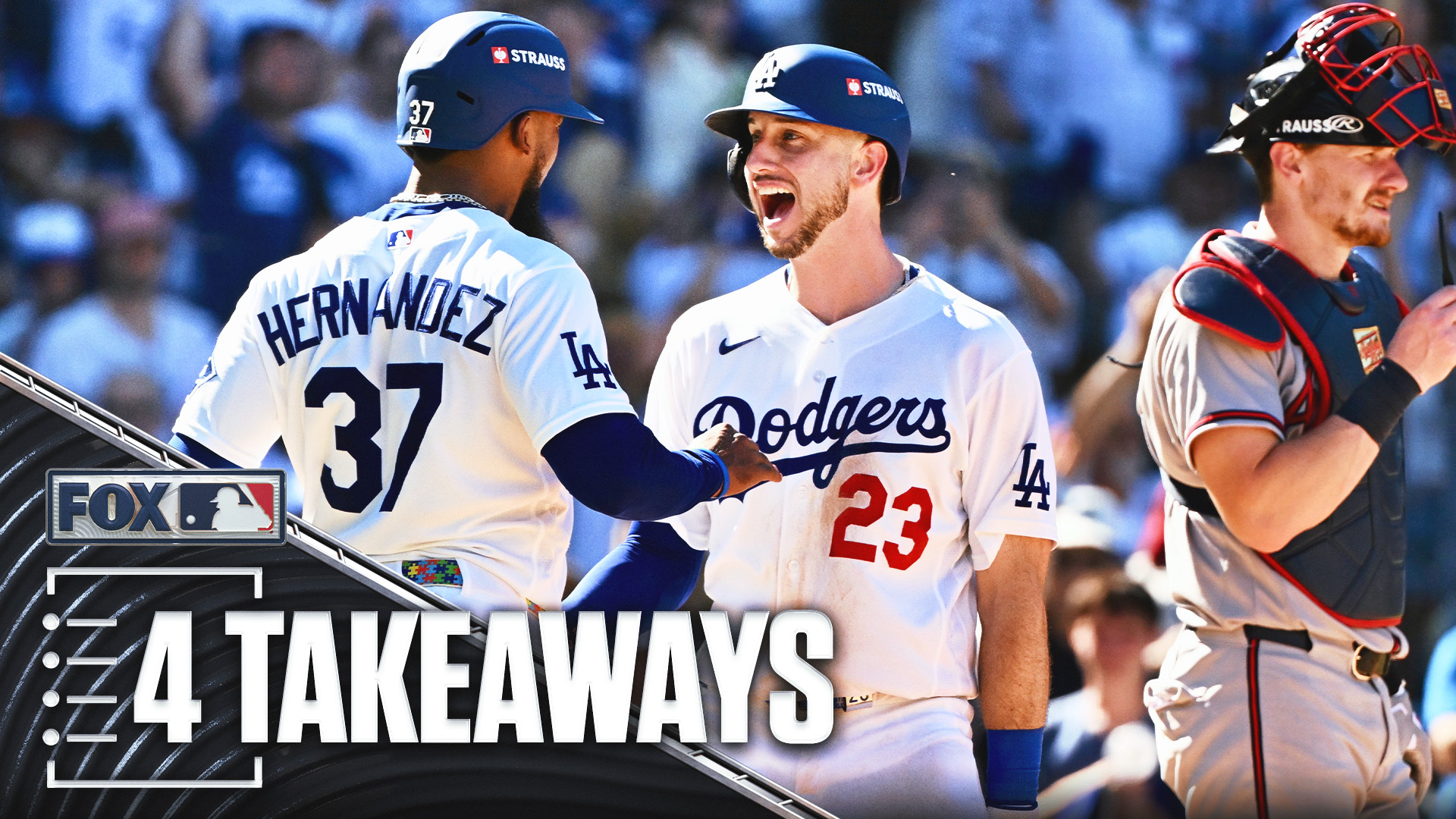
Dodgers Show Off Depth; Brewers Escape: 4 Takeaways From Division Series Game 1s
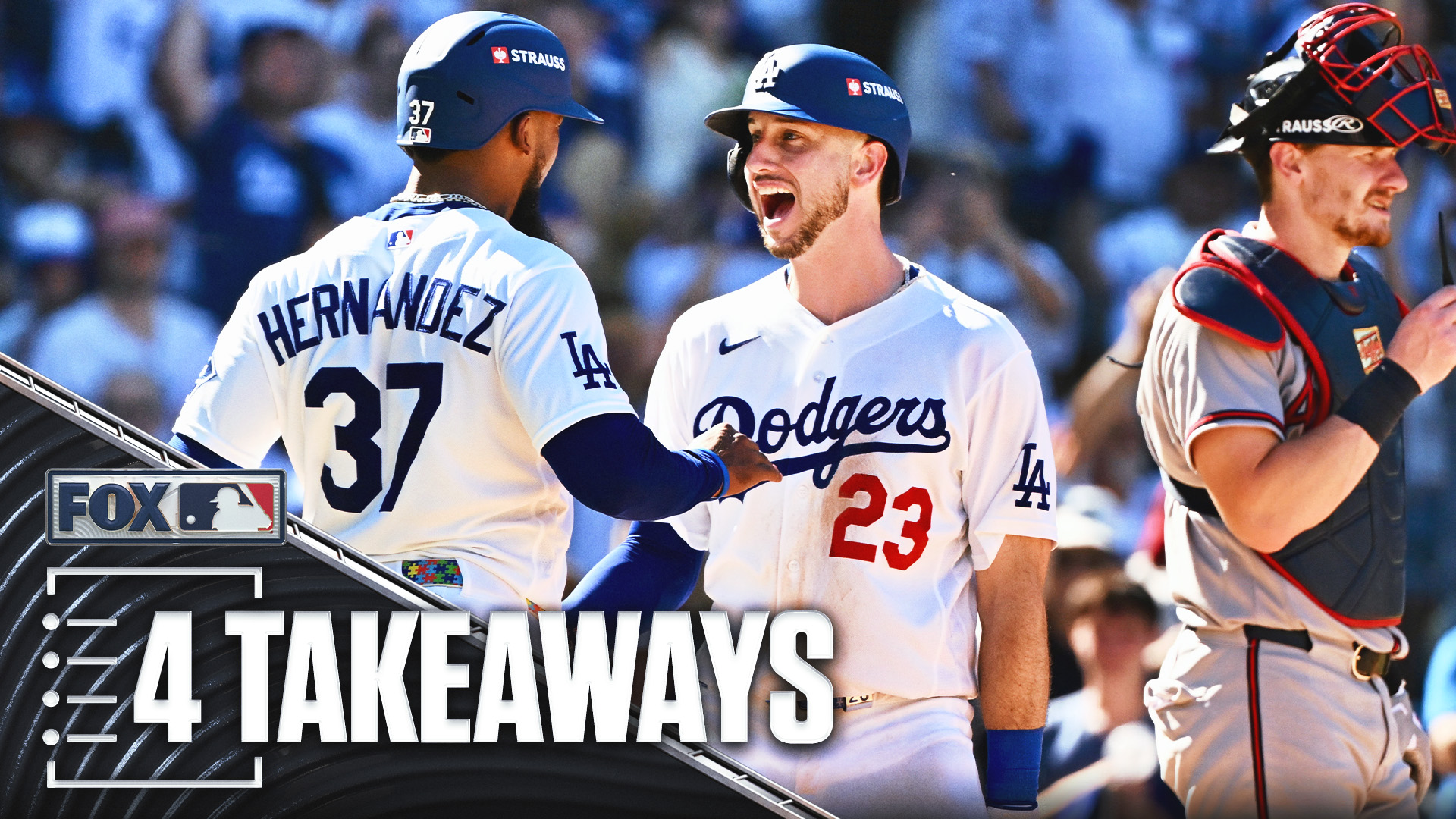
From big home runs to dominant pitching and confusing late-inning calls, the first four games of the Division Series had everything.
After the Chicago White Sox opened the day with a win, the three home teams – the Dodgers, Rays and Brewers – held serve with wins. Los Angeles and Tampa Bay got huge outings from their starting pitchers, while Milwaukee got some timely hitting and a little bit of luck.
Here are our takeaways:
Deesha Thosar: In the same inning, with two clutch swings, the two most valuable White Sox players showed just how quickly they can turn the table.
Guardians left-hander Parker Messick was dealing through three innings, racking up six strikeouts across his first 11 batters faced. Then, just when it looked like Messick was getting into a groove, the heart of Chicago’s order overmatched Cleveland’s talented rookie.
White Sox third baseman Miguel Vargas led off the fourth inning with a single that left his bat at 110 mph to left field, representing a nightmare scenario for Messick. Digging into the box was first baseman Munetaka Murakami, one of the league’s top sluggers this year, who instantly became a fan favorite in Chicago after he joined the club as a free agent through the Japanese posting system.
Murakami’s 45-day negotiating window this past winter gave all 30 teams a chance to speak with the power slugger. There was limited interest in a long-term deal for Murakami, so he signed a two-year, prove-it contract with the White Sox.
It didn’t take long to understand why every Murakami at-bat is must-see television, and why 29 teams should be kicking themselves for losing out on him.
In that electric fourth inning on Saturday, the 26-year-old rookie slugger didn’t even need to wait for a fastball to do serious damage. On the first pitch from Messick, a 93 mph sinker slightly up and in, Murakami connected at 112 mph off the bat and lifted it into the right-field seats for a thunderous two-run home run that gave the White Sox a 2-0 lead. It was the hardest-hit ball of the playoffs so far and traveled 440 feet, giving the White Sox an early lead they didn’t relinquish.
Munetaka was quiet in the wild-card series against the Astros, going 1-for-10 without finding his first postseason home run. When it finally arrived, he knew he got it. Murakami stayed in the box and watched all of it sail to right field before turning to his dugout, slamming his bat on the ground and pumping up his teammates.
Vargas, too, had been silent this postseason until Game 1 of the ALDS. After going 0-for-9 against the Astros, he went 1-for-1 with two walks and a run scored in the series opener against the Guardians.
Saturday’s performance was a full-circle moment of sorts for Vargas, who didn’t hide his disappointment when he was traded from the Dodgers to the White Sox during MLB’s trade deadline in 2024.
At the time, Vargas went from a Los Angeles super team that was on its way to winning the World Series to a historically awful 121-loss White Sox team. Vargas was a cast-off until he found his place on this year’s Cinderella Sox squad.
It all came together for Vargas and Murakami in Chicago’s gripping opening salvo on Saturday. Both players are critical to the White Sox’ goals for a deep postseason run, and both are enjoying terrific redemption arcs.
Miguel Vargas (left) and Munetaka Murakami combined to give the White Sox the lead on Saturday afternoon. (Jason Miller/Getty Images)
Rowan Kavner: In six career playoff starts entering Saturday afternoon at Dodger Stadium, Tarik Skubal had never received more than three runs of support from his offense.
He had also never played with a lineup like the one he has now.
Skubal starred in his Dodgers playoff debut, at one point retiring 15 straight Braves. Despite his success through five innings, he led just 2-0 when he left a sinker up to Braves catcher Sean Murphy, who deposited the pitch 421 feet over the fence to center field.
While it was a scorching hot day at Dodger Stadium — it was 100 degrees at first pitch and ascended to 103 degrees from there — it took a while for the Dodgers’ offense to warm up.
Eventually, though, it ignited in a 5-3 win – and it was their maligned corner outfielders leading the charge, continuing their late-season resurgence.
Teoscar Hernández had an OPS under .700 in late August and nearly started getting platooned in left field before he took off in September, producing an OPS over 1.000 in his final 25 games of the regular season.
Kyle Tucker, meanwhile, was mired in a year-long struggle in the first season of a four-year, $240 million deal. He was particularly ineffective at Dodger Stadium, where he was the fourth-worst qualified home hitter in the sport.
But he, too, started to look better in the season’s final weeks, also producing an OPS over 1.000 in his last 17 games.
And in their first game of October, both continued to rewrite the script of their season. After Braves opener Dylan Dodd carved through the Dodgers’ lineup for the first three innings, Hernández greeted Braves reliever Victor Mederos with a 431-foot blast to start the scoring.
Two innings later, Tucker and Max Muncy both went deep off AJ Smith-Shawver to break the game open — runs that would be crucial, after the Braves tagged Tanner Scott for two runs in the ninth on a home run from Ozzie Albies — demonstrating that even if Shohei Ohtani and Freddie Freeman aren’t right physically, there are myriad game-changers in the Dodgers’ lineup.
Kyle Tucker’s two-run home run drove in Teoscar Hernandez, two innings after Hernandez went yard to open the scoring. (Daniel Shirey/MLB Photos via Getty Images)
Thosar: Drew Rasmussen, or Yankee killer?
The final time Rasmussen took the mound in the regular season was against the Yankees, and he shoved. In front of a packed house in the Bronx last week, Rasmussen struck out 11 batters and limited New York to one run over 6 ⅔ innings on 114 pitches. It was a phenomenal way to wrap up his dominant year.
On Saturday night, under the bright lights of the MLB postseason, Rasmussen outdid himself. Call it the best start of his seven-year career.
Everything was working for Rays starter Drew Rasmussen on Saturday night. (Mike Stobe/Getty Images)
The 30-year-old right-hander was untouchable. The four-pitch mix coming out of his hand was ridiculous. The Yankees lineup was so stupefied by Rasmussen’s arsenal that he carried a no-hitter into the eighth inning. It wasn’t until Yankees catcher Austin Wells lined a two-out double down the first-base foul line that the Yankees had a man on base for the first time since the third inning.
Finally, the Yankees had their chance to rattle Rasmussen and bring Giancarlo Stanton off the bench to pinch-hit for third baseman Ryan McMahon. But Wells, a stocky backstop with catcher speed, decided to leg out a triple in a one-run playoff game. That was never going to end well. Wells was easily out at third, the Rays got out of their only jam of the game, and Rasmussen was completely fired up instead of flustered.
His final line was impeccable. Rasmussen struck out 10 batters, allowed two walks and one hit over eight shutdown innings and 101 pitches. Simply put, he could do whatever he wanted against these Yankees. They never stood a chance, and when they finally created one, they made yet another silly baserunning mistake, which has plagued them in October for the past several seasons.
Rasmussen’s dominance overshadowed what was actually a strong outing from Gerrit Cole in Game 1 of the ALDS. Cole pitched five one-run innings, allowed one walk and struck out five, with his only blemish being a solo shot to Jonathan Aranda in the third inning.
Cole’s start was in question leading up to the weekend, and nobody would’ve faulted Yankees manager Aaron Boone if he went with Carlos Rodón for the series opener instead. But Cole was solid, and the Yankees still have a fully rested Rodón to pitch a different game in the series.
Kavner: Throw out the script. Ditch the blueprint. Then raise the roof.
Or, if you’re a Brewers fan, maybe leave it right where it is.
In the playoffs, sometimes things go awry. On Saturday in Milwaukee, the Brewers countered with Plan B. Or maybe C or D.
Their Cy Young favorite lasted only four innings. They got into a battle with the best bullpen in the sport. They watched a deep ninth-inning drive nearly put the Padres ahead.
But they somehow prevailed in a wacky 3-2 victory, protecting home field in Game 1 of the NLDS with an assist from the roof at American Family Field.
Trailing by a run with one on and one out in the ninth, Padres first baseman Ty France pulled a fastball from Brewers closer Trevor Megill deep to left field. It looked like it might get out when suddenly the ball struck a roof cable and ricocheted back into the field of play.
Ty France reacts after his fly ball hit the American Family Field roof before being caught by left fielder Jackson Chourio. (John Fisher/Getty Images)
By rule, any ball that strikes the roof, roof truss or roof cable at the stadium in fair territory is in play. Left fielder Jackson Chourio was alertly camped underneath to catch it. One batter later, Jackson Merrill lined out to end the game.
“Four years in this stadium, never seen that before,” Megill said. “Just glad it worked in our favor.”
Even before the bizarre finish, this was certainly not how the Brewers drew up their win. They had the clear starting pitching advantage, with their ace Jacob Misiorowski facing veteran Robbie Ray, who had an ERA over 5.00 in nine starts after getting traded from the Giants to the Padres. The first pitch of the game from “The Miz” clocked in at 104.8 mph, making it the fastest postseason pitch on record.
Jacob Misiorowski wasn’t his usual dominant self on Saturday night, but he ended the night by emphatically celebrating a strikeout of Padres infielder Jake Cronenworth. (Patrick McDermott/Getty Images)
So, the Padres decided to wait the flamethrower out.
They routinely spoiled heaters, then attacked his secondary pitches. Manny Machado doubled on a slider in the first. In the second, Xander Bogaerts singled on a slider, while Ethan Salas and Luis Campusano singled on cutters. A fielder’s choice followed, and the Brewers suddenly trailed 2-0.
Milwaukee responded when a 22-year-old who is already now their all-time postseason home run leader went yard. Chourio obliterated a first-pitch slider from Ray, launching it 113.3 mph off the bat and 420 feet out to left-center for a two-run shot in the third. It was Chourio’s fifth home run in just 13 career playoff games.
Brewers’ Jackson Chourio hits two-run home run, tying game vs Padres
Misiorowski, who lasted just four innings but struck out six and only allowed the two runs, has credited catcher William Contreras for helping him navigate through his record-setting season on the mound. But in the seventh inning on Saturday, it was Contreras’ bat that made the difference.
Contreras worked the count full against Padres reliever Adrian Morejon, then went the other way on a full-count, 100.1 mph sinker for a go-ahead home run. It was the first homer Morejon had allowed since Aug. 18.
A skirmish against the Padres’ high-powered bullpen is usually not a recipe for success. Milwaukee’s relief corps danced around trouble to post five scoreless innings, complete with a hat-tip to the roof, or maybe a divine power, to end it.
Afterward, Brewers manager Pat Murphy could only think of the late, legendary Bob Uecker.
“The only thing that you could probably figure on the ball that everybody’s going to be talking about is that Ueck decided to put his hand on it and swat it down so Chourio could catch it,” Murphy said. “So, thanks, Ueck.”