
Dénia hospital’s pioneering spine surgery « Euro Weekly News
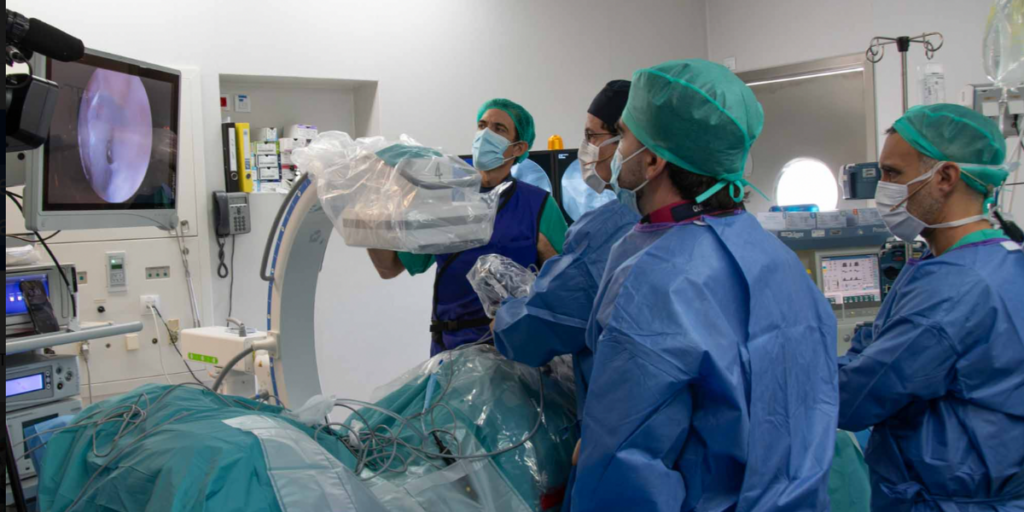
Operations were broadcast live to more than 100 national and international specialists
Credit: GVA
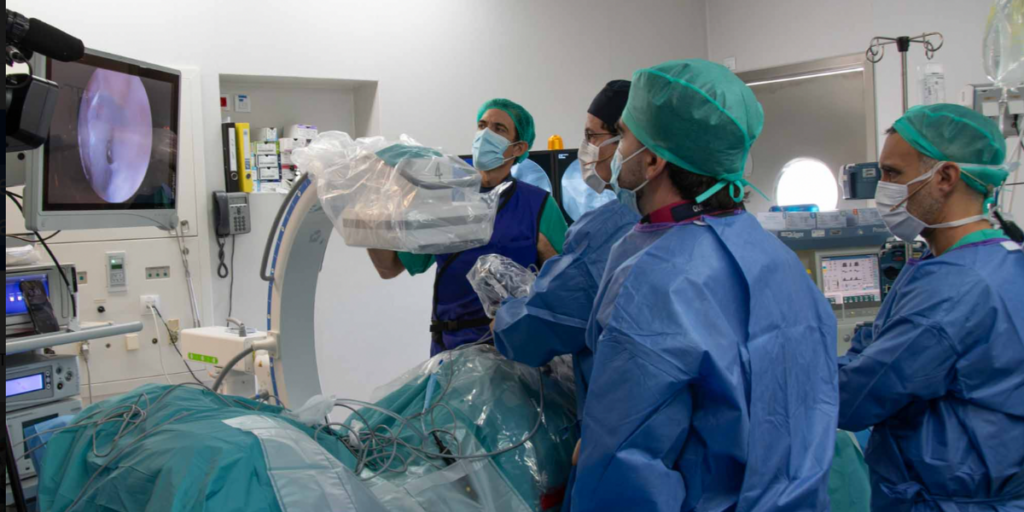
Dénia Hospital has put its specialist spinal surgery techniques in the spotlight after two minimally invasive operations were broadcast live to more than 100 national and international specialists during a major medical congress in Valencia.
Live surgery brings specialists closer to new techniques
The procedures were carried out at the Dénia Hospital as part of the pre-congress programme for the third edition of the Spanish Society of Percutaneous and Endoscopic Spine Surgery (SECPEC) congress.
Specialists attending the event in Valencia were able to watch the operations in real time, providing an opportunity to see how endoscopic techniques are being used to treat different spinal conditions.
The congress took place at the City of Arts and Sciences in Valencia, with Dénia Hospital trauma specialist José Lizón Aguilar chairing the organising committee.
He highlighted the value of being able to observe surgical procedures as they happen, particularly when demonstrating minimally invasive approaches to other specialists.
Two different spinal conditions treated
The first operation involved an endoscopic decompression for lumbar spinal stenosis, a condition in which narrowing of the spinal canal can put pressure on nerves.
Surgeons accessed the affected area through two small incisions before removing the tissue responsible for the nerve compression. The approach is designed to limit disruption to surrounding muscles and soft tissues.
The second procedure treated vertebral instability using an endoscopically assisted lumbar fusion.
During the operation, surgeons inserted an interbody cage and fixation systems to stabilise the affected vertebrae, while using an endoscope to help minimise damage to surrounding tissue.
Dénia introduced the technique in 2017
Dénia Hospital began using endoscopic spinal surgery in 2017, becoming the first hospital in the Valencian Community to introduce the technique.
Its Traumatology department initially developed the procedures, followed later by the Neurosurgery department. Both services have subsequently played an active role in the development and running of SECPEC.
Endoscopic spine surgery uses very small access points, with cannulas measuring approximately 8 millimetres to 1 centimetre in diameter.
The technique can now be used to treat around 80 per cent of the most common spinal conditions, including herniated discs, spinal stenosis and certain types of vertebral instability.
Potentially shorter hospital stays
One of the main advantages of the minimally invasive approach is that it causes less disruption to muscles and other soft tissues than more traditional surgical techniques.
According to information presented by the Generalitat, this can mean less post-operative pain, shorter hospital stays and a faster functional recovery.
In some cases, patients undergoing endoscopic spinal procedures can be discharged on the same day as their operation or the following day.
The live demonstrations formed part of a wider programme bringing together specialists from across the country and beyond.
Around 130 spine surgeons attended the third SECPEC congress in Valencia, while a further 50 healthcare professionals took part in the practical course held beforehand, where endoscopic techniques were taught using anatomical models.