
The language America left behind at 250 Opinion:
In the fall of 2015, in the limestone caves of Bama, China, I stood beneath stalactites that took ten thousand years to form. I was there as communications lead for a nonprofit delegation, in a county famous for its elders. I learned their secret: the air, the water, the food, the singing and the dancing. I held a 110-year-old woman in my arms, and I stood inside a civilization that measures itself in millennia.
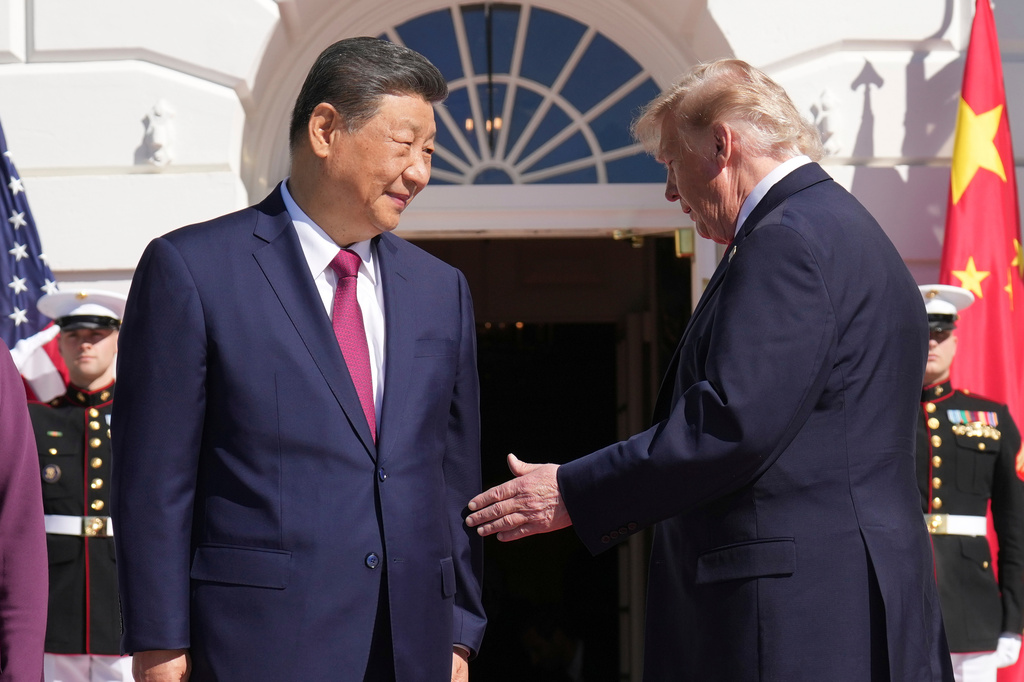
I thought of that cave this week, as China’s President Xi Jinping stood on the South Lawn of the White House, in the 250th year of our republic, and reminded Americans of their own history.
He did it gracefully. At the state dinner he walked us through two centuries: George Washington’s Chinese porcelain, Ping-Pong Diplomacy, the redwoods President Nixon gave that still grow in Zhejiang Province. That morning he spoke of two great countries and two great peoples, and of steering “the giant ship of China-U.S. relationship on a steady course toward the future.” He called for strengthening communication, expanding cooperation, and coexisting in peace. He even congratulated us on our nation’s birthday.
We all know a state visit is theater. Everyone in that room and everyone watching knew the game. But listen to the words themselves. Friendship. Cooperation. Coexistence. The people. Those were ours. That was the vocabulary of the free world, the language America carried abroad for three generations. This week it was spoken back to us, in our own house, by the leader of a one-party communist state.
The question I cannot put down is not what China is doing. It is what we stopped doing.
In March 1961, President John F. Kennedy created the Peace Corps, and Congress made it permanent that September. At its recent peak, around 2011, the Peace Corps fielded roughly 9,000 volunteers. In fiscal year 2025, it deployed 3,322.
In November 2009 President Barack Obama stood in China and pledged to send 100-thousand young Americans there to study. The initiative launched in 2010, grew into a bipartisan foundation, and by 2014 it met its goal. Then we let it go. Today that foundation has gone dark. We built the bridge, and we walked away from it.
Now the pledge runs the other way. In San Francisco in 2023, Xi Jinping offered to bring 50,000 young Americans to China, and this year Beijing announced the target had been met, ahead of schedule. On Thursday, at the White House, he doubled it to 100-thousand over five years.
But he met the number, not its meaning. Most of those young Americans came as visitors, on short exchanges and tours, not as students. The number who actually study in China has collapsed, from roughly 15,000 a decade ago to fewer than 2,000 today.
Some lawmakers call the invitation an influence operation. Perhaps. But influence only travels where there is room for it. In my work promoting public diplomacy, I sat in rooms with young people who were skeptical of America, some openly, and days later they were arguing about ideas instead of enemies. That is what an open hand builds.
I also know what happens to a room when you stop showing up. It does not stay empty. Someone else walks in.
This week, the Silk Road reached another inflection point in the U.S. Not the Belt and Road Initiative, Xi’s modern Silk Road of ports and railways, but its people: 100-thousand young Americans, invited through the front door of our capital.
I have seen this door swing the other way before. As a member of the executive board of the CT World Affairs Council, I was privileged to be in the presence of Henry Kissinger in the spring of 2010, the year he received the Council’s Luminary Award. He made the secret journey to Beijing in 1971 that opened China to the West. Now they are walking through it.
Underneath the shared vocabulary lie two very different ideas of where power lives. During that same trip to China, I traveled to Jinan, in Shandong Province, the home of Confucius, as communications lead for a delegation hosted by the city’s government. Connecticut knows Shandong well. The two have been sister states since 1986, a relationship older than many of the students it was meant to serve, run for decades through the Connecticut China Council.
Seated at a round table with our Chinese hosts, reading from my phone, I quoted the teacher back to them, from the Analects, Book IV, Chapter 25. “Virtue is never alone. It always has neighbors.” I meant it as an offering, that nations, like people, draw others near by how they live. That is the whole idea of soft power, to attract rather than compel. It is the idea America once carried into the world, and the one we have quietly set down.
In the Analects, Book XII, Chapter 19, Confucius held that the bond between those above and those below is like wind and grass: when the wind blows, the grass must bend. Harmony flows down, from authority above. Our founding wager was the opposite. Governments derive their just powers from the consent of the governed. Authority rises up, from the people.
For 3,000 years China has called itself Zhongguo. The Middle Kingdom. The state at the center, around which everything else arranges itself. However warm the language of friendship, that claim to the center has never changed.
America has never been shy about the center either. But ours was a claim of a different kind. Not a fixed place on the map, but a center of principle that had to be carried outward, and could only hold if others chose to join it. Set it down, and we vacate the one answer we ever had to the Middle Kingdom.
Nowhere is the reversal sharper than on artificial intelligence. Standing on our soil, Xi said the two countries must “ensure that the development of AI is always under human control and serves the well-being of the people.” The leader of a surveillance state spoke the language of restraint and the well-being of the people, while Washington speaks of AI as a race to be won. Which of us sounds like the free world?
Xi even named the danger. The Thucydides Trap can be overcome, he said, the ancient warning that a rising power and a ruling one drift toward war. But notice what naming it does. He cast the roles. China is Athens, rising. We are Sparta. He did not finish the story. Athens overreached, and its own hubris destroyed it. Ruling powers rarely lose in a single battle. They lose ground quietly, by leaving a vacuum.
This is not a piece about China. It is a piece about us. When did we, as Americans, stop speaking our own language? And if the road lies open, who among us left it that way?
The centenarians of Bama sing, they say, because it keeps them alive. Our republic has its own song: consent, liberty, justice, and dignity for every person, the courage to go out into the world and meet it. At 250, that song is being sung back to us in another voice.
In 1852, Frederick Douglass, born a slave, stood before the nation and told it that 76 years was a mere speck in the life of a nation. Nations, he said, number their years by the thousands. By that measure, at 250, we are still young. A civilization of millennia may simply endure. A young republic still gets to choose. Douglass, who had every reason to give up on this country, closed with, “I do not despair of this country.” Neither do I. But the words are ours only if we speak them.
Yvonne Renée Davis, of Avon, is a former appointee under President George W. Bush who is a consultant specializing in media, crisis communications, leadership and strategic counsel.