
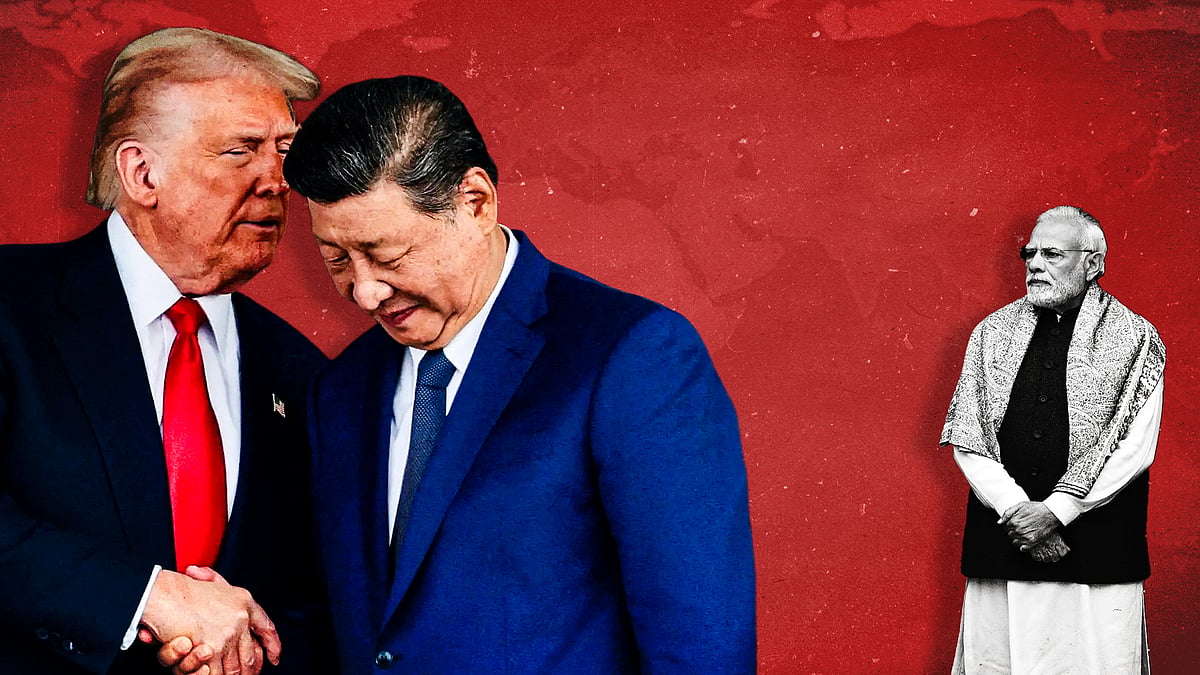
India’s strategic value cannot rest on US-China hostility
After a summit between the leaders of the world’s major powers, the temptation is to read too much into it too soon. At the same time, the turbulence of the international order and the vagaries of geopolitics in recent years have meant that many diplomatic takeaways from such meetings have short shelf lives. Agreements are revised, understandings unravel, and today’s apparent shift in the balance can look rather different after the next crisis, negotiation or election.
Therefore, any reading of the Trump-Xi in Washington must be made with a degree of caution. Even after factoring in these uncertainties, a question remains from a distinctly Indian standpoint. What does it mean for New Delhi when Washington and Beijing, the world’s two most powerful states, are trying to recalibrate their relationship and adjust the balance of their rivalry?
The question becomes particularly important for India because, on September 12 and 13, New Delhi was itself with Xi Jinping at the BRICS summit, working to protect its interests in a grouping in which China and Russia remain major players. The Trump–Xi meeting needs to be viewed not as an isolated encounter between two great powers, but in light of the choices India has been making at home, in its neighbourhood and across its wider diplomatic relationships.
The question would have looked different when Xi was in New Delhi. India was then trying to show that it could work with China and Russia within a larger multilateral framework without turning BRICS into an anti-American bloc. The objective was not to erase disagreements but to prevent disagreements from paralysing cooperation. The same instinct is visible in India’s handling of China bilaterally.
The relationship has not returned to the pre-Galwan comfort zone, nor can it be described as a settled partnership. But neither side seems interested in letting every disagreement become a confrontation. The border remains the central security problem while trade imbalance, market access and supply chains remain core economic concerns. Yet political engagement has resumed.
Strategic stability, Indian anxiety
In some ways, this can be better seen as competitive coexistence than either confrontation or smooth reconciliation.
With these elements in play, the Trump-Xi summit adds another layer to this calculation. India’s former foreign secretary Vijay Gokhale’s reading of the summit, in his Times of India , is particularly useful. He examined the extent and limits of reciprocity at the recent summit. Gokhale’s central point is that Trump approaches diplomacy through personal chemistry and political theatre, whereas Xi can participate fully in that theatre without abandoning China’s longer strategic objectives. The important phrase emerging from the meeting, in Gokhale’s reading, is “constructive relationship of strategic stability”. For China, this is not merely diplomatic vocabulary. It can become a framework for defining how American power should behave in relation to China.
That is also a part India would keep an eye on. The summit did not resolve the fundamental US-China disputes like Taiwan. Intense technological competition remains, as AI stands out as an emerging arena of both rivalry and possible cooperation. China continues to maintain leverage in rare earths and other critical minerals. And the trade truce between the two countries has been extended to January 10, 2027, offering both sides breathing space rather than a settlement. Yet breathing space itself has strategic value.
The two largest powers are discovering that they can compete fiercely while building mechanisms to prevent every disagreement from becoming a crisis. That is what makes the summit more consequential than its modest list of deliverables might suggest.
For India, however, there is a paradox. A stable relationship between Washington and Beijing is preferable to an uncontrolled confrontation. A military or economic crisis involving the world’s two largest powers would be disastrous for Asia and the global economy. But greater US-China accommodation could also reduce one of the structural incentives that has driven Washington’s strategic interest in India over the past decade: the need to strengthen partners in response to China’s rise.
India therefore cannot base its strategic calculations on the assumption that America and China will remain permanently locked in confrontation.
That is where the BRICS summit becomes important. India’s approach to BRICS this month offered a useful indication of how New Delhi is trying to navigate the changing environment. The expanded grouping contains countries with sharply different interests. India does not agree with China on the border. It does not share Russia’s geopolitical relationship with the West. The presence of Iran and the UAE brings its own contradictions. Yet India has tried to preserve the group’s functioning without demanding ideological uniformity from its members. That is a significant distinction.
Multilateral cooperation does not require strategic agreement. India can oppose China’s actions on the border and still engage China in BRICS. It can maintain a close relationship with Russia without making BRICS an anti-Western platform. It can deepen its relationship with the United States while participating in institutions in which Washington has no place. This is not indecision. It is an attempt to preserve multiple channels of influence at a time when the international system itself is becoming less predictable.
The Modi-Xi meeting on the sidelines of BRICS precisely illustrated this approach. The two leaders spoke of taking a strategic, long-term view of the relationship and ensuring differences did not become disputes. At the same time, India made clear that peace and tranquillity along the border remain essential to the development of bilateral ties. Economic engagement was discussed alongside structural trade imbalances and supply-chain concerns.
In other words, India is attempting to separate the different components of the China relationship. That may be the only practical way forward. China is too important for India to ignore and too consequential for India to trust blindly.
The same logic increasingly applies to the United States. This is where the deterioration in India-US relations becomes significant. Former diplomat Navtej Sarna’s argument in is deliberately stark. He sees the American pressure over Russian oil and the new sanctions legislation as evidence that India can no longer assume that the strategic logic of the relationship will automatically overcome political and economic disagreements in Washington. One need not accept all of Sarna’s language to recognise the underlying problem.
The India-US relationship has accumulated substantial strategic depth in defence, technology, intelligence, trade and the Indo-Pacific. But strategic depth does not eliminate conflicting interests. The Russian energy issue has exposed that fact with unusual force.
India’s problem is particularly acute because China occupies a different position in the American calculus. If China can secure temporary accommodation from Washington while India remains exposed to pressure over Russian energy, New Delhi has every reason to examine the terms of American bargaining more carefully.
That does not mean India should turn away from the United States.
It means India should stop treating the relationship as if its strategic importance makes it immune from bargaining.
The same principle applies to China. India’s economic relationship with China cannot be wished away. Nor can the border problem. Nor can China’s growing presence in India’s neighbourhood and the Indian Ocean region. New Delhi therefore needs enough engagement with Beijing to reduce unnecessary friction, while maintaining enough military and economic resilience to deter coercion.
Competitive coexistence, not equidistance
That is competitive coexistence. It is not friendship. It is not trust. It is not appeasement. It is an acknowledgement that two large neighbours can have deeply opposed interests in some areas and overlapping interests in others.
The Trump-Xi summit reinforces this logic. The significance for India lies not in whether the Chinese conception of strategic stability is ultimately accepted. It lies in the possibility that Washington and Beijing may increasingly learn to bargain directly over their differences.
India should therefore avoid becoming a variable in that bargain. That is perhaps the biggest lesson of the summit. A country’s strategic value cannot safely rest on the hostility between two other countries. Excessive dependence on the US-China equation would leave India reacting to circumstances it does not control.
The answer is not equidistance. India cannot be equidistant from China and the United States because its interests and problems with the two countries are fundamentally different. China is India’s immediate neighbour and principal military challenge. The United States is a major source of capital, technology, markets and defence cooperation, but it is also an independent great power with its own interests.
The answer is capacity. The greater India’s economic weight, energy diversification, technological capability, military preparedness and diplomatic reach, the greater its freedom to make choices without being forced into them. This is why the apparent modesty of the Trump-Xi summit may be deceptive. The absence of a grand settlement is itself part of the story.
And the process of managing the rivalry is likely to continue through further leader-level meetings, trade negotiations and institutional mechanisms. The language of “strategic stability” may acquire substance, or it may prove to be another temporary formulation in an extraordinarily volatile period. The trade truce may hold or break down. The US-China relationship could improve, deteriorate or oscillate between the two. That uncertainty matters, and India therefore needs something less fashionable than strategic cleverness; it needs a lot of diplomatic patience.
The Modi-Xi engagement in Delhi should be judged not by the warmth of the photographs but by what happens on the border, in trade and in market access. The Trump-Xi summit should be judged not by the red carpet but by whether the trade truce survives, whether the two countries establish durable guardrails and whether their accommodation extends into areas that directly affect India’s interests.
The international system is in a state of flux, but that should not be an excuse for exaggerating every diplomatic movement. There are too many moving pieces, and their direction is not always clear. For India, the sensible response is neither alarm nor complacency.
That is what makes the recent BRICS summit and the Trump-Xi meeting part of the same larger story. In Delhi, India tested whether cooperation was possible amid profound differences. In Washington, Trump and Xi tested whether rivalry could be managed without resolving those differences. India now has to do both things at once: compete with China without making coexistence impossible, and partner with America without making independence impossible.
That is a narrower, harder and more realistic definition of strategic autonomy. And, in the unsettled international order taking shape around it, it may also be one of New Delhi’s most valuable strategic assets.
A quarter-century of Modi governance calls for questions and a hamper. To mark the occasion, we have offers and .