
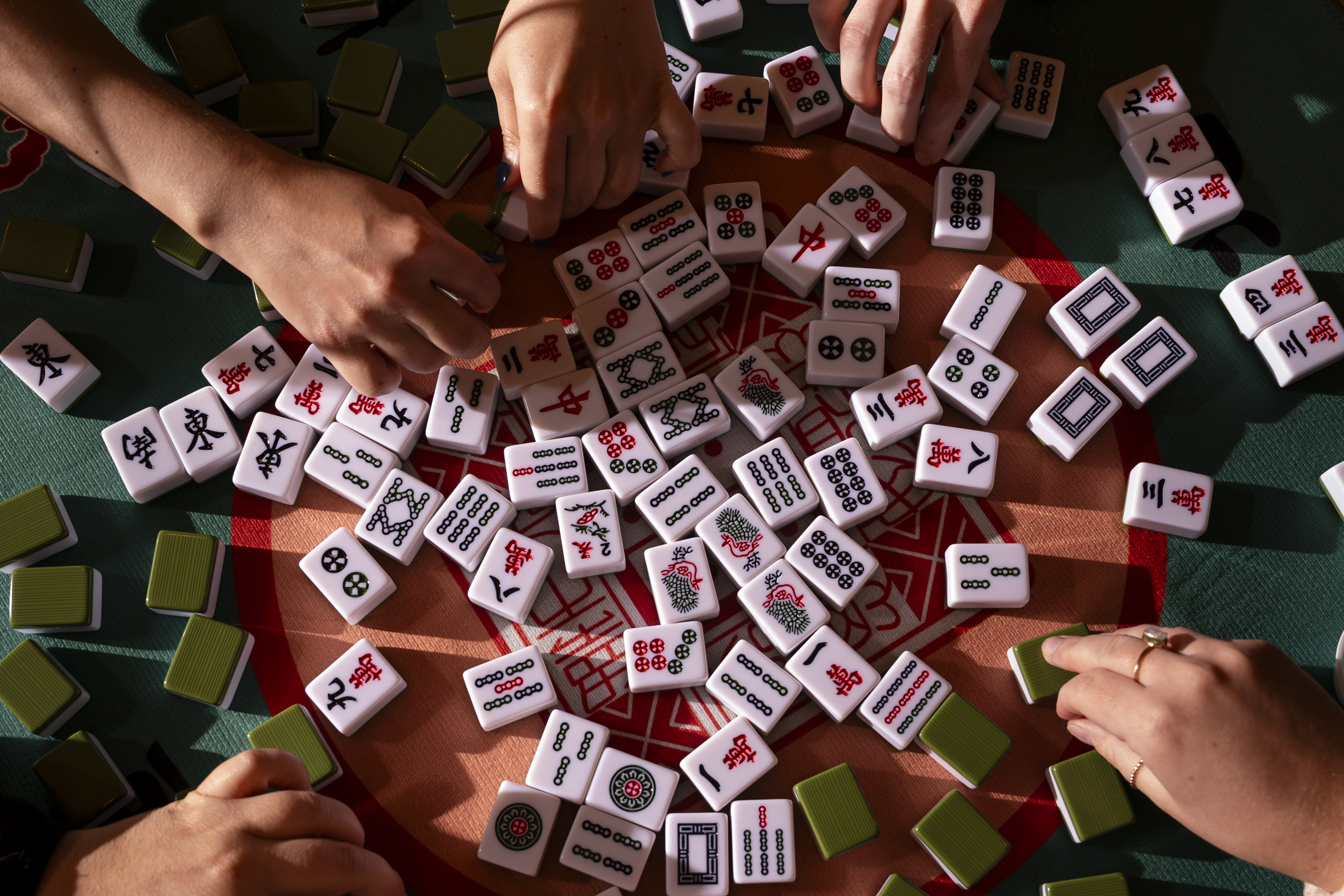
Mahjong, a 150-year-old Chinese tile game that never really left, is back
The clatter of tiles, clinking of glasses and chatter of women fill the room. The place is Wash Park Social, a hip bar in Denver’s Washington Park neighborhood, and the occasion is mahjong.
Kelly Warren, the enthusiastic cofounder of The Mahj Squad, is bouncing between tables answering questions about the cacophonous tile game and handing out goodie bags of mahjong-themed merchandise.
One woman pulls a small trinket tray wrapped in tissue paper from her bag. It’s bright and striped and reads: MAHJONG WITH MAHGIRLS.
Recently, the Chinese tile game has been making a comeback in libraries, bars and living rooms all over the state. The four-person game is part of the broader trend of moving social spaces offline, driven initially by the isolation of COVID, and more recently by the disorientation of social media. (Even tech folks are reinvesting what’s dubbed “the experience economy.”)
“We were looking for something different to do with friends, you know, sitting around having drinks, talking,” Warren said. “Something better than being on social media. Connecting and playing a game, doing something, using your brain.”
The game was first imported to the U.S. in the 1920s, marketed as an “exotic” and “ancient” Chinese game, even invoking Confucius to further the association. Never mind that the game was created in the mid-1800s.
The women in Washington Park are playing American mahjong, a variation of the game popularized by Jewish American women in the late 1930s. They’re shuffling pastel and jewel-toned tiles supplied by The Mahjong Line, founded in 2020 by two women from Texas. Except for the occasional exclamation of “pong” (three of a kind) or “kong” (four of a kind), you’d be forgiven for not noticing the “Confucian” roots of the midsummer gathering.
As they sip cocktails the color of sunsets, their staccato storytelling is broken while each woman takes her turn at the table. They pause, sometimes midsentence, and deliberate what to do with the tile they’ve just drawn, discard it for the next person to pick up, or swap it out to build their hand.
To win mahjong you have to be the first person to complete a hand. Just like in poker, a winning hand looks different depending on which version of mahjong you’re playing. To assemble the hands, players take turns drawing and discarding one tile at a time.
There are — again, depending on which version you’re playing — around 144 tiles total, grouped by symbols and numbers. If you think of it like a deck of cards, instead of hearts, diamonds, clubs and spades there are three suits — circles, bamboo and characters — numbered one through nine. And instead of royal cards there are the winds, flowers, seasons and dragons.
There are innumerable ways to play mahjong, between the roughly 40 documented regional styles and an uncountable number of “house rules” developed over generations and echoed in living rooms and basements around the world.
Hong Kong-style mahjong plays with flower tiles, Japanese-style leaves them out. American-style uses jokers. And there are about five ways to pronounce each suit, depending on who teaches you the game.
“The tiles that everyone calls the dragons, they have nothing to do with dragons,” said Tiffany Leong, founder of Honour Tile Society, which hosts gatherings of Hong Kong-style mahjong games. “Like, nothing to do with dragons. Zero dragons.”
Throughout its 100-year history in the U.S., the game’s ties to China have been alternately exaggerated beyond any semblance of truth and, at the other end of the spectrum, wiped clean of any cultural signifiers, generating a fresh set of controversies over cultural appropriation.
When assimilation was the important thing for Asian immigrant communities, mahjong was marketed as a thoroughly American game that happened to have ties to China. When authenticity became the new aspiration, mahjong became a Chinese game that happens to be popular in America.
The truth is it’s both, or, maybe, neither. As Amy He, a University of Denver professor put it, “it’s a game, for goodness’ sakes. Relax.”
The supposedly ancient import
There is one name that historians associate most closely with the game, and it’s not Confucius. It’s Joseph Park Babcock. Babcock was a Standard Oil representative from Indiana, stationed near Shanghai in the early 1900s. He read Chinese and spoke enough Mandarin to impress locals and learned the game at their tables.
Sensing a business opportunity, Babcock developed a set of rules in English and Anglicized the numbered tiles, distributing his first sets to wealthy Californians in 1920. By 1922 he and a few friends set up the Mah-Jongg Sales Company of America in San Francisco and began an aggressive marketing campaign that homed in on the rich and famous, distributing high-end sets to Hollywood stars who posed for photographs playing the game.
The game was also helped along by the well-networked women who carved out a niche as instructors, leading mahjong games “in cafés, at galas, or in private homes,” historian Annelise Heinz wrote in her comprehensive history of the game, “Mahjong: A Chinese Game and the Making of Modern American Culture.”
“On a societal level, elite and middle-class women were crucial in spreading the game as hostesses at home and social planners of large public events,” she wrote.
LEFT: Mahjong tables await players during an open play event cohosted by Honour Tile Society and restaurant popup Magnolion at BearLeek in Denver on July 19. RIGHT: Chef Tiffany Leung focuses on cooking dinner service for attendees of a mahjong event cohosted by her mahjong social club Honour Tile Society and her restaurant popup Magnolion at The Peach Crease Club in Denver on Aug. 24. (Andy Colwell, Special to The Colorado Sun)
The game took. Demand raged so wildly that the export of “sundries” — the category that includes mahjong — to the U.S. from China in 1922 was 33 times that of the previous year. By 1923 the American mahjong market eclipsed all others, and in 1924 Congress passed a 10% tax specifically on mahjong sets.
At the same time that Babcock was photographing politicians and stars with his mahjong sets, the Johnson-Reed Act, passed in 1924, banned immigration from all Asian countries. The Act was an expansion of a 1917 law that prohibited immigration from an “Asiatic Barred Zone.” That zone didn’t include China — since Chinese immigrants had long been barred from the U.S. via the the Chinese Exclusion Act, passed in 1882, and its subsequent extensions.
The same game that was being sold in department stores at elaborate Chinese-styled displays was also being played in the rec rooms (often a converted bathroom) at the Angel Island Immigration Station in San Francisco, where people from Asian countries spent long days in barracks, biding time around the tile sets.
As the game quietly made its way into Asian households, families developed their own sets of rules, etiquette and superstitions. Those developments are less well-documented because they happened mostly among family members and close friends, far from the spotlight of New York Times feature writers.
In 2025, Nicole Wong, a California-based writer, published a compilation of styles and rules in “Mahjong: House Rules From Across the Asian Diaspora,” a task the author described as “more like writing down elusive family recipes than a simple instructional guide.”
A seat at the table
Leong, who was born in Vietnam with Chinese parents, grew up around the game. Her grandmother would play “like every other day with her friends,” Leong said. When her grandmother moved to Colorado recently, Leong decided to relearn the game, “to connect with my grandmother and, like, do more stuff with her besides watch TV.”
She got together with a few friends for takeout and “How To” YouTube videos, and by the end of the day was reacquainted with the tile game of her youth. The next time they met up, the group had tripled in size, to about 24 people. Then 30 people. “I was like, oh, this is something the community is really craving,” Leong said.
So she started an Instagram account and called it Honour Tile Society.
On a quiet August weeknight, Leong stood at the front of a Denver bar and flipped through a PowerPoint presentation about the rules of mahjong.
After building four “walls” of tiles, players roll a dice to decide where to start pulling their hands from.
“OK, so let’s pretend everyone has rolled a seven,” Leong said, moving the lesson along.
Three dozen women clamored at the tables and shifted their tiles around, overpowering her microphone-amplified voice.
“Everyone has rolled a seven,” she tried again. “YOU’VE ROLLED A SEVEN,” she said, drawing the mic against her lips, her voice finally catching attention.
“What do we do?” someone asked from the cluster of tables.
“We’ll pretend like you rolled a seven,” Leong answered calmly. “So then, starting with the dealer in the east, you count seven walls moving counterclockwise,” she continued.
Maria Zalessky, first photo, and other mahjong players enjoy a beginner’s night at Blend.Co last month in Denver. The centuries-old game is experiencing a surge in popularity. (Cheney Orr, The Colorado Sun via Report for America)
Move by move, the women stuttered through the game for their first time. By the end of the three-hour lesson, they were ready to join the ranks of the other Hong Kong-style mahjong players in Colorado, a small but vital subset of the broader resurgence.
“I don’t think any Chinese mahjong players have issues with people who want to play American style,” Leong said. “I think the issues lie in the capitalization and the monetization of a game that is meant for people to enjoy and socialize over.”
Leong’s Honour Tile Society meetups are free to attend. She and her partner — both professional chefs — cook under the name Magnolion, blending Chinese and American Southern cuisines during pop-up events. They use the food sales to offset the costs of hosting the free meetups, which move around to different bars and restaurants in Denver.
“Maybe this is unpopular to say, but Asian folks know how to host over food, which is No. 1,” He, the professor at DU, said. “I’m not talking about chips and beer, right? It’s like, tables and tables of food.” He hosts her own living room mahjong group with a neighbor, Ken Chu, whom she met at an Honour Tile Society gathering about a year ago. They call themselves the Midnight Mahjong group.
That group has grown to filling almost six tables — about 24 people — for their monthly gathering. It has become a safe space for her to be in the company of other people from the Asian diaspora — an “emotional third space,” she said, citing an article that she’d read recently about places where people can let their cultural guard down.
Women of the game
In 1937, as the first wave of mahjong craze was receding, a crowd of nearly 400 women gathered in the Essex House hotel on the edge of Central Park in New York to talk mahjong.
The group, mostly Jewish American women, was convened by Viola Cecil, president of the newly formed National Mah Jongg League. They were there to standardize the rules of their game — their mahjong — which over the two decades since the game’s arrival in the U.S. had peeled away from its original form.
Among the League’s leaders was Dorothy Meyerson, the “indefatiguable” eldest daughter of a German American Jewish mother and Russian immigrant father, Heinz, the historian, wrote.
Meyerson was an energetic and natural performer. She made TV appearances as early as the 1940s teaching mahjong with enlarged tiles, and showed up at Macy’s, Stearn Company and Bamberger’s, department stores that carried her rule books and hosted instructional clinics.
She was doing the same thing that many groups and brands use Instagram for now: She was marketing mahjong. And she was doing it well. Unlike her predecessors, Meyerson’s power was not derived from the image of international business prowess, but from her well-established and widely publicized role as a mother, housewife and PTA president.
“Indeed, she argued that having interests outside the home made women better able to ‘face their family problems with steady nerves and a clear head,’” Heinz wrote. “Meyerson skillfully negotiated the image and duties of a housewife while operating as an entrepreneur.”
Among the League’s innovations at that time was the introduction of the rule card, a changing set of winning hands published at the start of every year, which members could purchase for a dime.
The card was one way for the League to simplify and standardize their version of the game, but the fact that it changed every year meant that it drove an even deeper wedge between the League players and their non-League counterparts.
Chinese auntie era
Fast forward about 90 years, and the Dallas women marketing The Mahjong Line unveiled their own version of an annual card, what the Texas company calls “The Big Card.” The Big Card is printed on waterproof paper in a pleasing color combo of lavender and tangerine. The card costs $10 (first card is free!), and buyers have the option to add a personalized leather case for 60 extra bucks.
While there are still thousands of National League purists purchasing their annual card, The Mahjong Line and their Big Card have drawn in a brand new crowd with splashy colors and social media savvy. Like Meyerson and her cohort of Jewish American players, the new American mahjong is marketed mostly to women — especially mothers, housewives and PTA presidents.
The Mahj Squad is one of The Mahjong Line’s brand ambassadors, tables at their gatherings flaunt tile sets from the company’s nearly 40 themed options, with names like “The Cheeky Line: Santa Monica” and “The Minimal Line: Palm Springs.”
To become brand ambassadors, the Mahj Squad founders filled out an application to make sure they match “their aesthetic, style and brand,” said Warren, the Mahj Squad co-founder. “They put us on their website, and they don’t want 100,000 people in Denver,” she said. “They reviewed our website, and our social media, just to make sure we’re legit.”
When the Mahjong Line debuted their “refreshed” sets back in 2020 they received widespread ire from Asian and Asian American players. They’d replaced traditional Chinese characters with cartoonish puns like lightning (instead of the “crack” or character tiles) and bags of flour (instead of flower tiles), and rolled out the new line with marketing copy flush with culturally insensitive language.
In March, another Dallas-based American mahjong brand, Oh My Mahjong, received the brunt of online criticism when it was featured in a New York Times article about decorating with board games.
“We live in a capitalist society. If there’s a chance to make money, people will do it,” said He, the DU professor who grew up with mahjong in her house.
So, is she surprised by the game’s rebrand? No. Does she agree with it? Also no. Does she want to say anything more about it? Not really.
“I’m in my Chinese auntie era,” He said. “I’m teaching a lot of young folks from all backgrounds, white folks, Latinas, all these different people in my group who want to play the original, traditional game. I’d rather focus on preserving that.”
For He, there is an elegance to the original Chinese game that can’t be translated into the American version. Each tile is symbolic, even the rules and rhythms of play are rooted in Chinese values and systems.
Each of the four seats around a table corresponds to a directional wind, for instance.
This story first appeared in Colorado Sunday, a premium magazine newsletter for members. Experience the best in Colorado news at a slower pace, with thoughtful articles, unique adventures and a reading list that’s perfect for Sunday morning.
Play starts in the east and moves counterclockwise to the south, west, then north. The compass doesn’t map neatly onto the American way of learning the directions, but corresponds to older navigation techniques that rely on signals in the sky. (It’s also the way most Chinese students learn to name the directions — east, south, west, north. In the U.S., we learn the order north, south, east, west.)
“It’s like ‘Stranger Things’ upside-down world,” He said about the directions. “Just a totally different perspective of the same thing.”
The three so-called “dragon” tiles are actually honor tiles, Leong said, and all three have different names. The logo for Honour Tile Society combines the tile for west wind and “fat choy” in Cantonese, which symbolizes “prosperity, wealth and Confucian principles of sincerity and growth,” she said. Much more than a “green dragon” can convey.
And that’s one of the addictive properties of mahjong — the more you learn about it, the more there is to learn. About its history, its symbolism and its styles of play.
The game has splintered and evolved over the past 100 years, simultaneously splitting people apart into different styles of play, and bringing them together for food, drink and friendly competition. As much as it has changed, the game is still, after all these years, four people with their backs to the room, negotiating a table of tiles from the east, south, west and north.
“At the end of the day, everyone does just want to have fun,” Leong said. “But the thing that gets lost is acknowledgment.”