From “No Do-Overs in Paradise,” a fall venture conjures mortality
September Solo
Oh, it’s a long, long while from May to December
But the days grow short when you reach September
When the autumn weather turns the leaves to flame,
One hasn’t got time for the waiting game.
Lyrics: Maxwell Anderson
The road trip got off to a promising start but, after a half day’s drive, as I approached my first destination, I felt dogged by ambivalence. Upstream in the dull gray light, I could make out a rustic cabin. There was a painted Adirondack chair under a covered porch and it was a distraction as, stripping line from the reel, I made several false casts, and then presented my fly tight to the edge of a mossy bank, shadowed by firs.
The cabin was a very long stone’s throw from the boundary of public and private land. I was speculating about its occupancy when, at the edge of my vision, I detected a rise and instinctively set the hook. The fish shot upstream in a pool, more like a deep trough, with a pulsating strength. Well hooked in the roof of his mouth, the fight was brief. Watching the richly spotted brown fin away after I released him, I could feel a coiled tension draining from my core.
UNDERWRITTEN BY
Each week, The Colorado Sun and Colorado Humanities & Center For The Book feature an excerpt from a Colorado book and an interview with the author. Explore the SunLit archives at coloradosun.com/sunlit.
Fall has a way of getting away from you. And by fall, I’m referring to September, that shoulder month, between the last golden warmth of summer and the incoming fronts, frosty mornings, and loss of light. At the third week’s end, we find ourselves at the equinox where the clock of day and night equalize. Being a romantic by nature, I find Sinatra’s interpretation irresistible (in “September Song”), “Oh, the days dwindle down to a precious few…”
In this part of the world, the aspens glow with an internal fire; the rivers reveal their bleached cobbled bones, and the trout become selective. The large adult insect cycles of mid-summer have passed. If you like to fish “fine and far” you can throw size 20s, though I’ve never been entirely comfortable with minutia. Your #12 Elk Hair Caddis won’t get it done, and it’s still too early for streamers. There is something to be said for a twenty incher on a size twenty.
It’s good to get away and to be reminded that, ever the iconoclast, I want to distance myself from what most people care about — the relentless materialism of survival, our attachments, and occasionally, the meaning of things, or if not things, ideas. Yet, increasingly, with my children grown and gone, I find myself stymied, dwelling in the past instead of redirecting my attention into the moment, the space that mirrors eternity. For many years, once the snow flies, I’ve had the feeling I’ve squandered the fall.
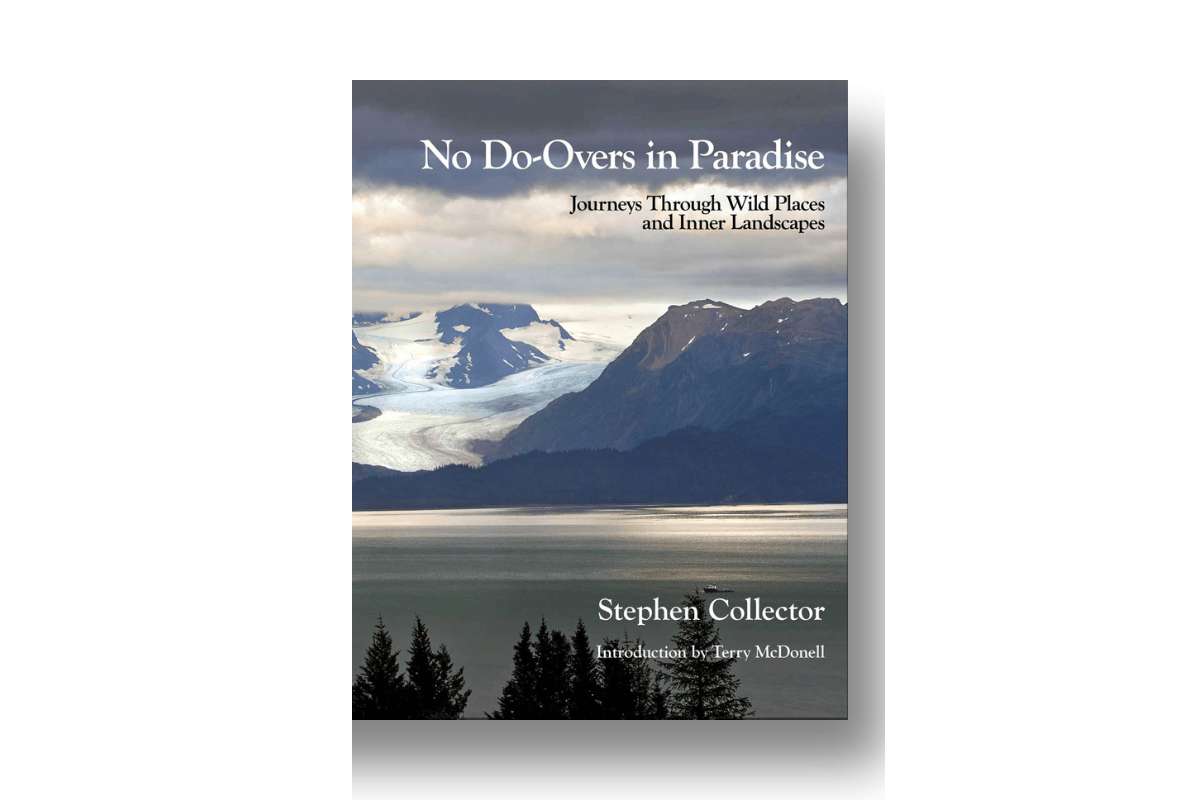
“No Do-Overs in Paradise: Journeys Through Wild Places and Inner Landscapes”
>> READ AN INTERVIEW WITH THE AUTHOR
Where to find it:
SunLit present new excerpts from some of the best Colorado authors that not only spin engaging narratives but also illuminate who we are as a community. Read more.
As darkness settled in, the sound of thunder rolled off the canyons. Windless, the rain drummed the camper’s roof. The two battery-powered lights cast a dim yellow pall in the crowded space of my vintage camp trailer. A mountain trout stream, Cebolla Creek, gurgled nearby, mingling with the sound of the oscillating rain. Bone weary, after a long drive over the Continental Divide, I switched off the light and zipped into my bag.
As my body warmed, my mind replayed a banner afternoon enticing not so cunning browns to sip small dry flies. Things were panning out on the first of my five-day game plan to fish two streams I’ve long neglected. The last thing I heard was the hoot of an owl as I fell into a fitful sleep.
On the morrow, I was to meet a fishing guide based in Gunnison to guide me on Cebolla, a generous offer to fish as a compatriot on one of his days off. Cebolla Creek is a little known tributary to the Gunnison River, which pre-construction of the vast Blue Mesa Reservoir, was considered the second-best trout stream in America. The Gunnison’s many tributaries are not without considerable charm. One pool in particular, where two boulders created a chute into a long deep pool, had the typically enigmatic browns rising with a rarely witnessed abandon.
My camp was at a state wildlife area, tucked into a grove of fir and cottonwoods. The nearby stream wound its way through a wetland meadow. A little before ten, our rendezvous time, I was back at the camper, hoping to make a new friend. The drainage bifurcates two vast reserves — the Powderhorn Primitive Area on the north and the La Garita Wilderness to the south. Upstream, the narrow hanging valley pinched in, which somehow added to a sense of isolation. It wasn’t just a sense of freedom or wilderness I felt in this massive, remote landscape, a small section of a vast national forest, but in the back of my mind crept a void-like loneliness, an alienation within myself.
I’ve hunted for decades. Many of my hunts have been solo ventures. But for reasons unknown, I felt an inner resistance to my departure. These feelings of indecisiveness were disappointing. My mind wants to run an Excel spreadsheet; to lobby, to negotiate, to do the math, and ultimately, it’s all intellectual gobshite. I don’t need no stinking spreadsheet! Besides, I convinced myself, at least for one day, I’d have the guide to share this experience. Except, after waiting over an hour at my camp, the guide never showed.
On the tailgate of my truck, I pulled on my hip boots, grabbed my 4-weight and hiked up the stream. At the creek’s edge, the rocks were irregular, and I had to wade with caution. I saw no rising fish, nor did I get a strike, but the flow of the water around my legs acted as a salve to my disappointment. In search of more productive water, I jumped into the truck. Driving up the valley, my thoughts turned to my youngest son, a chef with whom I very much wanted to share this experience, unavailable, the same with my wife and friends, which left me a choice; go solo or not at all.
Above the settlement of Cathedral the canyon tightened as you entered a mile of public water hard by the gravel. I had wonderful fishing here, all browns, larger than average. The road broke out into a vast meadow. At the base of Slumgullion Pass, I found a place to pull out and fished a deep run, catching a fish on the first cast, and then lost my entire rig to a snag high up a pine tree. My mind drifted back to that rustic cabin.
That evening, I heated a pot of water; then lit the second burner, and in a cast-iron skillet browned garlic and venison Italian sausage. After cooking it, I poured in a jar of good marinara to simmer. While the spaghetti boiled, the camper warmed and filled with the aroma. I added plenty of crushed chili flakes, sprinkled Parmesan, and ate with relish. After dinner, as the rain became intermittent, my spirits plunged, as my mind struggled with the guides’ inexplicable no-show. Instinctively, I knew this wasn’t the sole reason. As the cold seeped into my canvas-sided camper, sadness enveloped and as my mood darkened, I considered breaking camp and heading home on the morrow.
I was relieved to be awakened by a woodpecker’s cry. After igniting the burner for the coffee, I turned on the heater and quickly made breakfast. Throwing my clothes into a duffle, I broke down the camper, the basic chores a distraction from last evening’s hour of the wolf. After the rain, I drove slowly on the slick, muddy road. In the raking early light, a new day beckoning, my spirit lifted. The Lake Fork was the next valley over.
A one-lane, two-track dirt road serviced the lower canyon, formerly hacked out of basaltic stone, a testament to man’s eternal lust for gold. The D&RG built a narrow-gauge railroad 36 miles to Lake City in 1889. My logic was to sample the water not far upstream from the confluence with Blue Mesa Reservoir. The kokanee salmon were running, and I hoped some larger trout had worked upriver. Using the foot trail, I passed a group of elderly anglers in lawn chairs, country people from Kansas, their baited poles propped on forked sticks, catching nothing. Just beyond them, I encountered a debris field of bleached logs. I’d hit the upper arm of the reservoir. I backtracked to a wide riffle that braided into two deep pools and began to nymph the run.
I hooked and lost two successively larger fish. An emerald colored pool circulating against an enormous boulder just below the trailhead parking lot garnered my attention and within minutes, I sensed, more than I saw, my indicator pause. I set, and in the shadowed depression, I saw a long gleam of silver flash. It was a rainbow, a hen fish over twenty inches. Upon the prick of the barb, the fish angrily tore off downstream. Using side pressure, I stopped the run and awkwardly stumbled downstream. As I fought the fish, my thoughts wheeled to a comment my older son, James, made about my 5-day solo as being equivalent to a vision quest. I wasn’t knowingly attempting to achieve a vision of a future guardian spirit, nor was I fasting or practicing self-torture.
She made two more muscular runs, streaking further beyond my reach, before the line went slack. I’d lost a trophy. But had I? Instead of my typical despair, with the surge of adrenaline came a soaring euphoria. Unguided, on a stream I’d never seen, in an hour, I’d had an unforgettable experience (it’s the lost big ones that lodge in memory).
It rained again that night, harder than ever. Whiskey from a tin cup warmed the back of my throat. Powering up my laptop, I crawled into my bag and typed a few details about my memorable last day on the Lake Fork. With the loss of the trophy, I had returned to the lower canyon stretch. This time I was landing them, including an impressive male kokanee who ate a small Prince nymph. At one point, my nymph snagged upon a heavy stick at the base of a boulder. I waded deeply; wedging my wading boot into some rocks, water lapping into my waders, unable to budge for several minutes.
That image of the cabin returned later that night. It was as if the black dog from the previous evening in my camper leaped off the cabin’s porch, headed for my throat. Shaken by the image, I splashed another whiskey, its warm sharp bite a momentary consolation. It wasn’t just the guide not showing, or that I had lost such a big fish. I had ventured out in search of sanctuary and what I encountered were various expressions of loss.
With this realization, I felt something heavy fall away. As I listened to the burble of the river, my mood lightened. The rain ceased, replaced by a drying wind. No black dog was staring back in the dimly lit space. I was unpracticed in the mood swings of solitude. My intention was simple — catch a few fish, see some unfamiliar country, and experience summer’s fleeting passage. From such an outlook, my road trip was a success.
I don’t expect to be sad in the fall. But what I realized as I typed was the fall acted as a mirror that reflected my mortality in everything I witnessed; from the changing of the leaves to the exposed, desiccated bed of the river’s diminished flow. Being alone the other evening, it was as if a mask I wore shattered, left me naked, with no one to distract me from this reality. And at that moment, with my spirits restored, I could faintly detect a melody and a line of lyrics.
Stephen Collector attended George Washington University and received a degree in English literature from the University of Colorado in 1973. He began a career as a freelance photographer in 1975, for the most part, self-taught. Collector freelanced for a number of magazines and periodicals, including Esquire, Men’s Journal, The New York Times, Outside and Field & Stream. A lifelong sportsman, he lives in Boulder, Colorado, with his wife, Leigh.