India women’s cricket gold at Aichi-Nagoya and the gap behind the Asian cricket sweep
Sport is a kind of conquest. Rulers often get one significant, special coronation that cements their legacy before their followers. Sport, though, offers that sensational feeling of ‘taking over the horizon’ on a platter, again and again, patiently allowing those who persevere to have their fill.
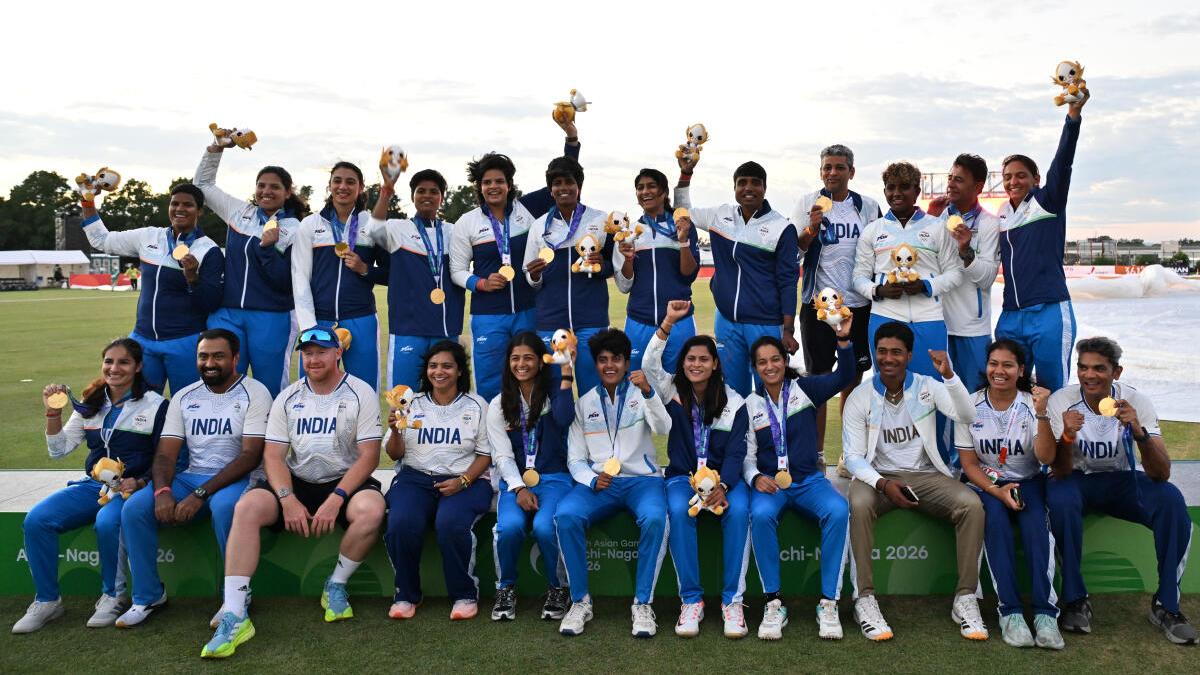
The Indian women’s cricket team knows the feeling, with two such anointments in the span of a week, when it was undisputedly crowned the best in Asia — a record-extending eighth Women’s Asia Cup title in Dubai and a savoured gold medal at the Asian Games in Japan, both against the same opponent: Sri Lanka. Two summit clashes, two similar submissions to authority.
A marauding top order headlined India’s unopposed quest for glory, both in Dubai and Nagoya. The tempestuous youngster in Shafali Verma has well and truly given way to a wiser allrounder, hungry to contribute to a win in every way possible.
Smriti Mandhana rose to the zenith of international cricket, leaving behind names who had influenced her in the sport. Sree Charani’s incredible year kept getting better as she hacked down a number of records while reigning supreme in the T20I rankings.
Shafali Verma (188 runs) and Smriti Mandhana (116 runs) were the backbones of India’s batting effort in the Asian Games. The pair also managed 236 and 213 runs respectively in the Asia Cup a week prior, the top two run-scorers of that tournament.
| Photo Credit:
AP
Shafali Verma (188 runs) and Smriti Mandhana (116 runs) were the backbones of India’s batting effort in the Asian Games. The pair also managed 236 and 213 runs respectively in the Asia Cup a week prior, the top two run-scorers of that tournament.
| Photo Credit:
AP
ALSO READ | Smriti Mandhana breaks record for most runs in women’s T20Is
Nothing came in the way: be it feeble attempts at a fightback from weaker opponents, an unforgiving travel itinerary that barely gave the team breathing space between the Asia Cup and the Asian Games, modest accommodation provisions or threats of a Japanese typhoon that ultimately steered clear of the Korogi Sports Park in Nisshin City.
Mismatch aplenty
Take away the passions of sporting merit from the consumption of these two tournaments, and the chronology and character pools are nearly identical. The traditional Asian top four — India, Sri Lanka, Pakistan and Bangladesh — are paired against starry-eyed gladiators emerging from the Qualifiers. Valiant campaigns and campaigners come up against the Full Members, akin to bringing a knife to a gunfight, and eventually get found out.
In the Asia Cup, Indonesia, Thailand, Hong Kong China and UAE asked the occasional tough question but were ushered out of contention without much mercy. One’s heart beats and breaks for the underdogs and keeps you invested long enough before you realise how every competition day across editions feels the same — lopsided contests, a glaring mismatch in resources and infrastructure, and a tape growing increasingly stale in an impatient consumer market where sport is primarily produced for broadcast.
The story was no different at the Asiad. While the big four — courtesy of some continuity gathered over their travels across the continent — found their rhythm, Thailand was the only constant among the rest, with Malaysia, China and Japan completing the pack. These are not random draws; qualifying tournaments guarded the gates to these stages. But as much as things change, teams improve or find their footing in the global game, the overall imbalance between the Associates and the Full Members stays the same.
India’s players are full-time professionals, global stars who play in front of packed stadiums and command lucrative contracts. Japan’s team is made up of university students, office workers and teachers who squeeze international cricket around their studies and jobs. They hadn’t even qualified for the 2022 Games in Hangzhou.
| Photo Credit:
PTI
India’s players are full-time professionals, global stars who play in front of packed stadiums and command lucrative contracts. Japan’s team is made up of university students, office workers and teachers who squeeze international cricket around their studies and jobs. They hadn’t even qualified for the 2022 Games in Hangzhou.
| Photo Credit:
PTI
ALSO READ | India wins first gold medal of Asian Games 2026 after women’s cricket team beats Sri Lanka in final
Asian teams are playing more fixtures, a welcome change from years of calendars filled with blots of emptiness. The focus now is on the quality of opponent one can afford to face.
Within the Asian fold itself, a tiered system operates where the likes of India, in particular, barely face Associates. So regardless of how futile a pampered cricket fan might think these tournaments are, they are, so far at least, the only avenues for teams to experience a top-class global opponent.
The knowledge transfer, by itself, becomes the biggest takeaway for so many of these teams. Images of Hong Kong players flocking around India’s senior players and Japan and China players lining up for photographs with women they had only watched in videos or heard about in lore passing over from the subcontinent made for heartening visuals. Hong Kong China’s Marina Lamplough’s videos through the Asia Cup, in which she showed glimpses of how the team took notes from the Indian openers’ style and strategy, are one such example.
But that’s as deep as the engagement goes. India’s ‘responsibility’ to democratise its presence in the Asian circuit now has the hurdle of a packed calendar standing before it.
In the Asian Games and Asia Cup, the eastern cricketing wave doesn’t realise what it has, Netherlands skipper Babette de Leede pointed out, highlighting Asia’s advantage over other continental groupings.
“You know how Asia has the Asian Games and the Asia Cup? We don’t have any of that in Europe. It would be great because you get more games. Look at the difference between the number of games we play and the number Australia or India play. We do have entities like the European Cricket Network… the T10 tournament they organise. Those numbers are developing. And now there’s the European T20 Premier League too. If there was something like that for us in Europe, it would be quite cool,” she told Sportstar on the sidelines of the T20 World Cup earlier this year.
ALSO READ | How Japanese women prepared for a moment of blossoming
The wish for integration isn’t random. With cricket making the Los Angeles Summer Games, the ecosystem hopes this is the start of a long stay in the Olympic roster. In 2028, six teams each will compete in the men’s and women’s events, with rankings deciding the majority of the slots and qualifiers filling the gaps. The Asian Games is no different: an eight-team tournament that begins at the quarterfinal stage in a continental showpiece involving 46 countries.
In Aichi-Nagoya, China didn’t even get to play, despite making the cut, after rain washed out its quarterfinal against Bangladesh, the latter advancing due to higher seeding. Cricket’s intense weather vulnerabilities leave teams on the bigger stage of amateur sport short-changed when months of preparation and dreams can drown in a downpour.
Work at the roots
The International Cricket Council, especially after the recent FIFA World Cup, has made its intention of expanding cricket to counter football, covertly and overtly, known. Development initiatives with Associates, infrastructure assistance and advocacy have spruced up since the turn of the decade.
The Indonesian ecosystem is a direct beneficiary, having landed Asian Cricket Council membership a few years ago. Cricket chief Abhiram Singh Yadav credits the role of former ACC president and incumbent ICC chair Jay Shah for making room for Indonesia at the high tables of Asian cricket.
“Mr. Shah thinks quite broadly about the game. He sees the potential of global markets. Indonesia is a country with a population of over 200 million. We are a G20 member. That recognition also came through in Mr. Sanjog Gupta’s (ICC CEO) visit. Both are working towards developing emerging markets and looking at non-traditional cricketing nations. With the sport now in the Olympics, this is the only way we can make cricket inclusive,” Yadav told Sportstar.
“Cricket wants to work towards becoming bigger than FIFA, and that requires looking deep into different international markets. As an Associate member, we want to support that vision. Indonesia, Thailand, Malaysia, Japan and Korea are promising markets, and we want to be a model for others to follow,” Yadav added. UAE, too, has a promising women’s side drawing heavily from the expat Indian population in the Gulf. While the national side benefits from their quality, the Emirates Cricket Board has been trying to foster an interest in the sport among natives too.
ALSO READ | Asian Games 2026: Shafali Verma scores her maiden T20I century during Bangladesh semifinal
“I won’t say that it’s a challenge,” Emirates Cricket Board COO Subhan Ahmed told Sportstar. “If you look at the overall demographics of this country, about 80 per cent of the population is expat. So it’s natural that the sports that they have played back home and that culture travels. The infrastructure here has grown because of it. We have 62 grounds across the seven states in the Emirates. There are some Full Members who do not have that kind of base. The local Emirati population is always a part of our plans. We don’t envisage a complete takeover by the local population, but we do anticipate greater participation given how much it can do for overall community unity here,” he added.
Indonesia, too, faced the same predicament of leaning entirely on the diaspora, but Yadav underlined that the setup is on a war footing to ensure cricket can become a 100 per cent localised sport.
Sports tourism has emerged as a way to galvanise smaller boards, as Yadav pointed out earlier, allowing them to tap newer markets within cricket. Sanjog Gupta has also identified China as a potential cash cow, hoping to convert at least some of its 1.4 billion people into cricket fanatics.
The ICC pumped USD 1.5 million into cricket in the nation, broadcast World Cup games in Mandarin to whet the appetite for the game, and has also seen the cricketing system build three top-level cricket venues, including a new 1,500-seat stadium in Taicang that is primed to host domestic and international matches and provide a training base for the national teams. The Marylebone Cricket Club has chimed in with support, saying it will send a women’s team there for an overseas tour next year.
The women’s national team, made almost entirely of homegrown players, has climbed 10 spots in the rankings over the last two years, which only underlines why that faith isn’t misplaced. That Asiad washout stings that much more now, right?
Dissonance at the top
The one-sided nature of this fairytale Asian romp was known to all before the curtains rose. But even for the world’s most successful team, backed by the world’s richest board and cricketing circulatory system, multi-sport events bring with them nostalgia and old-time achievement.
Indian skipper Harmanpreet Kaur, for instance, grew up in Punjab, where tales of legendary Olympians were often served alongside a child’s daily meals. The Games — of the Asian, Commonwealth and Olympic kind — hold a special place. It’s why her creaking knees want to carry on till she makes it to Los Angeles 2028, till that Olympic gold finds its way to her neck.
ALSO READ | Asian Games a teaser to 2028 Los Angeles Olympics: India Women’s head coach Amol Muzumdar
While parallels can be drawn between India’s comfort and dominance here and what might lie ahead at the Olympics, that would be an oversimplification. At the end of the day, Olympic cricket — as it stands — is still a T20 knockout tournament, the sport’s most fickle format. It cares not for past laurels. Fortune only favours the brave here, as India learned at the Birmingham CWG when it watched Australia don gold while it made do, grudgingly, with silver.
For all the expansion, the view from the top remains fairly myopic. Players being dragged into the political theatre of handshakes and trophy tug-of-war took the sheen off what is, in theory, one of the most promising learning opportunities for teams on the fringes of the power core. If one wants to be doggedly apolitical, two high-importance tournaments in 2026 without television referrals and held at a single venue are no vote of confidence in the efforts of the custodians of the sport. The ICC can’t wash its hands off either, as the inaugural Women’s Champions Trophy — taken away from Sri Lanka due to political interference in administration — is due to be held across just two Tier 2 Indian venues.
While the prosperous continue to prosper, Pakistan, Sri Lanka and Bangladesh face tumultuous transitions within and outside the team. Outside India, franchise cricket is not a reality or a liberating financial avenue for any other Asian nation. FairBreak Global, an ICC-based independent initiative that brought several Asian Associate nations much-needed game time with stars from SENA countries, is now defunct.
Indonesia, for all its ambition, still played the Asia Cup without a shirt sponsor, while a Full Member nation like Afghanistan is still being shielded from accountability for failing the cardinal principle of said membership — mandatorily fielding a women’s team.
Hierarchy masquerades as competition in Asian cricket, with one crown after another for those already on top, while the rest are left arguing over scraps of legitimacy. Showpieces without follow-ups, expansion without equity and Olympic ambition without Olympic-standard competitiveness will only widen the gap the game is desperate to bridge.
Published on Sep 22, 2026