New Tuas sorting facility collects 27.5 million bottles and cans for recycling in under 2 months
SINGAPORE – These sorting machines in Tuas Bay do what many people in Singapore fall short on: sorting and emptying metal and plastic containers for recycling.
Every day, they take in around 1,200 large bags of flattened cans and bottles returned under the Beverage Container Return Scheme (BCRS) and put them on an industrial “roller coaster”.
Magnets separate steel containers from the plastic ones, which are then sucked through pipes to another area, where the labels are stripped.
The plastic containers are further separated into four different types using infrared light.
Manual labour is not needed to sort the recyclables or to discard around 40 per cent of contaminants, unlike other sorting facilities for the blue recycling bins located at HDB estates.
The BCRS Counting and Sorting Facility in Tuas, which was officially launched on Sept 21, started operating in August.
Its operations could not have come at a better time as more labelled containers appear to be entering the market.
From the start of the BCRS on April 1 to early August, 5.5 million containers were collected by the facility.
A vehicle unloading bags of used drink containers at the Counting and Sorting Facility during a media preview on Sept 16.
ST PHOTO: JASON QUAH
Between August and Sept 13, the solar-powered facility by waste collector Cora Environment and the scheme’s operator BCRS Ltd has collected around 27.5 million used bottles and cans – five times more than before.
It is located within Cora Environment’s material recovery centre, which also sorts and processes recyclables collected from the blue bins, such as paper, cardboard and other plastics before sending them off to recyclers.
Under the BCRS, customers pay an extra 10 cents for each drink and get the money back via EZ-Link or DBS PayLah! when they deposit the used containers into a reverse vending machine. There are around 1,300 such machines islandwide.
Once fully operational from October, the BCRS is expected to recover more than one billion beverage containers used each year and over 16,000 tonnes of material a year. Since the scheme’s launch, around 553 tonnes have been recovered.
Recycled bottles at the Counting and Sorting Facility on Sept 16.
ST PHOTO: JASON QUAH
Within the first year of the BCRS, the aim is to have 60 per cent of bottles and cans returned for recycling. Within three years, the goal is to reach an 80 per cent return rate.
The scheme was launched to help raise Singapore’s household recycling rate, which reached an all-time low of 11 per cent in 2024 and 2025. Plastic recycling was at 4 per cent in 2025.
The blue bins, for collecting a mix of recyclables, have been plagued with contamination rates of about 40 per cent since 2017. Segregating recyclables can improve their value, the authorities have said.
Senior Minister of State for Sustainability and the Environment Janil Puthucheary, who visited the facility on Sept 21, said: “The more that we can reduce the contamination, and we can have clean containers to return into the recycling process, the better the scheme is going to work. The more materials we can then reuse to produce beverage containers.”
Using AI, robotic arms and infrared
The Tuas Bay facility, operational since August, is 2,000 sq m in size.
ST PHOTO: JASON QUAH
The Counting and Sorting Facility – roughly the size of two Olympic swimming pools at 2,000 sq m – is the first in Singapore capable of sorting six material types on a single automated line. They include aluminium, steel and PET.
Fifty-five per cent of the materials collected so far are plastics, while the remaining 45 per cent are metal.
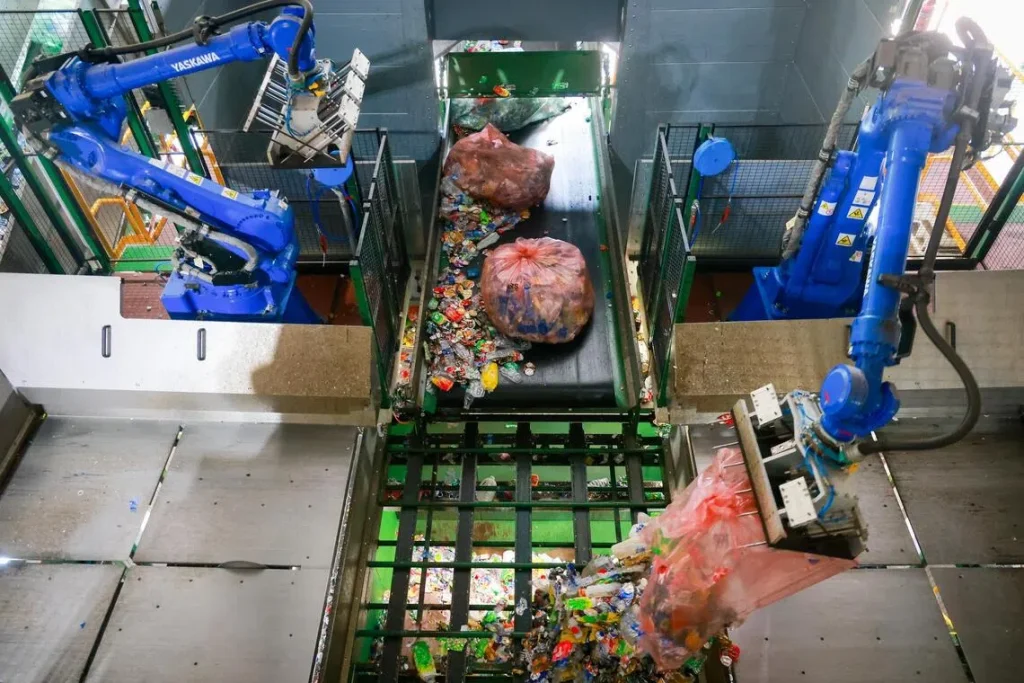
The bags used are red, blue and green, based on the regions they are collected from. Red bags come from reverse vending machines in the west.
ST PHOTO: JASON QUAH
While artificial intelligence and overhead cameras identify and count the bags of crushed containers, robotic arms swing them onto slicers that break the bottom of the bags to release the contents into a heavy-duty storage bin called a screw bunker.
Containers are further compressed inside this bin. Any residual liquid that collects at the bottom is drained out, reducing the risk of contamination.
Used bottles and cans returned by the public must be empty but do not need to be rinsed, although that is encouraged. The facility has a liquorice-like odour, caused by the residue of unrinsed containers.
Once the screw bunker releases the materials, it enters a “roller coaster” of pipes and conveyor belts to sort each material and bundle them up before sending them off to recyclers. Using the air-propelled vertical pipes reduces the facility’s footprint and minimises odour.
A magnetic separator attracts steel cans. The rest of the containers travel through the pipes to a separating drum and wind sifter, which remove the labels, further raising the materials’ purity. A rotating drum screen filters out bottle caps and rings.
An eddy current machine with rapidly changing magnetic fields then separates aluminium cans from the plastic containers.
Four types of plastic bottles remain: Clear PET; coloured PET such as Mountain Dew bottles; HDPE, which holds milk and juice; and PP (polypropylene).
These are individually identified in a plastic sorter machine using infrared rays, before compressed air shoots each container into its designated bin.
The infrared plastic sorters help to sort the different types of plastic containers.
ST PHOTO: JASON QUAH
Sorted plastic and aluminium are compressed into bales and sold to recyclers.
Revenue from recyclers is used to fund BCRS, alongside fees from drink producers and unredeemed 10-cent deposits.
BCRS Ltd said: “We are working with a panel of recyclers for the different materials. Due to commercial sensitivities, we will not be able to reveal the recyclers.”