
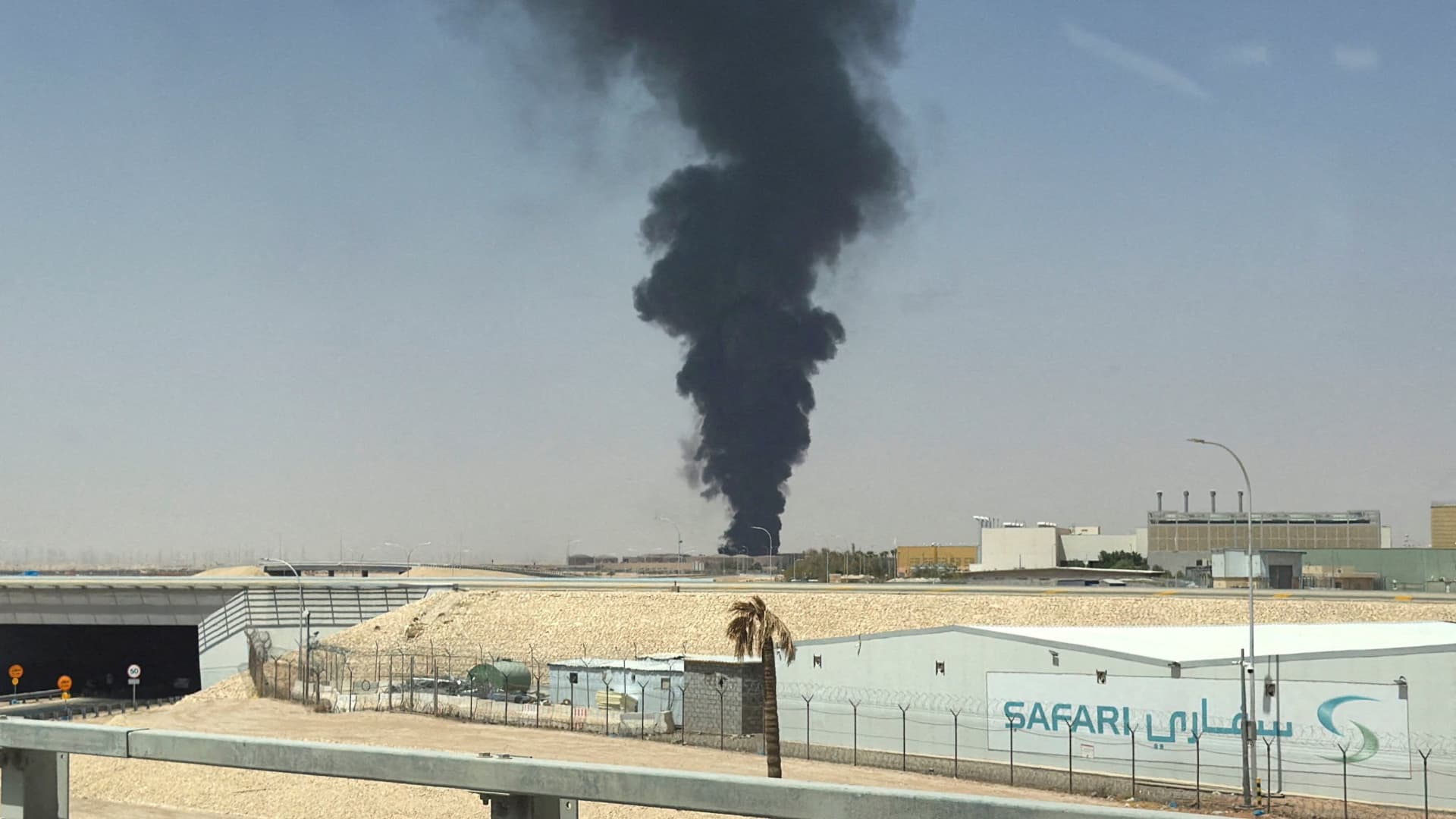
Flames, smoke seen near Riyadh airport; Houthis claim attacks
Large plume of black smoke rises from the fuel storage area at King Khalid International Airport, in Riyadh, Saudi Arabia, Sept. 19, 2026.
Stringer | Reuters
Yemen’s Houthis said they attacked “sensitive” sites in the Saudi capital Riyadh on Saturday with missiles and drones, hours after flames and a large plume of smoke were seen near the city’s main airport.
Saudi Arabia had sent alerts overnight warning of potential danger around Riyadh, amid an escalation in attacks by the Houthis in the kingdom.
Reuters video and photographs showed a huge pillar of black smoke rising in the area, with the airport highway, main terminal building and other facilities in the foreground. At one point in the video, flames were visible rising from behind what appeared to be fuel tanks.
The Houthis did not specify what they had targeted in Riyadh, but said they had also attacked an Aramco facility in the Red Sea city of Yanbu, a key Saudi oil export hub.
The Houthis said the operation came as a response to an attack in the Yemeni capital Sanaa.
The Saudi-led military coalition fighting the Houthis said its air defenses had destroyed a missile fired by the Yemeni group toward Riyadh early on Saturday.
In a statement, the coalition also said it had foiled attacks targeting civilians in the Saudi cities of Bish and Farasan in the southwest and Taif in the west, as well as Yanbu on the Red Sea coast. It did not say whether there was any damage.
Saudi civil defense sent alerts by phone overnight about potential aerial attacks in Riyadh and the city of Al-Kharj east of the capital, before issuing an all-clear on Saturday morning. A Reuters journalist in Riyadh’s Olaya area heard booms before the all-clear was sent.
Although some alerts had been issued in Riyadh this year after the start of the U.S.-Iran war, these were the first since the escalation with the Houthis began in July.
Late Saturday, U.S. embassies in Jerusalem, Oman, and Iraq issued security alerts for American nationals in the Middle East because of heightened tensions and the potential for unforeseen escalation.
Houthi warning
The Houthis, who control the most populous parts of Yemen and much of the north, have been launching attacks against Saudi Arabia since declaring a naval blockade against Riyadh in July, with strikes targeting Saudi vessels in the Red Sea.
The attacks have targeted Saudi cities, energy infrastructure and shipping, creating new threats to global oil supplies and putting at risk the main alternative Red Sea route for Gulf exports while traffic through the Strait of Hormuz remains blockaded.
Turkish Foreign Minister Hakan Fidan said Saudi Arabia may have military needs due to the ongoing Houthi attacks and Turkey was ready to help under a trilateral defense pact that also includes Pakistan.
It was unclear what kind of support Turkey might provide, but Fidan, in an interview with broadcaster NTV, said Saudi Arabia’s needs could include “some technical issues.”
The trilateral agreement signed last month stipulates that an armed attack on any of the three countries would be regarded as an attack on all of them.
On Friday, Houthi military spokesperson Yahya Saree said the group had foiled unspecified “criminal attempts” in the Yemeni capital Sanaa, blaming Saudi Arabia and vowing a response.
The Iran-aligned group, which seized Yemen’s entire Red Sea coast in a lightning advance this month, says the Saudi Air Force has conducted hundreds of airstrikes against it in recent days.
The fighting between the Houthis and Saudi Arabia has developed as a new theatre of conflict in the wider war that began with U.S. and Israeli strikes against Iran at the end of February. U.S. President Donald Trump has rebuffed Saudi requests for direct U.S. military intervention against the Houthis.
Mohsen Rezaei, secretary of Iran’s Supreme National Security Council, told Al Jazeera in an interview aired on Saturday that Tehran wanted the war between Saudi Arabia and the Houthis to end, adding that he believed Yemenis also wanted a settlement with Saudi Arabia.
Rezaei also said Iran had conveyed its conditions to mediators for re-engaging in stalled negotiations with the United States, including “ending the war on all fronts.”
Consultations were continuing with Qatari and Pakistani mediators, and Tehran was awaiting a response from Trump, Rezaei said.
The UN Security Council, in a statement on Friday, “condemned in the strongest terms continued Houthi attacks against the Kingdom of Saudi Arabia, including attacks impacting civilian and energy infrastructure, which have resulted in the injury of civilians, including women and children.”
In the statement, the Security Council also condemned “Houthi military escalation in Yemen.”
— CNBC contributed to this report.