
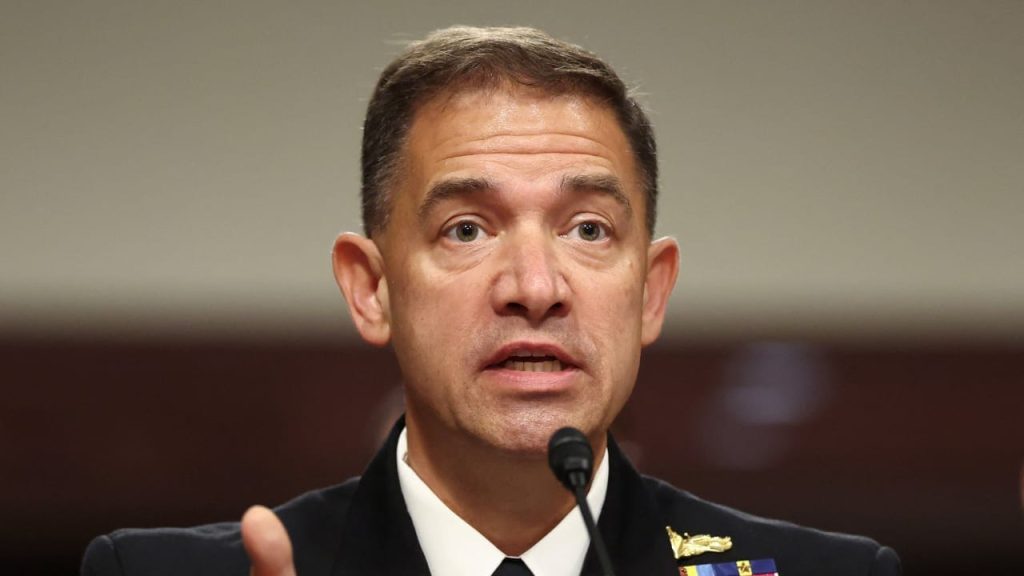
US CENTCOM chief hosts military meeting with Israel, Arab nations
Military commanders from the US, Israel, and several Arab countries convened in Germany last week for a discussion organized by US Central Command (CENTCOM) Chief Admiral Brad Cooper that centered on the conflict with Iran, Israeli officials told Axios.
The eight militaries that attended the meeting were the United States, Israel, Saudi Arabia, Bahrain, Kuwait, Qatar, the UAE, Jordan, and Egypt.
A source from within CENTCOM later confirmed to The Jerusalem Post that it hosted senior military leaders from eight countries at a closed conference in Germany last week, where discussions focused on strengthening security cooperation in the Middle East.
“Last week, CENTCOM hosted senior military leaders from eight nations during a scheduled conference in Germany,” a US official told the Post. “The leaders discussed opportunities for enhancing security cooperation in the Middle East.”
In the meeting, Cooper reassured the chiefs of staff that the US would not withdraw its forces from the region in the face of Iranian attacks on US bases throughout the Middle East, according to Axios. He also briefed the military leaders on US plans to secure the Strait of Hormuz and increase maritime traffic.
Cooperation between Israel and Arab states
Israeli officials also told Axios that the IDF Chief of Staff, Lt.-Gen. Eyal Zamir, briefed the Arab nations on Israel’s operations on its various fronts.
The open communication of military intelligence potentially signals the strengthening of ties between Israel and nearby Gulf States in the vein of the Abraham Accords.
In March 2022, then-IDF chief of staff Lt.-Gen. Aviv Kohavi and senior Arab military leaders, including Saudi Arabia’s Chief of Staff General Fayyadh Al Ruwaili, met in Sharm el-Sheikh to discuss countering the escalating regional threats posed by Iran.
Besides some of these rare snapshots, Mossad and IDF officials have hinted at various communications with the Saudis or through the US to the Saudis in recent years.
Israel’s ambassador to the UAE, Yossi Shelley, said earlier this week that Kuwait is likely to join the Abraham Accords within four to six months.
Trump also held talks with leaders from throughout the Middle East, including Saudi Crown Prince Mohammed bin Salman, UAE President Mohammed bin Zayed Al Nahyan, as well as leadership from Qatar, Pakistan, Turkey, Egypt, Bahrain and Jordan.
He said that “after the great work the United States has invested in formulating [an] agreement, the countries involved should sign the Abraham Accords simultaneously.”
Houthi attacks escalate regional conflict, Iranian proxies a threat to Gulf
The meeting comes as the Houthis have stepped up attacks on Saudi cities and energy infrastructure while advancing along Yemen’s Red Sea coast towards the Bab al-Mandab Strait, a key shipping route.
The escalation has opened a second theater in the wider regional conflict and raised concerns over Saudi oil exports and global shipping.
Trump did not agree to US strikes on the group, but Washington told Riyadh it would provide intelligence-sharing and targeting assistance, the sources added.
Jerusalem also committed to assisting Riyadh in its defense against the Houthi threat by providing military intelligence in a recent meeting between Israel and Saudi Arabia mediated by CENTCOM.
On Monday, thirteen civilians were wounded in strikes by the Iran-backed Houthis on the Saudi cities of Khamis Mushait, Abha, and Taif.
Reuters contributed to this report.