
Tax Cut Plan Leaves Funding Gap As BOJ Decision Nears
TOKYO –
Prime Minister Sanae Takaichi’s government entered a decisive political week on September 15 after approving an outline for food-tax relief and household payouts without settling how the package will be funded, keeping fiscal concerns alive just days before the Bank of Japan is expected to decide whether to raise interest rates again.
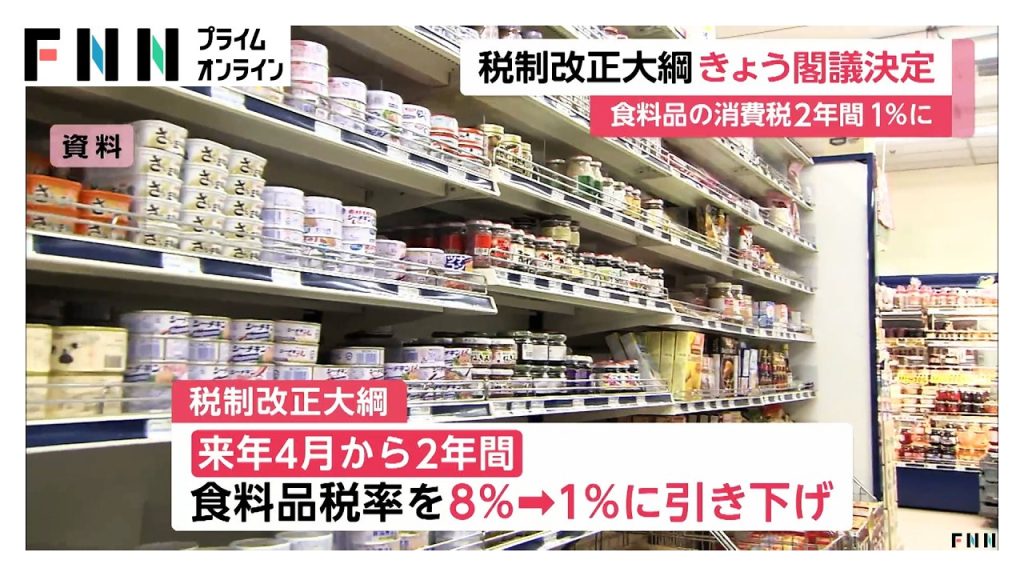
The cabinet-approved outline keeps the administration’s central cost-of-living pledge intact: reducing the consumption tax on food from 8% to 1% for two years from April 2027, while providing additional payouts that would effectively remove the remaining tax burden for households during the period. The measure is intended to answer voter frustration over higher food prices, but its funding remains the main political and market problem.
The tax cut is expected to create a revenue shortfall of around 5 trillion yen. Finance Minister Satsuki Katayama has said the government will not rely on deficit-financing bonds and remains committed to reducing Japan’s debt-to-GDP ratio. But the latest outline avoided a detailed funding structure, meaning the government has preserved the political promise while postponing the most difficult fiscal question.
That gap matters because bond markets are already under stress. Japan’s 10-year government bond yield has risen to a 30-year high of about 3.025%, reflecting concern over inflation, future BOJ rate hikes and the government’s ability to finance tax relief, defense expansion and long-term investment without weakening fiscal credibility.
Takaichi has tried to reassure markets by saying the fiscal 2027 budget will aim to cap new government bond issuance at around 40 trillion yen. The pledge is meant to show that her administration is not abandoning discipline even while pursuing what she calls responsible active fiscal policy. But investors are likely to judge the cap against actual spending demands, not only political language.
Budget pressure is rising from several directions at once. The government is preparing the food-tax cut, ministries are seeking large fiscal 2027 appropriations, defense spending remains on an expansion track, and Takaichi continues to promote a 370 trillion yen public-private investment roadmap through fiscal 2040. The roadmap targets strategic areas including artificial intelligence, semiconductors, shipbuilding, energy, space, quantum technology and advanced manufacturing.
The political logic behind the strategy is clear. Takaichi wants to show that Japan can help households now while rebuilding national strength for the long term. But September 15 showed how difficult that balance has become. A tax cut without a funding plan reassures voters only partially, while giving markets another reason to question the overall fiscal path.
The Bank of Japan is now the immediate test. The BOJ meets on September 17 and 18, with markets watching whether Governor Kazuo Ueda and the Policy Board raise the policy rate from 1% to 1.25%. The yen’s sharp rally in recent weeks has been driven partly by expectations that the BOJ may accelerate rate hikes, but Reuters reported that the rally could reverse if the central bank disappoints markets.
The yen rose to a seven-month high at 152.89 to the dollar during its recent rally, supported by hawkish BOJ expectations and speculation that more Japanese capital could be directed back into domestic assets. But analysts have warned that expectations may have moved too far, especially if the BOJ does not clearly signal a higher terminal rate or a faster tightening path.
For Takaichi, a stronger yen is politically useful because it can ease import-driven inflation by lowering the cost of food, fuel and raw materials. It also helps reduce the immediate pressure that forced rare Japan-U.S. coordination over currency markets earlier in the summer. But a stronger yen driven by rate-hike expectations comes with costs.
Higher rates would increase government borrowing costs and make it harder to finance the tax cut, defense spending and investment program. They could also weigh on business investment, housing and corporate earnings. That means the government benefits from the yen’s recovery, but must live with the tighter financial conditions that make the recovery possible.
The BOJ also faces a communication problem. If it raises rates this week, it must explain the move as a response to inflation, wages and financial conditions, not as a reaction to political pressure from Tokyo or Washington. If it holds rates steady or sounds cautious, the yen rally could weaken, reviving concern over import prices and household inflation.
The government’s relationship with the BOJ remains sensitive because of earlier concern that Takaichi wanted monetary policy to support her growth agenda. The administration has repeatedly said that specific monetary tools belong to the central bank, but the combination of large spending promises, a tax cut and rising bond yields keeps the independence question alive.
Security policy also entered the day’s political picture after the Air Self-Defense Force lost contact with an RQ-4B Global Hawk surveillance drone during a flight off Japan’s northwestern coast near Tottori. The unmanned aircraft is one of only three Global Hawks operated by the Air Self-Defense Force and is based at Misawa Air Base in Aomori Prefecture.
The incident is operational in nature, but politically it touches a larger debate over Japan’s defense modernization. Global Hawk drones are part of Japan’s surveillance capacity, supporting high-altitude, long-duration monitoring in a region shaped by North Korea’s missile program, China’s military activity and Russia’s presence near Japan.
The disappearance also comes as Takaichi’s administration prepares new security and defense strategies and continues to emphasize drones, unmanned systems, artificial intelligence and advanced surveillance as central to Japan’s military modernization. If the aircraft is confirmed lost, questions may follow over procurement costs, operational risk and whether Japan’s defense buildup is producing reliable capabilities quickly enough.
Okinawa remains another security-policy flashpoint. The recent election victory by government-backed Genta Koja has been seen as giving Tokyo more room to advance its military agenda in the prefecture, including issues related to U.S. base realignment and expanded access to ports and airports. Okinawa’s location along the First Island Chain, close to Taiwan and the East China Sea, makes it central to Japan’s defense planning.
For Takaichi, Okinawa’s political shift strengthens the case that voters in strategically important regions may be more willing to accept defense expansion than before. But it also raises the risk that local concerns over base burden, accident risk and wartime exposure will become sharper if Tokyo moves too quickly.
China remains the foreign-policy backdrop to both defense and economic security. Beijing’s new technology and national security exit rules, which took effect on September 15, reflect a broader tightening of controls around sensitive technology and personnel. The measures are not aimed only at Japan, but they reinforce the sense that technology, security and diplomacy are becoming more tightly linked across the region.
Japan has already faced Chinese measures affecting chip-related materials, rare earths and other strategic inputs. That strengthens Takaichi’s argument for supply-chain resilience and domestic industrial investment. But it also means that tensions with Beijing can quickly become business risks for Japanese companies.
The September 15 political picture is therefore one of convergence. The tax-cut outline keeps Takaichi’s household-relief promise alive but leaves the funding question unresolved. The BOJ meeting could stabilize the yen or disappoint markets. Bond yields are testing whether the government’s fiscal message is credible. The Global Hawk incident and Okinawa politics keep defense modernization in focus. China’s technology controls reinforce the importance of economic security.
The central question is whether Takaichi can make her agenda look coherent before the autumn Diet session. If the government can provide credible funding for the food-tax cut, keep bond issuance under control and allow the BOJ to act independently, the administration may regain policy momentum. If the BOJ disappoints markets, the yen weakens again or yields rise further, the tax-cut outline approved on September 15 may be remembered less as household relief than as another warning that the government’s promises are running ahead of its fiscal explanation.
What To Watch Next
The BOJ’s September 17-18 meeting is the immediate focus. Markets will watch whether the central bank raises the policy rate to 1.25% and whether Governor Kazuo Ueda signals further tightening.
The yen’s reaction after the BOJ decision will be the clearest test of whether markets believe Japan has a credible monetary and fiscal path.
The government still needs to explain how it will fund the food-tax cut and household payouts without deficit-financing bonds, especially given the expected 5 trillion yen revenue shortfall.
The 10-year Japanese government bond yield should be watched closely after rising to around 3.025%, a level that increases scrutiny of Takaichi’s budget and investment plans.
The autumn Diet session will test whether opposition parties can turn the tax-cut funding gap into a broader attack on fiscal discipline and household relief.
The Global Hawk disappearance could trigger questions over Japan’s drone strategy, surveillance capacity and the cost of defense modernization.
Okinawa policy remains important after the government-backed election result, particularly if Tokyo moves faster on military access, U.S. base issues or southwestern island defense planning.
China’s tightening technology-security controls will keep economic security near the center of the political agenda, especially for semiconductors, rare materials and companies exposed to China.