
Takaichi Retains Core LDP Team
TOKYO –
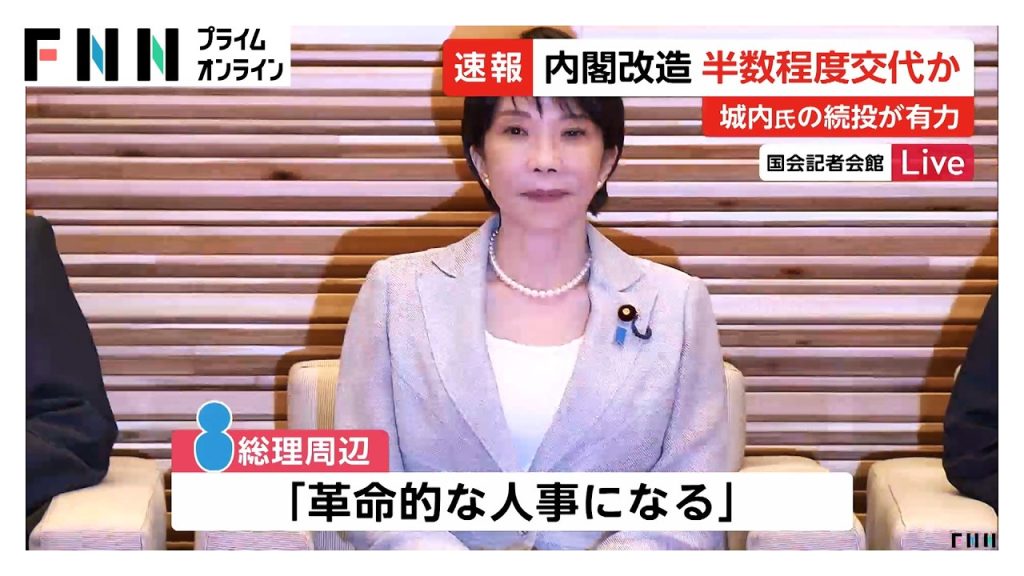
Prime Minister Sanae Takaichi launched a new Liberal Democratic Party executive team on September 16, retaining most of the party’s senior leadership while pledging to unite the government and ruling party to overcome a difficult political and economic environment.
Takaichi entered LDP headquarters at around 9:40 a.m. and attended an extraordinary General Council meeting before the party’s new leadership lineup was formally announced.
“We will open the future through policy by having the party and government work as one to overcome these difficulties, until the people can truly feel prosperity and security through economic growth,” Takaichi said.
The reshuffle left the core of the party leadership largely unchanged. Vice President Taro Aso, Secretary-General Shunichi Suzuki, Policy Research Council Chairman Takayuki Kobayashi and Election Strategy Committee Chairman Yasutoshi Nishimura were all retained.
The main change was the appointment of former Diet Affairs Committee Chairman Hiroshi Kajiyama as General Council chairman. Kajiyama’s former post as Diet Affairs Committee chairman was given to former Deputy Chief Cabinet Secretary Masafumi Murai.
A senior LDP official described the lineup as a shift made with next year’s party presidential election in mind. The decision to keep many senior figures in place suggests Takaichi is prioritizing party stability and factional balance as she heads into a politically difficult autumn.
The Upper House leadership also saw changes. Diet Affairs Committee Chairman Yosuke Isozaki was retained, but Secretary-General Hiroshi Ishii was not reappointed. The post will instead be taken by Hiroshi Aoki, chairman of the House of Councillors Rules and Administration Committee.
The Upper House personnel process appeared to be difficult. Several lawmakers, including former General Council Chairwoman Haruko Arimura, were approached as possible successors to Ishii but declined, leaving the appointment unsettled until a late stage and raising the possibility of lingering tensions within the party.
The reshuffle gives Takaichi a leadership team designed more for continuity than renewal. That may help her maintain control inside the LDP, but it also leaves her dependent on many of the same senior figures as she confronts tax, budget, monetary policy and election strategy challenges.
The timing is politically sensitive. Takaichi is trying to stabilize her administration after a difficult summer dominated by the weak yen, rising bond yields, debate over household relief and questions about the government’s relationship with the Bank of Japan.
The BOJ’s September 17-18 policy meeting is now the immediate test. Markets expect the central bank to raise its policy rate from 1% to 1.25%, continuing Japan’s shift away from years of ultra-low interest rates.
For Takaichi, a rate hike would be both helpful and difficult. Higher rates could support the yen and help ease import-driven inflation, particularly for food, energy and raw materials. But they would also raise borrowing costs for the government, companies and households, making it harder for the administration to finance its tax cuts, defense spending and long-term investment plans.
That tension has become the central political issue facing the government. Takaichi wants to present her administration as capable of helping households through higher prices while also rebuilding Japan’s industrial base through strategic investment. Markets, however, are asking whether those promises can survive in a world where government borrowing is no longer cheap.
The cabinet last week approved an outline for food-tax relief and household payouts, keeping alive Takaichi’s pledge to reduce the consumption tax on food from 8% to 1% for two years from April 2027. The government also plans payments that would effectively remove the remaining 1% burden for households during the period.
The plan is politically important because food prices remain one of the clearest sources of voter frustration. But it is fiscally difficult. The cut is expected to create a revenue shortfall of around 5 trillion yen, and Finance Minister Satsuki Katayama has said the government will not rely on deficit-financing bonds to cover the cost.
The funding question remains unresolved. The government has pointed to budget reforms, non-tax revenue and reviews of past inflation-relief spending, but it has not yet provided a detailed structure that would satisfy markets. That leaves the tax cut vulnerable to criticism as a promise that is politically clear but fiscally incomplete.
The BOJ’s expected rate hike increases that pressure. Higher interest rates will raise debt-servicing costs, and Japan’s 10-year government bond yield has already climbed to around 3%, its highest level in roughly three decades. Takaichi has said the government will aim to cap new government bond issuance at around 40 trillion yen in the fiscal 2027 budget, but investors are likely to judge that target against actual spending needs.
Those needs are rising across the government. Ministries are preparing large budget requests, defense spending remains on an expansion path, social security costs continue to grow, and Takaichi is promoting a 370 trillion yen public-private investment roadmap through fiscal 2040. The roadmap covers strategic sectors including artificial intelligence, semiconductors, shipbuilding, energy, space, quantum technology and advanced manufacturing.
The yen is the immediate signal of whether markets believe that balance is credible. Its recent rally has been driven by expectations of BOJ tightening, but currency markets remain vulnerable to sharp moves if the central bank’s guidance differs from investor expectations.
A stronger yen would help households by lowering import costs, but a rapid unwind of yen-funded carry trades could create market volatility. For years, investors borrowed cheaply in yen and invested in higher-yielding currencies and assets abroad. As Japanese rates rise and the yen strengthens, those trades become less attractive and may be forced to unwind.
That makes Governor Kazuo Ueda’s communication after the BOJ decision as important as the rate move itself. If Ueda signals a steady path toward further hikes, the yen could strengthen and bond yields could rise further. If he sounds cautious, the yen rally could fade, reviving concerns over import inflation and weakening the political benefit of the rate hike.
The BOJ must also protect its independence. Takaichi’s administration has repeatedly said that specific monetary policy tools belong to the central bank, but the broader political setting remains sensitive. Reports earlier this year that Takaichi had asked Ueda to increase government bond purchases if necessary to contain rising long-term yields have kept the issue alive.
If the BOJ hikes rates this week, the government will need to show that it accepts the decision as part of inflation control, not as an obstacle to its agenda. If the administration appears to pressure the central bank over bond yields, investors may again question whether fiscal policy is constraining monetary policy.
Trade data has added to the pressure. Japan recorded a trade deficit of 1.1 trillion yen in August, the fourth straight monthly deficit, as oil imports surged. Imports rose sharply from a year earlier, while exports also increased, supported by computer chips and autos. The figures underline Japan’s vulnerability to energy prices and exchange-rate movements.
The trade deficit strengthens the political case for a stable yen. Japan remains heavily dependent on imported energy, and higher oil prices can quickly feed into household bills, transport costs and corporate expenses. That makes currency policy and BOJ credibility directly relevant to voters, not only to markets.
At the same time, a stronger yen could weigh on exporters. Automakers and other major manufacturers benefit from a weaker currency when overseas earnings are converted into yen. Takaichi must therefore manage a divided economic constituency: households want relief from import inflation, while export industries may be more cautious about rapid yen appreciation.
China remains another foreign-policy concern. Regional tensions over Taiwan, defense spending and strategic supply chains have reinforced Takaichi’s emphasis on economic security, while also raising the risk that diplomatic disputes could spill into trade and business confidence.
Japan’s latest defense white paper has already generated controversy by framing military buildup not only as a security necessity but also as part of economic growth and industrial development. That message fits Takaichi’s wider strategy, but it also adds to the fiscal debate. Defense expansion, industrial policy and food-tax relief all compete for credibility in the same budget environment.
The September 16 political picture is therefore dominated by two linked developments: Takaichi has secured continuity inside the LDP leadership, but she still faces a narrowing policy corridor outside the party. She needs the BOJ to be credible enough to support the yen and contain inflation, but not so aggressive that it undermines her growth and tax-relief agenda. She needs to reassure bond markets while funding household support. She needs to strengthen defense and economic security without making fiscal policy look overloaded.
The central question is whether the new LDP leadership can help Takaichi maintain control through the autumn. If the BOJ’s expected rate hike stabilizes the yen, if bond yields remain manageable and if the government explains the food-tax funding plan, the administration may regain some momentum. If higher rates push yields up further, unsettle markets or expose gaps in the tax-cut plan, the leadership reshuffle may be seen less as a fresh start than as an effort to hold the party together before a difficult policy fight.
Source: FNN