
In cosmopolitan Berlin, elections still closed to foreigners
Abdu Taviq, an Egyptian software developer, ended up in Germany’s capital more or less by chance seven years ago. “I wouldn’t say I chose Berlin,” he told DW. “It was just that the company that offered me a job was here.”
But now he loves it. The culture is “better than any other city I have experienced,” he said. That’s partly because of its diversity, but he also likes the way Berliners approach life. “They’re more interested in living than just working,” he said. “Here I feel life is more relaxed, and this also offers the opportunity for people to get more creative.”
But there’s plenty about the city that he’s not particularly happy with, including Berlin‘s rapidly rising rental prices, and the notoriously opaque bureaucracy is a constant source of annoyance. “I myself would like to start my own business, but it is difficult because of all the bureaucracy,” he said.
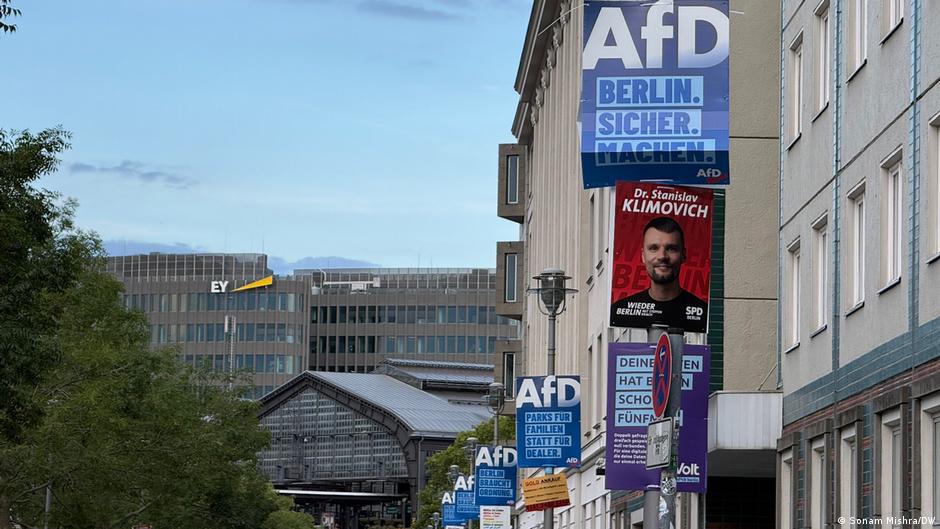
In general, Taviq is dissatisfied with Berlin’s current government, a conservative-led coalition of the Christian Democratic Union (CDU) and the center-left Social Democratic Party (SPD) — but the trouble is, as a non-German national, he has no say in deciding whether it should stay in office or not. That is particularly frustrating at the moment, when the streets are bristling with campaign posters ahead of the election on September 20.
“We are people who pay taxes, but we don’t have any representation at all, even on local level,” he said. “The cuts to kindergartens and German courses, for example, affect me directly.”
Berlin: Bigger and more international
The German capital is growing and becoming more international. While the voting population in the upcoming election will be bigger than ever — mainly because the voting age has been lowered to 16 — so is the number of the disenfranchised.
Of Berlin’s population of 3.9 million, a full quarter — around 976,000 adults — cannot vote because they don’t have German citizenship. That number has doubled since 2011.
This is partly because of Germany’s political structure. In Germany and across Europe, citizens of other EU countries can vote in municipal elections. In London, people from Commonwealth countries can do the same as long as they have UK residency. Spain, meanwhile, also has reciprocal voting agreements with several non-EU countries — in South America and elsewhere — that allow their citizens to vote in municipal elections, including for the mayors of Madrid and Barcelona.
Berlin’s upcoming election is not a municipal one. Since Berlin is one of Germany’s 16 federal states, this will be a state election, which means that voting rights are more restricted. Berlin’s municipal elections, where EU citizens are allowed to vote, only decide who governs the city’s individual districts, and their political influence is limited.
The disenfranchisement is particularly acute in central Berlin. For that reason, Stefanie Remlinger, Green Party mayor in the district of Mitte, has organized a “symbolic election” for the non-Germans in her area — some 135,000 adults out of a population of 365,000. The initiative invites foreigners to vote at 15 ballot stations over a two-week period in early September to “raise awareness for the issue of voting rights for all.”
“Mitte is an extremely heterogeneous district with a very international population,” Remlinger told DW via video call from her office. “We have people from 170 different countries living here, and a lot of them don’t have the right to vote. It’s important to us to signal to those people that we value their opinions, that we see them.”
Germany’s ‘rightward shift’
Getting people to vote in a meaningless election is a tough sell. Remlinger said she expected only a few hundred people to take part, and, anyway, she thinks the political climate in Germany is not exactly immigrant-friendly at the moment. Even in cosmopolitan Berlin, the anti-immigrant Alternative for Germany (AfD) is currently polling in second place, with nearly 20%.
“We as the Greens would liberalize voting rights even more, but I don’t see the general debate in Germany going that way,” she said. “We’re fighting a rightward shift and a lot of hostility to immigration, and I think the chances of changing something on that issue right now are very bad.”
To illustrate the state of the current debate, Remlinger mentioned a recent panel discussion she was part of, where a politician from the neoliberal Free Democratic Party (FDP) — a party that calls itself socially liberal — said voting rights shouldn’t be opened to foreigners because they might start their own parties and take over the government. “And that from someone from the FDP!” said Remlinger, exasperated.
Taviq is also aware of this anti-immigrant shift in German politics. In fact, he said, that was one of the reasons he was considering leaving Germany altogether. “All the parties are trending right-wing, so it’s getting more hostile,” he said.
Is expanding voting good for the economy?
From an economic perspective, it might be considered a shame if qualified people like Taviq decided to leave Germany. The country lacks workers. The government estimates that the country will be short of about 440,000 workers by 2029, and even the AfD leadership claims it has nothing against immigrants who contribute to the economy.
Though some German cities and local authorities do have an elected advisory board for non-German residents, offering immigrants a real vote is frequently seen as a step too far.
Remlinger herself thinks that the best path to enfranchisement is not to offer foreign nationals voting rights, but to make it easier for immigrants to become German citizens.
That happens to be another one of Taviq’s complaints about Berlin: “I applied for citizenship two years ago, and I didn’t get any response,” he said.
Germany has recently tightened citizenship rules again. Last year, Chancellor Friedrich Merz‘s government reversed the three-year “fast-track” citizenship option introduced under his predecessor, Olaf Scholz. Still, the government did keep another of Scholz’s reforms, which allows people to apply for citizenship after only five years of residency.
More and more Berliners are in fact becoming German: 2025 saw about 39,000 people naturalized in the capital, 17,000 more than in 2024.
That avenue is still closed for Taviq, but in the meantime, a little more political participation would go a long way. “If I could vote, I would reconsider leaving, to be honest, because then I could affect things, but now I’m just like a bank machine — they come to me and take half of my salary.”
Edited by: Rina Goldenberg