
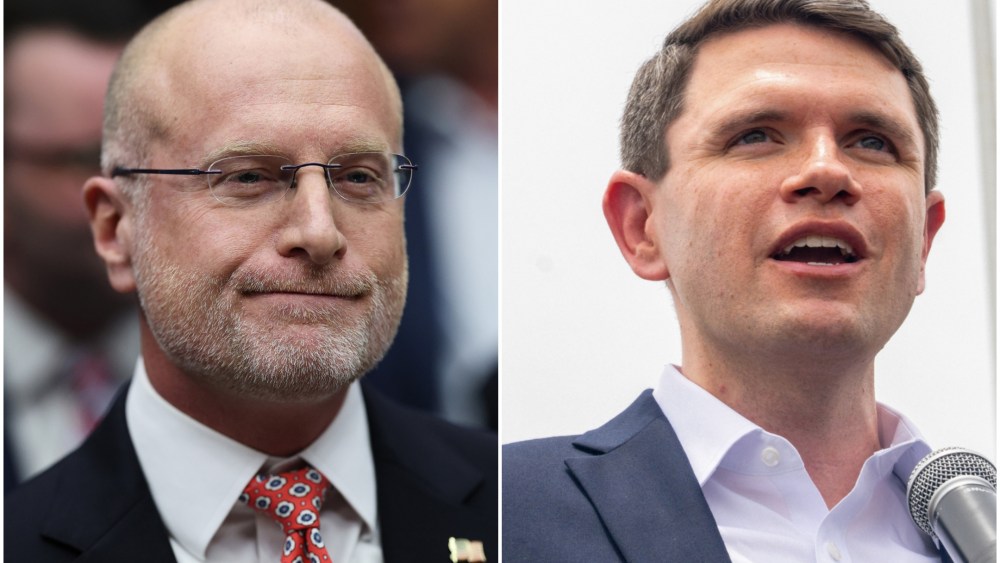
FCC Chairman Accuses James Talarico of ‘Hoax’ With Kimmel Appearance, Which ABC Punted to YouTube
Brendan Carr, the Trump-aligned Republican chairman of the FCC, accused James Talarico, a Texas Democrat running for the U.S. Senate, of running a “hoax” to garner attention and campaign donations by sitting for an interview with Jimmy Kimmel — which ABC put on YouTube instead airing it on broadcast TV to avoid a potential clash with the FCC.
In a post on X Saturday night, Carr wrote that Talarico is “just running the same hoax he did a few months ago on Colbert for the purpose of getting clicks and donations — he’s banking on people not understanding the statute or operating as partisan lemmings.”
Carr’s post included a meme mocking Talarico and Kimmel meant to show a self-inflicted fail. It depicts Kimmel riding a bike with Talarico tucked into a baby backpack carrier on the TV host’s shoulders; Kimmel then inserts a stick into the spokes, causing the bike to crash.
Variety has reached out to Talarico’s press office for comment.
Kimmel on Wednesday announced on his ABC late-night show that the interview Talarico would be on YouTube and not TV, saying the decision was made “out of consideration for our local stations, especially our ABC affiliates in Texas who would have to deal with this nonsense.”
The concern was that the FCC would retaliate against ABC over Talarico’s appearance under the agency’s equal-time rule, which requires broadcast programs give equivalent airtime to political candidates (unless they are “bona fide” news programs). Late-night shows and daytime talk shows have long been considered exempt from the rule. But earlier this year, Carr kicked off a formal review of whether ABC daytime talk show “The View” qualifies for an exemption to the equal-time rule. The FCC chairman has alleged that many talk shows on broadcast networks function as partisan mouthpieces for Democrats and should be subject to agency regulations like the equal-time rule and a prohibition on “news distortion,” because they are using publicly licensed TV spectrum.
Talarico characterized ABC’s decision to abstain from putting his interview with Kimmel on TV as effectively amounting to censorship by the U.S. government. “Government censorship should be a concern to all of us, regardless of our political party,” Talarico said in an interview Thursday on MS NOW. The Democrat called the FCC’s threats against broadcasters over “The View” and other programming “the most dangerous form of cancel culture.”
After Kimmel’s interview with Talarico was posted Thursday on YouTube, it notched over 5 million views in the first 24 hours. As of this writing, it has racked up 7.3 million views on the platform.
“We are being targeted by the FCC for the crime of interviewing political candidates,” Kimmel said at the top of the segment. “Even though, for years, we and every other late-night talk show have welcomed numerous candidates including Donald Trump when he was running [for president]. He was on this show two times. But now I guess he doesn’t like me anymore or the First Amendment. And so the FCC has threatened me or threatened my show, our network, even our local ABC stations because they want to make our editorial decisions for us, which of course we cannot accept. And so tonight, we are bypassing the public airwaves and hosting this interview on YouTube, even though our government would clearly prefer that we not do it at all.”
Earlier this year, Talarico similarly was kept off TV over CBS’s fear of running afoul of Carr’s enforcement of the FCC equal time rule. In February, Stephen Colbert said CBS execs pulled his interview with Talarico from air over concerns about violating the equal time rule. CBS said it didn’t block the interview from airing but that the network provided “The Late Show” producers “legal guidance that the broadcast could trigger the FCC equal-time rule.”
Meanwhile, ABC has dragged the FCC into federal court over the agency’s demand it submit licenses for its eight owned-and-operated TV stations early renewal. ABC sued the FCC and Carr last month, alleging the commission was waging an “extraordinary assault” on its First Amendment rights through the implicit threat of revoking its local TV broadcast. The Disney-owned broadcaster’s lawsuit alleged that the FCC’s “true target” is not the stations’ employment practices but the content of their programming: “Because the Commission cannot regulate that content directly, it has used its review of the Stations’ licenses as an instrument to the same end,” the suit said. The FCC asserts the ABC early license renewal was initiated from the agency’s investigation into “allegations of unlawful discrimination” in employment practices at Disney and ABC. On Sept. 3, the agency asked the court to dismiss ABC’s lawsuit, arguing that the network failed to establish that the license review represents “retaliation” for disfavored speech.
Carr, in his Saturday-night commentary, was responding to a comment on X by an organization called University Democrats at UT Austin, which asked rhetorically, “So I can’t watch Talarico on Kimmel but I have to watch Ted Cruz on GameDay?” That’s a reference to an appearance on ESPN’s “College GameDay” Saturday by Sen. Ted Cruz (R-Texas), who was on-air for almost 10 minutes. Cruz, who spent most of his time on the program lobbying for the Protect College Sports Act legislation that would impose new restrictions on collegiate sports practices, was loudly heckled and booed by the fans in attendance.
Carr, who was appointed chairman of the FCC by Donald Trump in 2025, noted that the FCC’s equal-time rule doesn’t apply to ESPN’s “College GameDay” because Congress applied it to broadcast TV stations, not cable networks. In addition, he pointed out correctly, the statute only applies to “legally qualified candidates” running for office.
He also argued that the equal-time statute “does not prohibit anyone from interviewing anyone on broadcast tv. It is about more speech, not less. Congress wanted to ensure that voters would decide elections, not media gatekeepers picking winners and losers by providing preferential airtime to some candidates and not others.”
Carr, explaining why broadcast and cable networks are regulated differently by the FCC, continued, “Broadcasters are unique. The FCC gave them free licenses worth many billions of dollars to use a public resource (spectrum). They are given a government sanctioned monopoly on their broadcast frequencies, too. If anyone else wants to use that same public resource (spectrum) for the purpose of expressing their own views, the government will not let them — it will eject anyone else that tries to use a broadcaster’s licensed spectrum.”
The Supreme Court has ruled that “holding broadcasters to their public interest obligations is not censorship or any sort of 1A [First Amendment] violation,” Carr wrote. “And Congress has charged the FCC with ensuring that broadcasters meet those public interest obligations, as required by their licenses. The agency should do so.”
Of course, today, most Americans watch broadcast television networks like ABC on cable, satellite or internet pay-TV services — not using over-the-air antennas.
In response to Carr’s 479-word post, UT Austin’s University Democrats wrote, “ok brandon.”