
‘Father of emergency medicine’ among 17 doctors to receive apex title in S’pore medical field
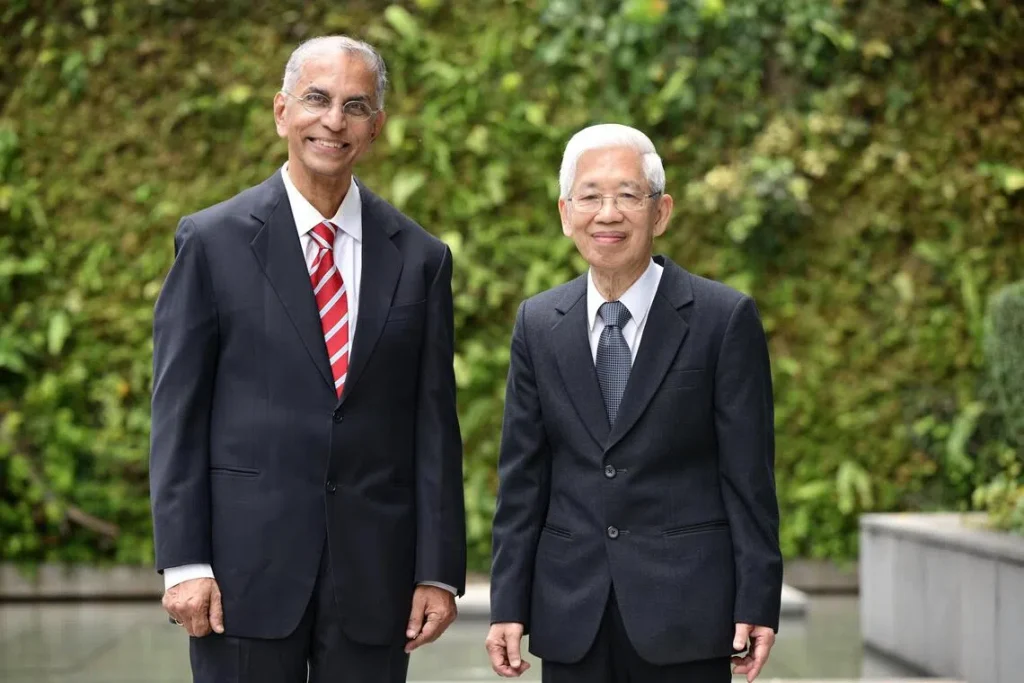
SINGAPORE – A professor of medicine recognised as the “Father of Emergency Medicine” in Singapore, Venkataraman Anantharaman, and paediatrician Phua Kong Boo, who led vaccine trials for rotavirus, received the highest medical honour on Sept 12.
They were among 17 pioneering doctors and dentists who received the Eminent Academician title from the Academy of Medicine, Singapore, at the Lee Kong Chian School of Medicine’s Clinical Sciences Building.
In a speech at the ceremony to confer the titles, Health Minister Ong Ye Kung said the title honours clinicians who have made a significant lifetime of contributions.
He added: “Not only have they journeyed alongside the development of Singapore’s healthcare system – guiding, enriching and improving it over many years, they have also touched the lives of many patients and their families.
“Concurrently, they have made their mark in clinical excellence, research, education and leadership, and have upheld the ethos and standards of the medical profession.” Ong said the title demonstrates to the medical profession what the highest standards of medicine and dentistry look like.
“To those who are just starting out on your medical career, the life’s work of the eminent academicians in this room is a testament to what each of you can and should aspire towards,” he added to an audience that included graduates of the Academy of Medicine.
Ong said the title sees Singapore medicine and dentistry join countries such as the United States and United Kingdom in a well-established international best practice.
The Academy of Medicine noted that there are also comparable practices and recognition among other professions in Singapore including engineers and lawyers.
For lawyers, the senior counsel title is reserved for an elite group who have top-tier advocacy skills, professional integrity and are learned in the law.
In an interview with The Straits Times, Anantharaman said he was spurred to raise the standards of emergency care because he was unsatisfied with the quality of care emergency patients were given when he started out as a medical officer at the Singapore General Hospital (SGH) in the 1970s.
“For example, a patient was not able to pass urine, his bladder has been distended all the way, and we were not allowed to put in a tube to relieve that blockage.
“We were told it’s only safe to do this in a ward… The patient will be distressed all the way until he reaches the ward,” added the 74-year-old emeritus consultant at SGH.
He took to designing and organising regular training programmes for doctors in public hospitals once emergency medicine was recognised as a specialised discipline in the 1980s.
“Today, there is definitive treatment (like blood tests) initiated at all our emergency departments, and therefore a lot of patients begin to get better much faster. And some of them don’t even need hospital admission. “That’s very important because patients don’t like to stay in hospitals,” he added.
Beyond the hospitals, Anantharaman sought to prepare the public in lifesaving skills to respond to people who collapse on the street. He helped to form the National Resuscitation Council in the 1990s.
To date, about 180,000 people are trained yearly in cardiopulmonary resuscitation (CPR) and in using the automated external defibrillator to be first responders when people suffer a heart attack.
After the Hotel New World collapsed in 1986, Singapore wanted to relook the way in which medical support is provided during civil disasters. Anantharaman drew up the plan which was eventually accepted by MOH.
“Over the years, every hospital would’ve prepared teams, equipment, always on standby, so they can respond on very short notice.”
Anantharaman recalled how the former World Trade Centre received casualties after the cruise ship Royal Pacific sank in the Strait of Malacca in 1992, and medical teams were dispatched to the airport after a Singapore Airlines flight was hijacked in 1991.
The 17 pioneering doctors were mainly nominated through their respective colleges in the Academy of Medicine. All nominations had to be disseminated to MOH’s Director-General of Health for comments and concurrence.
Phua, an emeritus consultant with the KK Women’s and Children’s Hospital, led clinical studies on a new rotavirus vaccine for infants in the early 2000s. Rotavirus was a leading cause of gastroenteritis in children in the past.
The clinical trial, which involved more than 2,000 healthy babies, led to an oral vaccine. Although strongly recommended, it is not mandatory in Singapore.
Phua also recently discovered a rare genetic disease called PKB syndrome after encountering a six-year-old patient with curious symptoms.
A test he ordered identified a mutation in the EIF6 gene, which caused symptoms such as growth failure, blood-related abnormalities and bone marrow failure.
This discovery was published in a 2020 paper, and the disease was named after him.
With years of teaching experience, his lasting message to his medical students is: “Never miss a treatable condition. It’s great to diagnose all these rare conditions, but if you can’t do anything for them… treatable condition must not miss.”
On what the next generation of paediatricians should focus on, the 85-year-old highlighted childhood obesity, mental health and inflammatory bowel disease, which he has been encountering more of in recent years.
Symptoms include bloody diarrhoea, abdominal discomfort and pain, and ulcers in the intestines. Currently, the hospital sees 20 to 30 patients a year, compared with one every few years in the past.
In his speech, Ong told the audience that Singapore has now established three career tracks for doctors as the key pillars of a well-rounded medical profession.
They are family physicians, who anchor care in the community; hospital clinicians, with broad-based competencies to coordinate and integrate care; and specialists, with deep expertise in specific disciplines.
Addressing the clinicians and healthcare professionals, Ong laid out the challenges on the horizon, including Singapore as a super-aged society, epidemics of mental health, antimicrobial resistance and another global pandemic crisis like Covid-19.
“Our ability to respond and overcome them depends on how well we can synergise our collective know-how and experience,” he said.