
DA update: How is dearness allowance calculated? Here’s why there is demand for change in the formula
Dearness allowance (DA) is a percentage of the basic salary component for central government employees and pensioners, which is intended to address the rising cost of living. It is reviewed twice a year, with new announcements usually made in March and October, and rollouts in July of the same year and January of the next year.
Over 1 crore workers, comprising nearly 50 lakh central government employees and close to 65 lakh pensioners, including defence and railway personnel and retirees, benefit from the DA and Dearness Relief (DR) hikes.
DA hikes announced so far
Notably, DA was last revised by 2% in April this year, taking it from 58% to 60% of basic salary, with effect from 1 January 2026. In the following months, the Indian Banks’ Association (IBA) announced revised DA and DR for workmen and officer employees across levels for May, June and July 2026. Later, the Indian Railways also announced a 2% DA and DR hike for its personnel.
Since then, multiple state governments have also increased DA and DR to close the payment gap with the central government.
How is DA hike calculated? Formula explained
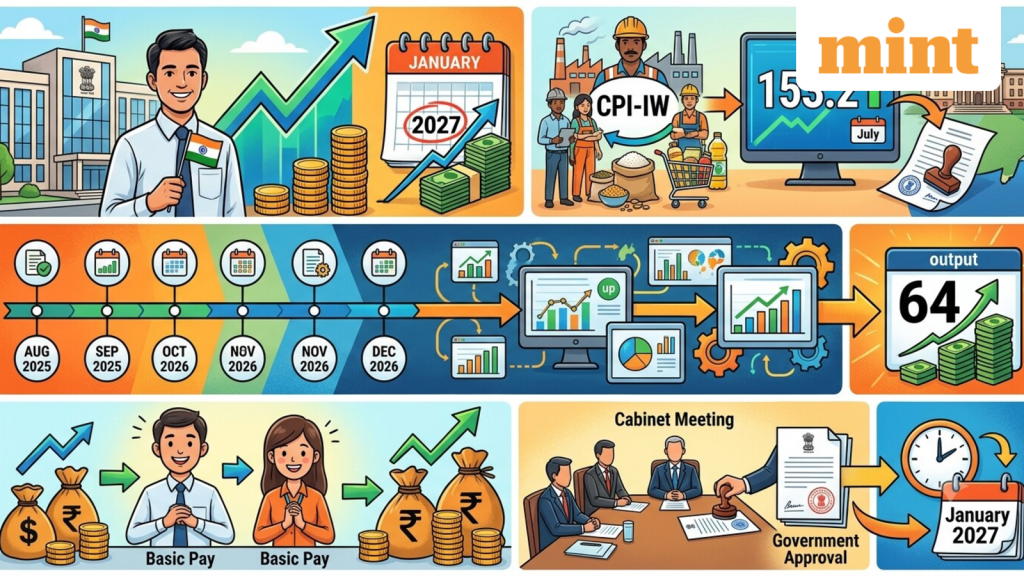
DA hikes are calculated based on data from the 12-month average of the Labour Bureau’s All India Consumer Price Index for Industrial Workers (AICPI-IW), as prescribed under the 7th central pay commission (CPC).
The index measures retail inflation by tracking fluctuations in the prices of goods and services consumed by industrial workers.The formula used is as follows, according to Clear Tax:
- For central government employees: DA percentage = [(Average of AICPI (Base Year 2001 = 100) for the last 12 months – 261.42) / 261.42] x 100
- For public sector employees: DA percentage = [(Average of AICPI (Base Year 2001 = 100) for the last three months – 126.33) / 126.33] x 100
Thus, the 2% DA hike announced in April was calculated using the AICPI’s 12-month average formula as follows:
DA percentage = (145.54 × 2.88 − 261.33) / 261.33 × 100
= (419.155 − 261.33) / 261.33 × 100
= 157.825 / 261.33 × 100 = 60.39%
This has been rounded down to 60%, which means the component was hiked 2% from the previous 58% of the basic salary.
Why are employees seeking change in DA calculation?
The All India Defence Employees’ Federation (AIDEF) in its suggestions submitted to the 8th pay commission has sought a change in DA calculation. It stated that the current formula does not adequately mitigate inflation pressure on households or reflect the actual cost of living.
The major issue raised by the AIDEF is that while food and beverage account for only 36.75% of the AICPI index, categories and aspects such as healthcare, housing, transport, communication and digital services have received greater weightage, despite generally experiencing more enduring price movements and changes. It also categorically stated that the revised Consumer Price Index (CPI) basket, introduced in FY23, does not fully capture increase in food commodity prices and seasonal agricultural products.
| Key Details | Existing Position |
|---|---|
| Inflation Index Used | AICPI-IW |
| Basis of DA Calculation | 12-month average of AICPI-IW |
| Food & Beverage Weight in 2012 CPI Basket | 45.86% |
| Food & Beverage Weight in 2022-23 CPI Basket | 36.75% |
| Main Concern Raised by AIDEF | Lower weight for food inflation and higher weight for relatively stable expenditure categories |
The federation has argued that for employees, especially those on lower pay grades, the bulk of the expenditures are towards food, education, healthcare, house rent, medicines and other essentials. It added that prices of these rises faster than overall CPI inflation, and thus periodic DR revisions may not fully protect them.
Notably, India’s retail inflation accelerated in August 2026, with consumers facing higher prices for several food items. CPI inflation rose to 4.82% in August 2026, from 4.45% in July 2026, while food inflation increased to 5.95% from 5.52% during the same period, as per data released by the Ministry of Statistics and Programme Implementation.
Employee groups are thus calling for a complete overhaul of the inflation index used for DA calculation. The AIDEF has proposed creation of an employee-specific cost-of-living index that gives due weight to changes in expenditure and better recognises elderly care expenses in pay and pension revisions under the 8th CPC.
Disclaimer: This story is purely for educational and informational purposes and should not be taken as any sort of financial advice.