
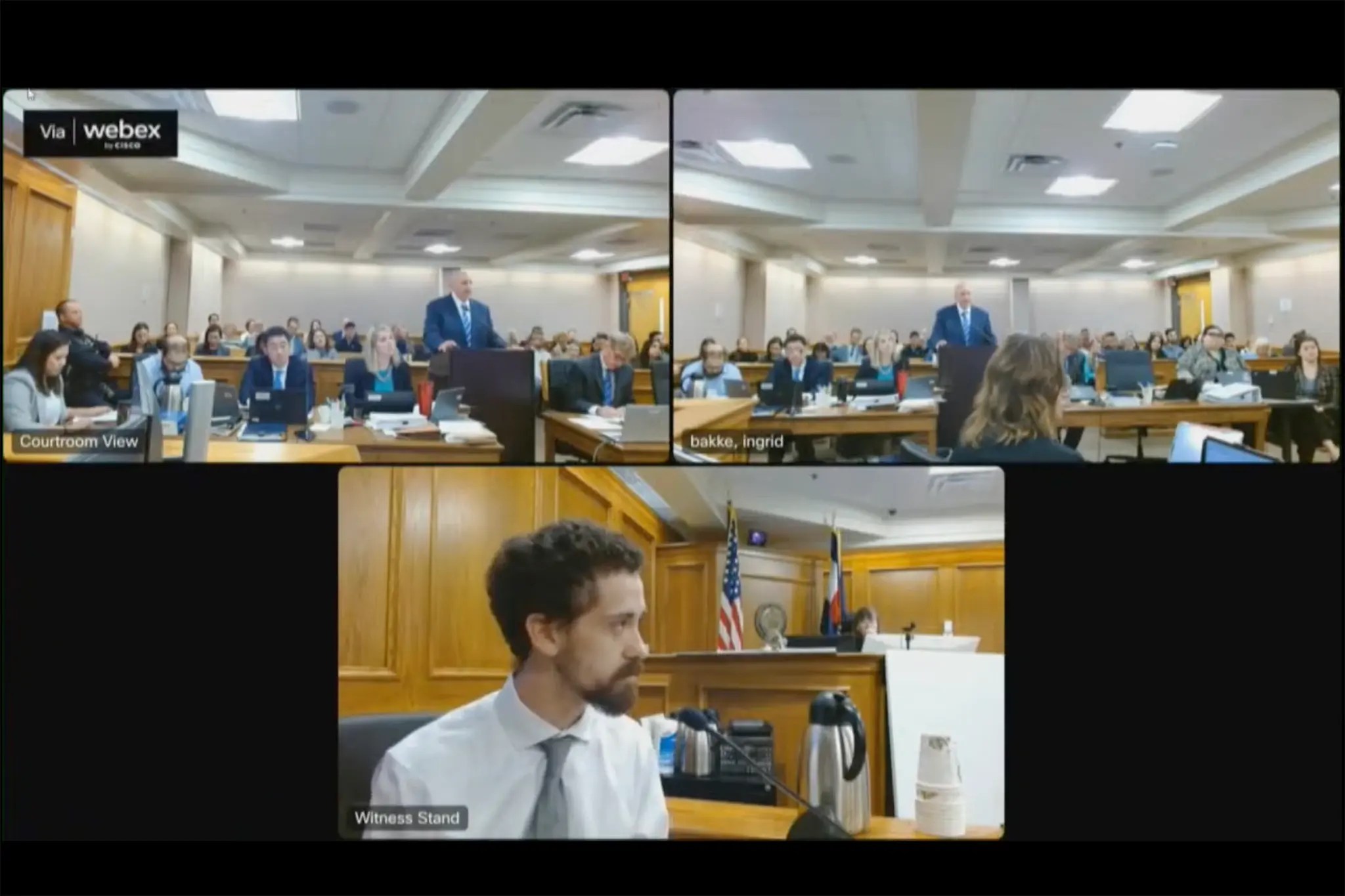
Colorado Supreme Court pauses mandatory courtroom livestreams
For the next three months, it will be up to Colorado judges to decide whether to livestream proceedings in their courtrooms. A directive by Colorado’s Supreme Court chief justice Tuesday said the pause on livestreaming by default is necessary to ensure the integrity and fairness of the judicial system.
The order is in direct contrast to a Colorado law passed in 2023 that requires all criminal proceedings to be livestreamed, and judges to make certain findings if they are to limit or discontinue the stream.
This story was produced as part of the Colorado Capitol News Alliance. It first appeared at cpr.org.
Virtual proceedings, like joining Webex for people involved in the case, will not be affected, the same for people who want to attend in person.
“The livestreaming technology that was intended to promote access to the courts has been subverted as a tool of disruption, disparagement, harassment, and private economic gain that is rapidly eroding the proper functioning of our system of justice,” Chief Justice Monica Márquez wrote in the four-page directive.
Márquez wrote that there’s been a flood of reports to judicial department leadership about unlawfully recorded proceedings being posted to YouTube, TikTok, Instagram, Facebook and other social media platforms. According to the directive, there have been hundreds of YouTube videos brought to the department’s attention.
The posted recordings are interfering with the fairness and integrity of court proceedings, Márquez wrote. She added that for some, it’s preventing due process and fair trials. If criminal defendants’ proceedings have spread online, finding an impartial jury could get more difficult. And for victims and witnesses, it’s led to harassment and intimidation.
For example, a livestream of a sexual assault trial was posted to YouTube, with the victim’s information included.
Chief judges in every Colorado district were in support of the decision, said Suzanne Karrer, a spokesperson for the judicial department.
High-profile cases
Illegally recording livestreamed proceedings is especially an issue in high-profile cases. In 2025, Barry Morphew’s attorney brought the issue to the attention of an Alamosa judge.
In a motion requesting livestreaming be disallowed in his case, his attorney referenced a proceeding in September 2025 livestreamed by at least two YouTube accounts. One of the users, he said, had 432,000 subscribers at the time.
Many of these accounts are also monetized — they get advertising revenue. He argued that livestreaming allows people to rile up the public and treat the litigation as true-crime entertainment.
The judge then limited the livestream to credentialed media, and wrote in the ruling that the public is still welcome to observe in person. She said she was concerned by the commentary and threats in the comments against her, attorneys and victims.
“If I do not pause the unfettered livestreaming of hearings in this case, at best, the unlawful recordings and ‘venomous’ commentary may affect both or either party’s right to a fair trial by tainting the small jury pool through the prevalence of factual inaccuracies and the court of public opinion,” she wrote in the ruling.
She added that Alamosa County has a relatively small jury pool, and that form of publicity would likely prevent at least some from being fair and impartial jurors.
Limits occasionally imposed on livestream
It’s common for high-profile cases to have restrictions on livestreaming. For example, when family members of the Boulder King Soopers shooter testified in trial, the livestream was audio only because of security concerns.
A spokesperson for the judicial department said that solution may have worked in that case, but it’s not a general solution to the livestream problem, because it would significantly impact virtual proceedings. Shutting off the video for the livestream, like what was done for video with certain witnesses in the King Soopers case, would prevent the Webex participants — the program people involved in the proceedings use to log on — from seeing what’s going on in the courtroom.
“This temporary pause is intended to uphold defendants’ constitutional rights, protect victims’ dignity, and allow witnesses to participate without fear of retaliation or abuse,” the judicial department wrote in a summary of the directive.
Márquez said in the directive that despite repeated requests, social media platforms have been unwilling to remove the content.
Many news organizations rely on livestreaming to cover legal proceedings that are sometimes hours away or conflict with other reporting duties.
Jeffrey Roberts is the executive director of the Colorado Freedom of Information Coalition, an organization that pushed for the livestreaming requirement becoming law.
“We think that more eyes on the judicial system is a good thing for accountability purposes, for just getting information to people,” he said. “Being able to tune in and see what’s going on without having to drive a few hundred miles or to try to be in multiple places at once because you’ve got six stories you’re working on or whatever, it really helps journalists be able to keep the public informed.”
He said the rules about recording exist for a reason. The livestream website has a big warning on the page before you click ahead to the courtroom you want to watch, which he said, people are just disregarding.
“It’s really a shame because it’s such a wonderful service, and this is ruining it in some ways,” he said. “Hopefully it won’t permanently, but this is ruining this great service for everybody else who likes to use it. And it’s an important public service because it keeps the public more informed about what’s going on in our courts.”
He said the Colorado Freedom of Information Coalition is thinking of some suggestions to present to the judicial department, to see if there’s a way to keep livestream up and running while mitigating these problems.
According to the summary of the directive, it leaves room for news organizations to file a request through the courts to get permission to record audio and/or video. It will however be up to the judge’s discretion to allow that livestream when deemed appropriate, instead of the previous status quo where all proceedings are on the stream, unless the judge finds a reason to limit it.
Directive could be challenged
Roberts said this directive does have a point of contention with a recently passed section to Colorado’s livestreaming law.
The requirement added this past session states that “requirements of this section supersede any statute, judicial guidance, or chief justice directive limiting remote public observation of criminal courts,” it continues, “the supreme court may prescribe rules of procedure pursuant to section 13-2-109 to implement this section, but the rules must not narrow or conflict with the requirements of this section.”
Theoretically, he said someone could challenge the directive in court, which ultimately would go to the Supreme Court.
“When they do limit livestreaming according to the statute, it’s supposed to be done on a case-by-case basis,” he said.
Considering possible solutions
The directive also comes at a time when the department is also facing challenges with disruptions in virtual courtrooms. For years, people have entered courtrooms, showing violent, pornographic, racist and misogynistic videos, which is then cast to participants and over the stream.
The department has been piloting a solution for that issue over the past several months.
Márquez wrote in the directive that the department needs the 90 days to explore effective solutions to both the disruptor and recording problems, and find the right balance between public access to the courts and upholding the dignity and integrity of the justice system.
Solutions could range from additional training for judges and staff, changes to the directive, technical changes and legislative amendments among other things, she said in the directive.
This story was produced by the Capitol News Alliance, a collaboration between KUNC News, Colorado Public Radio, Rocky Mountain PBS, and The Colorado Sun, with support from news outlets throughout the state. Startup funding for the Alliance was provided in part by the Corporation for Public Broadcasting.