Only 1/3 Germans happy with state of Democracy
November 11, 2026
German police chief urges closer ties to fight cybercrime
Germany’s Federal Criminal Police Office (BKA) has called for faster data sharing among police, intelligence services and the military, warning that artificial intelligence is helping criminals operate on an unprecedented scale.
BKA President Holger Münch said the number of crimes directed from abroad rose by nearly 24% in the first half of the year compared with the same period a year earlier. Fewer than 5% of such cases were solved, he said.
“We’re running out of time,” Münch told the BKA’s autumn conference in Berlin. He warned that criminals could use AI agents to identify weaknesses and select targets on their own, while the lines between organized crime and state actors were becoming increasingly blurred.
Münch urged faster cross-border data sharing and the use of AI to spot patterns.
At the same conference, Interior Minister Alexander Dobrindt said Germany was preparing legislation that would allow it to “strike back in cyberspace.”
He pointed to recent cyberattacks on supermarket refrigeration systems in France, Germany and other European countries. France has blamed Iran’s Revolutionary Guards for the attacks. Tehran denies the allegation.
Edited by:Sean Sinico
https://p.dw.com/p/5PM6B
November 11, 2026
Government delays tax plans, drops cuts to some benefits
Germany’s governing coalition has agreed to drop some planned cuts to social benefits in talks on the 2027 federal budget.
The measures include a supplement for children in low-income families.
Top members of the conservative CDU/CSU bloc and the center-left Social Democratic Party (SPD) also agreed to delay a tax on sugary drinks by six months, to January 2028, and hold off on introducing a plastic packaging tax in 2027.
The delay gives drinkmakers more time to change their recipes. The levy would have three rates based on sugar content and cover products including soft drinks, iced teas, energy drinks and fruit juice drinks with added sugar.
The coalition agreed to introduce the tax on sugary drinks as part of a package aimed at keeping public health insurance contributions stable.
Meanwhile, a cut in electricity tax for all consumers, backed by Chancellor Friedrich Merz, looks increasingly unlikely to take effect at the start of 2027. The coalition has yet to find the roughly €5.4 billion ($6 billion) needed to lower the tax to the EU minimum for everyone. The reduction so far applies only to manufacturing, agriculture and forestry.
The Bundestag’s budget committee is due to make final changes to the spending plan on Thursday, ahead of a full vote in parliament at the end of November.
Edited by:Sean Sinico
https://p.dw.com/p/5PM4T
November 11, 2026
Economic council warns of more uncertainty over US tariffs
The German Council of Economic Experts has warned of increased uncertainty over US tariffs following the midterms that saw a major defeat for President Donald Trump’s Republicans.
Gabriel Felbermayr said the stance on protectionist trade inside the White House is unlikely to soften during the presentation of the group’s annual report.
“This could come to a head as early as the beginning of next year, particularly with regard to China, as certain deadlines are set to expire,” he said.
“For the German export sector, this means that the US market — which had shown improvement over the last two or three months, with Germany partly benefiting from the AI boom — could see a cooling off.”
Edited by:Zac Crellin
https://p.dw.com/p/5PLAh
November 11, 2026
IN PICTURES: Carnival kicks off in Germany
Edited by:Zac Crellin
https://p.dw.com/p/5PL4m
November 11, 2026
German female soldiers report widespread harassment
The German Bundeswehr has a sexual harassment problem, especially for its female soldiers, according to the results of a survey released by the Defense Ministry on Wednesday.
The data revealed that 38% of female soldiers had been subject to sexualized verbal harassment in the past 12 months. For male soldiers, the share was 16%.
Defense Minister Boris Pistorius said that female, young and non-heterosexual soldiers suffered the most from sexualized harassment. He outlined a plan to address the issue, saying: “Zero tolerance applies to sexual harassment within the Bundeswehr.”
Some 7% of female soldiers said pictures of them had been taken without consent or edited with AI. Another 9% reported physical sexual assault and 2% reported being victim to sexualized violence.
For male soldiers, 2% also reported being subject to sexualized violence in the Bundeswehr.
Depending on the type of harassment, between 36% and 61% said they had not reported incidents, citing fear of consequences. Between 44% and 59% said they were doubtful the reporting would lead to anything.
The results of the study, which Pistorius called the “very first of its kind,” were based on 8,000 filled out questionnaires. That represents 4% of the Bundeswehr’s 186,200 total military personnel.
The German government is seeking to boost the numbers of the Bundeswehr to 260,000 active members with 200,000 reservists. This requires attracting both men and women into the forces.
Edited by:Kieran Burke
https://p.dw.com/p/5PKdg
November 11, 2026
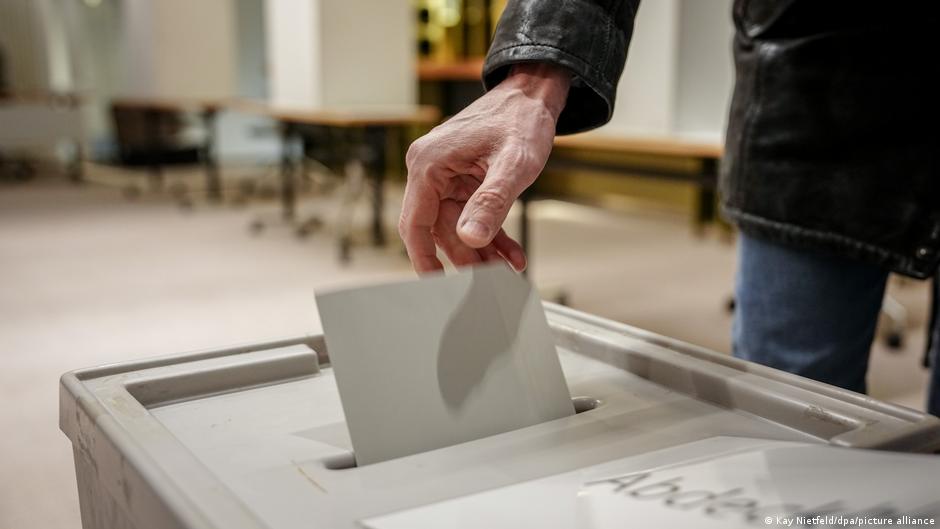
Satisfaction with democracy in Germany reaches new low — study
Just a third of respondents said they were satisfied with the state of democracy in the Federal Republic of Germany, according to a new report from the Leipzig Authoritarianism Study.
This marked a steep decline from the 42.3% level of satisfaction measured in the last study in 2024 and was the lowest point since the study began in 2002. The level was even lower in the former East German states where only 22.8% expressed satisfaction with German democracy, down from 29.7%.
At the same time, 89.3% of respondents said they agreed with the concept of democracy, however, this also marked the first time this level fell below 90%.
A large share of respondents also expressed chauvinistic and antisemitic views.
In response to the statement “Germany is being dangerously overrun by foreigners,” 34.9% were manifestly in agreement, with 24.4% in latent agreement.
At the same time, 15.5% manifestly agreed with the statement “the influence of Jews in Germany is still too great,” with 21.7% latently agreeing.
The research was carried out by the Else-Frenkel-Brunswik-Institut at the University of Leipzig. They surveyed 2,500 people between mid-March and the beginning of June this year.
Edited by:Kieran Burke
https://p.dw.com/p/5PKAR
November 11, 2026
Bundeswehr to stop using Chinese-made drones
The German military, or Bundeswehr, has said it had banned the use of Chinese-made drones, the Defense Ministry said.
The ban also includes for training purposes. Instead, the military can use German or European-made drones.
The ministry cited “security-relevant information,” saying “Chinese-made models will no longer be used … and existing systems will be replaced by products from domestic or, where applicable, European sources.”
The Bundeswehr may purchase “inexpensive, off-the-shelf drones for training purposes”, buying them “with minimal bureaucratic effort.”
Edited by:Kieran Burke
https://p.dw.com/p/5PK0n
November 11, 2026
Suspect in death of 13-year-old girl dies in hospital
A 22-year-old man has died in hospital from severe head injuries after he was found by police in an abandoned building with the body of a 13-year-old girl who had gone missing.
The man tried to shoot himself after being discovered by police in the small town of Altglietzen on the border with Poland on Sunday. He sustained life-threatening injuries and was taken to hospital for intensive care.
Prosecutors in Berlin said on Monday that the man had already been under investigation since January 2025 amid suspicion of possession of child sexual abuse material.
The 13-year-old victim went missing Tuesday last week after she left her home in Berlin at 7:15 a.m. to go to school. She never arrived.
Edited by:Kieran Burke
https://p.dw.com/p/5PJzL
WATCH: Autonomous drones — rescuers from above?
Autonomous drones can navigate without GPS, search for missing persons and make decisions on their own.
In Germany, developers competed to see which drone was the best rescuer.
Edited by:Kieran Burke
https://p.dw.com/p/5PJl0
November 11, 2026
Carneval festivities to begin in Cologne despite inclement weather
Rain has not appeared to put off carneval-revellers in Cologne with festivities set to kick off at 11:11 a.m. (1011 GMT) on November 11.
Groups of people in colorful costumes had already started gathering outside the Cologne main station, at the foot of the famous Cologne Cathedral, despite the wet weather.
Bakeries have been selling their traditional carneval pastries like hot cakes.
Local authorities expect tens of thousands of people to join the celebrations. Some 1,000 police officers as well as 1,200 agents from a private security firm have been deployed.
Edited by:Kieran Burke
https://p.dw.com/p/5PJoO
IN DEPTH: Germany’s climate standing sinks to lowest level in years
Germany has slipped down the climate action ranking for the third consecutive year, with the former green leader now being outperformed by Brazil, Columbia and Romania.
In its worst performance since 2019, the country fell to place 25 and received a “medium” rating overall on the yearly Climate Change Performance Index (CCPI), which assesses efforts to curb global warming in 64 countries plus the European Union.
Edited by:Kieran Burke
https://p.dw.com/p/5PJhJ
November 11, 2026
October inflation falls below 3% amid fuel rebate
Year-on-year inflation for October dropped down slightly to 2.8% after reaching 3.3% in September, according to preliminary figures from the Federal Office of Statistics (Destatis).
Record high prices for gas and diesel pushed up inflation in September but this was brought down thanks to government subsidy for consumers at the gas pump that was introduced in October.
“The main factor behind the persistently high inflation rate remained the trend in energy prices, even though the fuel subsidy, which was reintroduced in early October, may have tempered inflation somewhat,” Destatis President Ruth Brand said.
Edited by:Kieran Burke
https://p.dw.com/p/5PJe1
November 11, 2026
Workers over 60 taking a month off per year for sick leave
German workers aged between 60 and 65 took an average of 31.3 days of sick leave per year, based on data from 2024 released by the Health Ministry in response to a question posed by the Left party in the Bundestag.
The average number of sick days taken by all workers was 15, according to the Federal Office of Statistics (Destatis).
The number of 60 to 65-year-olds who have taken a year or more off for sick leave has also increased in recent years. It went from around 80,300 people in 2022 to 96,100 in 2024.
Left party spokesperson Sarah Vollath called the figures a “clear warning sign” in comments to the Rheinische Post and warned that workers cannot “keep working forever.”
“If the federal government has its way, the retirement age for workers will soon be pushed even further into the future due to another increase in the standard retirement age. This completely ignores the reality of life for older workers.”
The government of Chancellor Friedrich Merz has set retirement reform as one of its main goals, with policies including pushing the retirement age back to 67 years.
Edited by:Kieran Burke
https://p.dw.com/p/5PJaz
November 11, 2026
Welcome to our coverage
Good morning and Alaaf!
November 11, as well as being Armistice Day, is also the first day of the carneval season with events taking place throughout the Rhineland region, including in Cologne, Düsseldorf and Mainz.
We are also expecting the German Council of Economic Experts to publish their annual report providing forecasts and proposals to the German government.
Keep reading for this and more.
Edited by:Kieran Burke
https://p.dw.com/p/5PJZw