Opinion: Veterans in their fields
When the War for American Independence came to an end in 1783, American soldier and sailor Elisha Fisher was finally free. He had spent the better part of seven years enlisted in the patriot cause, ending his service aboard an infamous British prison ship in New York Harbor.
Now he ambled the city’s streets with no money and no food, asking passersby for assistance. Some gave him a few coins, others, he said “less than nothing but frowns.” Fisher, writes historian John Ruddiman in his book about Revolutionary soldiers Becoming Men of Some Consequence, “began his postwar life as a homeless beggar.”
I often find myself thinking about Elisha Fisher and others like him. I remember them on Veterans Day, yes, but also on many others. He comes to mind whenever I encounter a weather-beaten man on some well-trod street corner of New Haven, grasping a cardboard placard with the words “homeless” and “veteran.”
Fisher returned to me again a few days ago while I was driving home from Southern Connecticut State University where I teach American history, my car radio tuned to a report of rising VA mortgage rates. Many of us already know the egregious statistics on veterans’ suicide and their broader struggles to get jobs or to receive basic healthcare.
At my university, I regularly encounter the bureaucracy of GI Bill educational benefits that a surprising number of my students are trying to access and then to navigate, and I see the unwavering lengths to which campus veterans’ advocates go to support our students, their comrades. Many of these students are justly proud of their military service, but they are also left cynical –—some even embittered—- at their service and its fraught aftermath. Not a few turn to history for answers.
Some of those student-veterans join me and others in an annual Veterans Day tombstone cleaning at a New Haven cemetery just a short walk from our campus. There, we tend to 87 uniform headstones in the so-called “Grand Army of the Republic Plot.” The GAR was an enormous organization for Civil War veterans of the Union Army. In the first decades of the last century, the GAR and the city purchased burial plots for veterans who died too poor to pay for their own. Many of these men served in so-called “colored” regiments, all-Black units in an army that fought to destroy slavery, but not segregation.
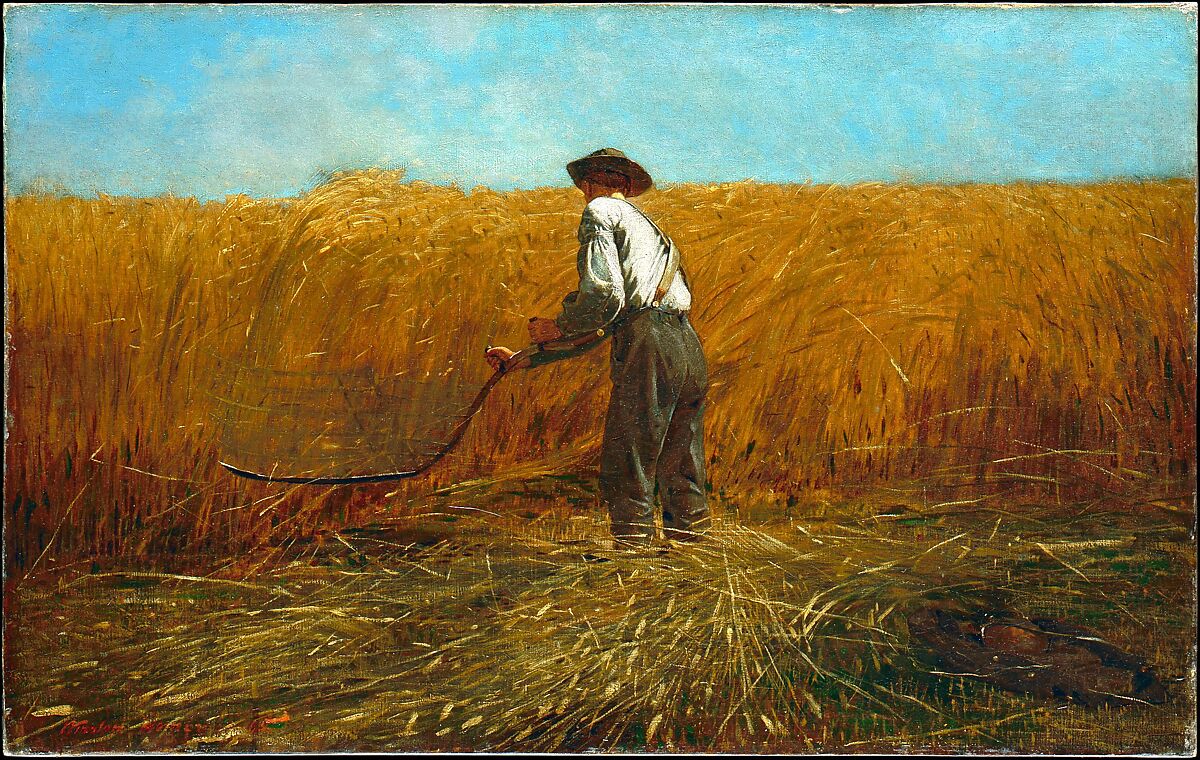
In 1865, the American artist Winslow Homer painted “The Veteran in a New Field.” It depicts a man just home from the Civil War, his back turned to the viewer, a scythe in hand, reaping a field of golden wheat. The painting, on view at the Metropolitan Museum of Art, evokes the oft-repeated turning of swords into ploughshares, the gratitude and relief that comes with the end of war and the embrace of peace. Awaiting Homer’s soldier-turned-farmer is an unbroken field of gilded grain in all its amber waves, stretching ever on toward the future. Tranquility and a modicum of prosperity would be gold enough, the artist seems to imply, a rich reward for service and sacrifice on behalf of one’s nation.
When we put Elisha Fisher or the men and women at attention on our streetcorners or those buried in the GAR plot or the ones who study in our college classrooms next to Homer’s veteran in his field, the disparities sometimes appear quite stark.
On this Veterans Day -—and, indeed, every day until the next-— as those of us who have never put on uniforms in service to the nation offer our gratitude, we would do well to remember these veterans past and present—that is, not only those depicted in the triumphal poses of so many iconic paintings and photographs and ceremonial arches.
More than, “thank you for your service,” we need to ask ourselves “what is our collective obligation” to these men and women, to gay and trans veterans alike, to Black sailors, Hispanic soldiers, and women pilots —some of whom are now being redacted from our national histories not long after belatedly being put there in the first place.
These are extraordinary, ordinary people, trying to make it in America. Many are simply attempting to access what is best about the prosperity and equity embedded in so many American Dreams, dreams that our ancestors fought, died, and struggled to make and then to preserve. More than anything, however, we must wonder and remember what becomes of those who served and fought —and of those who are still fighting — in our country’s seemingly endless wars.
Jason W. Smith is a Professor of History at Southern Connecticut State University in New Haven where he teaches and writes about American military history and the convergence of war and American society.