Asylum’s ‘The Odyssey’ Shows How Mockbusters Survive in Streaming
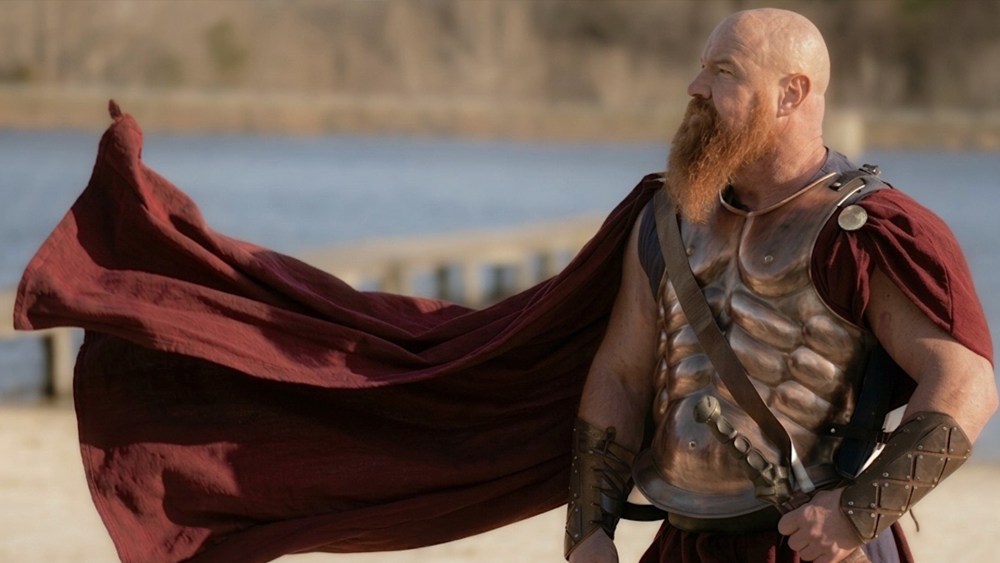
“Our journey begins with the Cyclops,” says a ginger-bearded and bald Odysseus somewhat nonchalantly in the trailer for “The Odyssey,” moments before a giant one-eyed AI-generated monster bursts onto the screens.
The film, based — rather loosely — on Homer’s epic poem, released this summer and was met with mostly comic derision and a flurry of one-star reviews.
“Dumb, ridiculous, embarrassing, nonsensical,” wrote one online critic. “Not a single redeeming feature,” bellowed another. But this “Odyssey” was not Christopher Nolan’s $250 million “Odyssey,” the epic from Universal, something many online said they’d discovered only after buying the film online. Nor was this the “historical accurate” retelling touted by Elon Musk and made using Grok.
This was the $250,000 version from the Asylum, the B-movie icons and American Film Market stalwarts both loved and loathed for its vast number of so-called “mockbuster” rip-offs, its cult “Sharknado” franchise and an array of ludicrous film posters often involving multiple-headed monsters.
In fairness, “The Odyssey” — thanks to being in the public domain for roughly 2,500 years — isn’t strictly a mockbuster. The title didn’t need to be tweaked for copyright reasons, like the Asylum did with other self-aware cash-ins “Top Gunner,” “The Da Vinci Treasure,” “Jurassic Domination,” “Alien Disclosure Day,” “Immortal Combat” and many more. But the film was absolutely made and timed to ride on the $125 million M&A coattails of Universal’s pic and, the company claims, succeeded.
“It performed very well,” says David Rimawi, CEO and co-founder of the Asylum. “We’ve said this before, but we’ve found there’s a direct correlation between how well the studio film does and how well ours does. If it’s a hit, ours is generally a hit as well.”
“The Odyssey”
Courtesy of The Asylum
Other recent Asylum mockbuster hits include “The Last Hail M.A.R.Y.,” a sci-fi with a similar Earth-saving theme to Amazon MGM’s “Project Hail Mary” (but, instead of a CGI alien rock creature, it’s “a dude with some prosthetics,” says the Asylum co-founder David Latt); “The Mummy,” a totally different horror story to “Lee Cronin’s The Mummy” yet released around the same time; and, more recently, zombie copycat “Resident Dead.” (The company notes that it chose not to make a low-budget version of “Digger”).
But success today is markedly different to how it was two decades ago.
Back in 2005, the Asylum shocked itself by selling around 100,000 DVDs of its $500,000 “War of the Worlds,” its first — and, it claims, mostly coincidental — mockbuster, released just a day before Paramount’s Tom Cruise-led behemoth. In the years that followed, its DVDs — often cunningly designed to look like a major Hollywood release or with outlandish graphics that disguised the tiny budget — would line the shelves at Walmart, ready to lure in either the comically aware, cinematically curious, foolishly unsuspecting or just plain short-sighted. (The latter is something the Asylum tipped a meta and tongue-in-cheek hat at in its 25th anniversary title “2025 Armageddon,” featuring a scene in which a grandmother mistakenly buys one of its DVDs rather than a studio film.)
But that highly-profitable physical market has long since come crashing down and, with it, the spoils. For its slate of mockbusters, monster thrillers and disaster movies, the Asylum now operates in what Rimawi describes as the “tiny margin world” of digital, mostly reliant on volume and the occasional breakout to lift the overall tide. “We actually have to make more to make a little,” notes Latt.
There is still business to be made, however, with ad-based streaming platforms, such as Tubi, Roku and Pluto TV having come to the rescue in recent years. “This is where our customers and the Asylum found each other again, and if you’re watching the wrong movie, you can gloriously just jump to the next,” he says. “It’s the core of our business model now.”
There’s also the ad-based FAST channel (the Asylum has its own), plus cable-based rental and purchasing transactions, although Rimawi says this business has largely shifted to Amazon, where “some films can do nothing, but some can be massive hits — that’s where our big performances come.” Curiously, the Asylum also still shifts around 10,000-20,000 DVDs a year at Walmart. “It’s baffling to us,” notes Rimawi. “I think people just use it like a rental store.”
The Asylum may be keeping itself afloat in its own shark-infested waters, but lurking further into the independent film depths, for fellow makers of wild genre titles, the challenges of today’s world seem even greater.
ITN Studios has spent years churning out scores of low-budget horror and action-thriller titles about clowns, dolls, dinosaurs, scarecrows, sharks and other classic baddies. This year it comes to AFM with a slate including the wonderfully named “Mary Magnum: Jiu-Jitsu Nun” (a thriller about a former military sharpshooter who breaks out of a convent to rescue her former lesbian lover). The film isn’t its first featuring a woman of the cloth. Its “Bad Nun” franchise launched in 2018 (the same year Corin Hardy’s supernatural horror “The Nun” stormed the box office).
With the DVD market gone, ITN is also plying its trade across platforms like Amazon, Roku, Xumo, Pluto, Peacock, Tubi and YouTube, many of them with revenue share agreements.
“But it’s definitely a lot harder now,” says ITN CEO Stuart Alson, who says operating as a volume business is the only way to survive. “If you’re trying to make it or break it on one film at a time, that’s what can be challenging. But if you have a slate of films and you’re constantly putting films out, some win, some lose.”
Thanks to ITN’s impressive library of more than 1,000 titles (just a few years ago it was releasing almost 100 a year), many of its older films have long since broken even — meaning any new earnings, however minuscule, help to keep the lights on.
Courtesy of ITN Studios
But for others, due to a growing oversaturation in low-budget genre, both the opportunities to grab money-generating eyeballs and the budgets to make these films have been dramatically squeezed. About five years ago, Alson says he was financing films in the $30,000 and under range, but even this microbudget has now more than halved. “You’ve got people making movies for $5,000,” he says.
Brit duo Scott Champer and Rhys Frake-Waterfield were among those making scores of cheap-as-chips horrors for ITN, but thanks to their slasher smash hit “Winnie-the-Pooh: Blood and Honey” (ITN’s biggest success to date), they are now focused on their own “Poohniverse” of murderous children’s characters (the third “Winnie” film is currently in post). But they assert that the low-budget genre arena where they once thrived is dying out.
With films, and so many of them, now battling for attention on VOD platforms, the pair claim that where DVDs in the past could effectively fool people into thinking a movie is a higher-budget production, online you simply can’t hide. “Often the trailer appears instantly, and straight away you can tell,” says Chambers, adding that the immediate availability of online reviews and IMDb ratings also plays into it. “People are just becoming more savvy,” adds Frake-Waterfield. “If it looks too low budget, why would you invest $5 when you could rent, I don’t know, ‘John Wick’?”
While many in the industry might turn their noses up at this schlocky corner of low-budget filmmaking, there’ll be little to celebrate were it to actually vanish. As Chambers and Frake-Waterfield note, it’s an area where emerging filmmakers can learn their craft, as they did. But there are also many who love it for what it is.
For all the angry reactions to the Asylum’s “The Odyssey” knock-off, there were plenty rejoicing in the audacity of the film’s existence and its unashamedly cheap, so-bad-its-good quality. “I’ve never laughed so hard,” said one, cheering at a supposed Greek warship that was “nothing more than a little rowboat.”
It’s too early to know the exact financials of the film — the figures from the various online platforms and the splits from the complex rent-sharing agreements can take months to come in. But with the $250 million blockbuster original having topped $1.6 billion at the box office, the Asylum is confident its version — coming in at a thousandth of the budget — can make at least more than $250,000 back.
“We’re very happy with how it turned out,” says Latt. “So we’re now looking forward to Christopher Nolan’s ‘Iliad.’”