Most S’pore parents see tuition as necessary despite wanting less academic pressure: Survey
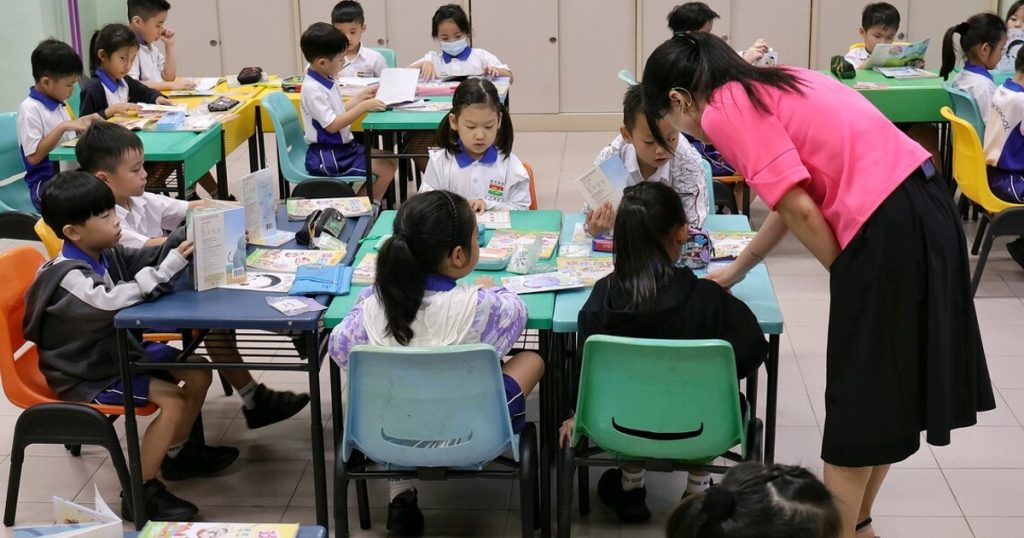
SINGAPORE – Three in four parents polled believe tuition outside primary school is necessary for their children to do well, according to a new survey released on Nov 9. Families spent a median sum of $600 a month per child on such extra classes.
Most parents – 72% of them – said they wanted to put less academic pressure on their children, but feared they would lose out in the Primary School Leaving Examination.
And 77% said they would ease the pressure if their children were guaranteed a place in secondary school through a system that made the PSLE optional.
The findings, released by education advocacy group EveryChild.SG, showed that most respondents had confidence in Singapore’s education system. But they were concerned about academic competition and tuition costs.
The survey conducted by market research firm NielsenIQ mainly between January and February polled 4,007 Singapore citizens and permanent residents.
They comprised 2,002 parents aged 25 to 65 whose children are in, or had in the previous five years attended a local primary school, and 2,005 young adults aged 18 to 30 who had attended local primary schools.
EveryChild.SG, a non-profit advocacy group founded in 2023 by former civil servant Pooja Bhandari, has called for education reforms to support children’s holistic development.
Its past reports include a 2025 study on support for children with special educational needs.
The latest survey was conducted mainly online, and administered in English, Chinese and Malay. The sample broadly reflected national demographics by race, gender and housing type, said Bhandari.
It found that tuition spending varied across income groups.
Households earning $5,000 a month or less spent a median amount of $300 monthly per primary school child, while families earning $5,000 to $15,000 forked out $600.
Those earning between $15,000 and $20,000 a month spent $1,000 per primary school child.
A separate Institute of Policy Studies study released in September found that parents spent a median of $500 a month on tuition. The study on parents’ attitudes and perceptions of the education system found that more of them were stressed about their children’s future.
Most respondents in EveryChild.SG’s survey thought well of Singapore’s primary schools.
Eight in 10 agreed that Singapore’s primary education system was among the best in comparison with those in other developed countries.
About 85% also felt positively about the school environment, including whether pupils felt emotionally safe and respected by teachers.
Said Bhandari: “Singapore has built an education system that is widely admired for its academic achievements. The challenge now is to build on these strengths while addressing the pressures and inequalities that have emerged alongside them.”
Assistant Professor Kwan Jin Yao of the United States’ University of Delaware, said the findings reflect a familiar tension: While Singapore’s education system prepares students well for further studies and employment, it also creates stress for families seeking the best opportunities for their children.
Kwan, whose research focuses on youth development, poverty and inequality, was among the academics who reviewed the report.
He said a key research gap is the lack of perspectives from current students, which could shed light on the sources of academic stress and how children perceive the PSLE.
The survey found that 80% of respondents believed a “Through-Train” system would make learning more enjoyable, and 79% felt it would reduce examination pressure. The report noted that this suggests parents are open to structural change.
EveryChild.SG has previously proposed such a system, under which 80% to 90% of pupils would progress directly to an associated secondary school without taking the PSLE, while those seeking places in selective schools could still opt to sit the exam.
About 66% of respondents felt that classes are too large for teachers to give each child sufficient attention, while 73% of parents believed large class sizes contributed to the need for tuition.
Kwan described the PSLE as an “imperfect but fairly useful sorting mechanism”.
Scrapping it may not end academic competition, he said. Pressure could then shift to Primary 1 registration, or subsequent national examinations, which could become even more “high-stakes”.
“Overall, there is a collective-action problem, when parents choose not to opt out if they worry that their children may be disadvantaged,” he said.