‘The Universal Bubba’: Willi Carlisle talks puppetry, existential crises and his new Tyler Childers-produced album
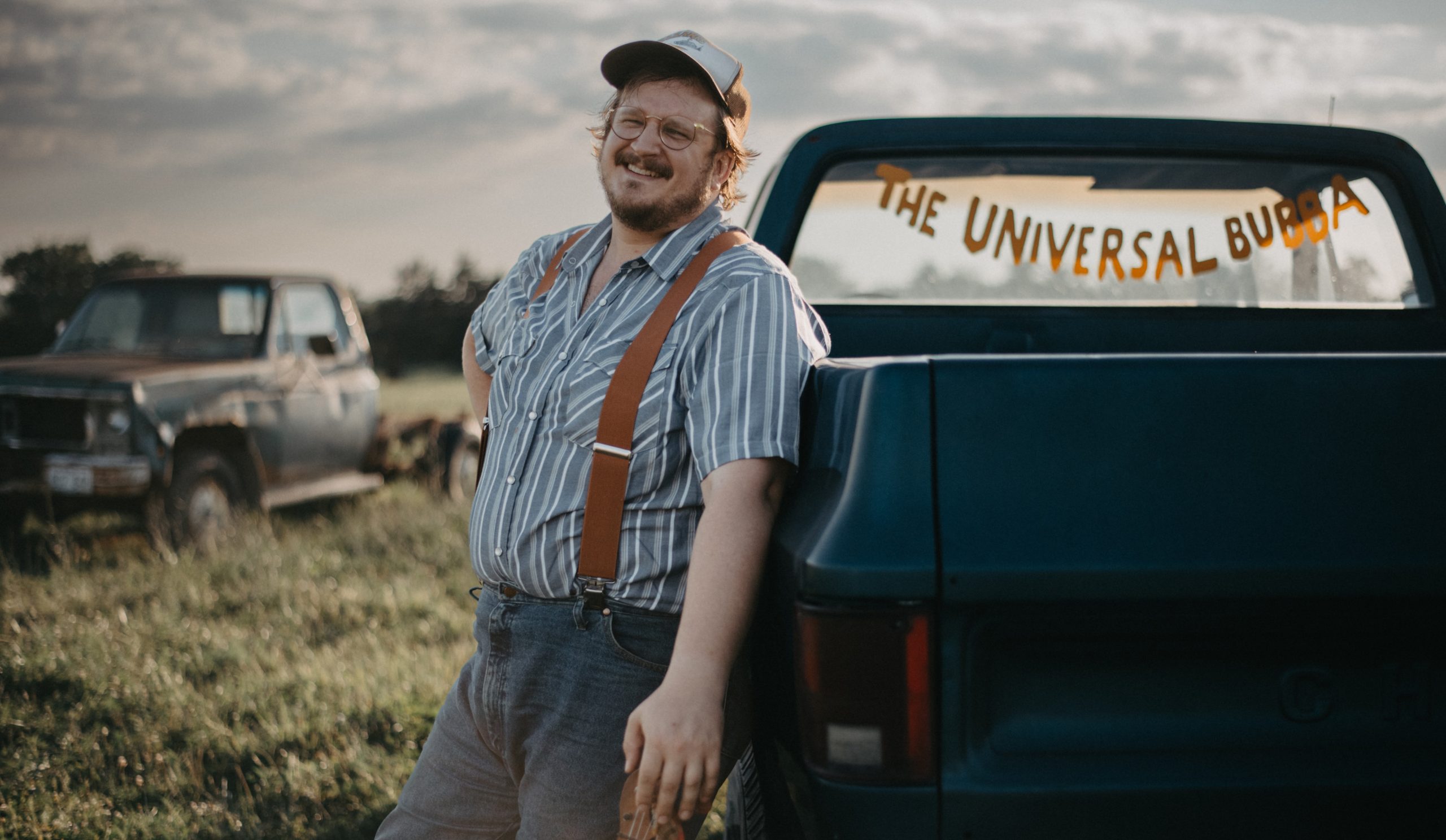
Prolific Arkansas-forged folk/country artist Willi Carlisle’s “The Universal Bubba,” out today on Signature Sounds, is a rollicking, electrified double album that Carlisle describes as “17 songs about ditch diggers, horse girls, existential crises at Chinese buffets, and the Universal Bubba who can fix anything.”
His third album in three years following 2024’s “Critterland” and 2025’s “Winged Victory” (and his fifth full-length studio effort generally), “The Universal Bubba” is sure to continue Carlisle’s ascendency to national prominence and acclaim, as much for its typically evocative storytelling and sustained musical excellence as for the fact that it’s the first album produced by alt-country star Tyler Childers. With Childers and some of his bandmates on board, Carlisle’s already sturdy frame often gains a newfound musculature, with many of the songs shifting into an uncharted, rocking sonic territory for the old-time music maestro.
Carlisle sat down with the Arkansas Times on the eve of a months-long tour to chat about his collaboration with Childers, the stories and themes that drive “The Universal Bubba,” 13-foot-tall puppets and much more.
The following conversation has been edited for length and clarity.
The big-ticket news item with “The Universal Bubba” is the involvement of Tyler Childers. How did that come to be?
I was opening for him in Australia and we just started having conversations, talking about songs and songwriting. We primarily talked about old-time music at first, and we sat down and played a bunch of old-time tunes: He played fiddle, I played banjo and we just kind of connected over our shared love of this vernacular music. We were at roughly the same level in terms of our playing, which was really fun. Nobody was ripping solos over one another or anything. My team was like, “Well, would you like to maybe work with him?” I wouldn’t have thought to do that, but we pitched him and it worked!
How do you think that collaboration added to or changed the writing or recording process?
In terms of how the record turned out as a result, the writing was still in my hands. I showed up with about 80% of the record, 90% really. Tyler took it over the finish line; he did one co-write with me and made some little suggestions here and there. In terms of the musicality, Tyler brought three members of his band, and we hired out from people in New Orleans, which is, of course, an astoundingly good musical scene. And we also had the great addition of a couple of other famous Kentuckians, Hayden and Kenny Miles. All those guys had a shorthand, they’ve been playing music together over a decade. I play alone a lot of time, so I was relying on their shorthand to make it make sense, and relying on our shared vernacular music vocabulary to fill in any gaps.
Can you talk about the sonic diversity on this record, and in particular, how having this new band might have created a heavier sound at times?
I’ll totally accept “heavy.” That band has a really wide vocabulary and are pushing themselves into this region of Appalachian-funk-fiddle-tune interpolation. Taking the old materials and cracking them open, turning them inside out, seeing what they see. Their ability to add electrification to that, and a broad spectrum of sounds that you can only get when you’re a lot more familiar with rock ’n’ roll than I am? I’ve never owned an electric instrument for more than, like, a couple of months before I got rid of it or traded it for a banjo or something.
The rhythm section did a lot of that work. They really thought about groove a lot. And because I don’t work with a drum kit usually, I think about grooves in a significantly different way. In old-time music, it’s the interplay between the banjo and the fiddle. So, it was like we were able to approach things from a bunch of different levels and places, and they were able to be on a level that I had never been to in terms of sheer volume.
Bringing in songs that are 80 or 90% written, did you have a vision for which ones were going to get the full-band treatment versus which ones were going to remain more in the old-time music lane?
No. On the demos I brought to these guys, I’m playing everything. I’m playing the bass, which I don’t play that well. If there’s percussion in it, I was literally clapping and banging on a pot. But I also brought in a bunch of references to music that I wanted it to sound like, which was a really broad swath of Americana from Pure Prairie League, to The Byrds, to Drive-By Truckers. I was interested in saying, “What if we tried to do old-time influenced southern rock?” And then I think that they took it to a funky, freakier place in a really cool way.
To be honest, a big difference between me and Tyler is that Tyler has a major record deal and an advertising budget that would blow my wig off. I’m at a little tiny label, my advertising budget is pretty much “please tell your grandmother.” It makes me feel free to experiment and I know it made those guys free to experiment because they were under a lot less scrutiny, and the stakes were a little lower for them.
“Universal Bubba, Part One” and “Part Two” occupy the central physical place on the double record, and they also are the title track. Tell me about why you gave them such prominent placement and what the Universal Bubba concept means to you.
It had to be the heart of the record because it’s what binds all these characters together. The record has all kinds of perspectives. I’m doing more ventriloquism than ever, more writing from the perspective of others than I’ve ever done. I wanted there to be a unifying statement that comes in the chorus of both those “Universal Bubba” tracks. And this idea of the Universal Bubba is that it’s a thing that lives inside of all of us. It’s the indefatigable spirit of progress. It’s the good side of the Protestant work ethic, the part that says, “We’re gonna improve together.”
I like to think of the Universal Bubba as a small-town teacher who maybe only gets a plaque on a wall, but who influences generations of people to be a little bit better. I think of my grandmother as a Universal Bubba. In fact, I wrote the chorus at my grandmother’s house, because she was the glue that held the family together. There was so much joy in watching her chop probably her millionth onion while also looking after a couple of other people’s babies. She was just capable in a way that made the world better in her context all the time, and that capability was a fundamental optimism about the world. It wasn’t, “The world is ending, and there’s nothing we can do.” It was, “I am ending, my life is ending, but there’s so much I can do.” I just loved that. And I couldn’t stop writing once I came up with the concept.
When you have the germ of a new song, what is it that starts to excite you and gets you dug in, staying up all night to finish it?
A funny turn of phrase that meets a melody and a rhythm. It doesn’t even have to be funny, it just has to tickle a little bit. It can be very somber content as long as it tickles. And, when rhythm and melody and phraseology meet, it has all of those things that end up stuck in your head, right? What fun to invent something that gets stuck in your own head.
Humor and linguistic playfulness seem very central to your work. Why is that?
I like to try to write something that would entertain anyone, a child or an old person. I like that humor crosses social and political and class boundaries pretty easily when it involves rhythm and music. I like that good humor punches up. That really helps me with the feeling that music should be community-oriented and egalitarian.
Would you say that your consistent and varied use of puppetry in live performances and music videos stems from some of those same instincts, or is there some other motivation behind that?
Absolutely, and no, there’s no other motivation. A puppet is simple magic. It works for a child, and you ask an adult, “Hey, can you please access your inner child for a moment?” There’s two responses: The adult is terrified, because their inner child is terrified, or they’re delighted, because their inner child is delighted. Those two reactions are so protean, and so rare, in what we actually get to experience.
I’m not gonna compete with TV and I’m not gonna compete with country singers that are, honestly, like Tyler Childers, that many millions of people listen to. So instead, we’re gonna compete at a lower level and it’s gonna be joyful, right? It’s gonna be great, because we can ask those really fundamental questions, like, “Hey, would you please engage with this in a way that isn’t Netflix?” We can’t offer you an explosion, but we can offer you a 13-foot-tall puppet.
We’ve got a puppeteer that travels with us. There’s visuals and puppets for every single song on tour and a set we bring everywhere with us. I’m really proud to have it become a carnivalesque experience. I think that makes it really fun and unique and a good value. And we try to make that good value with plywood and cheap amps.
Something you often do is fuse some unexpected subject matter together with very specific settings. I’m thinking, on the new album, of “Marlboro, Vinyasa,” with a dive yoga bar, or “Golden Dragon Buffet,” where you’re contemplating death and relationships at a Chinese restaurant. How did those ideas come to be?
You look for the marriage between the banal and the sacred. You look for the times when they’re shaking hands. The ugliness of beauty and beauty of ugliness, hanging out together. As far as dive bars and Chinese restaurants, name five other third spaces, right? I’m definitely choosing those because I want to celebrate third spaces where people go and I find it to be this really unifying thing to try to elevate common spaces, because they are being taken away from us. We already are spending more time with the small casinos that we carry in our pockets than we are doing things like yoga, going to a dive bar, thinking about life or death, or getting dinner together. So I’m definitely doing it on purpose as a part of the larger ideology of the thing, but another part of me has actually had a lot of existential crises in buffets.
I saw you call some square dancing at the Arkansas Folklife Festival earlier this year, and you talk about and play a lot of old-time music. How important to you is the preservation of things like square dancing and folk music, and where do you view your place in that preservation?
It’s incredibly important to me, and I view myself as a liaison. If I’m gonna make a living playing music then I can’t primarily play non-commercial American folk music. But I can try to be a liaison to the kind of community spirit, the spirit of reciprocity and group solidarity and orality that is present in that community.
I think of myself as a gateway drug. I would never pretend to be as good as the people that I learn about because most of them spend their entire lives on the human craft. But I enjoy being a liaison to it because it keeps a foot in that other world, keeps a foot in the 19th century, in the immigrant experience in America, in the last voice that hasn’t been crushed of people spreading music amongst each other on purpose, before there was a mass media apparati to get it to us. And it’s just so much fun and leads to so much of my very best friendships around the world.
I sat down in Scotland with an old woman who plays primarily English dance music, and she and I played Canadian old-time music that I learned from a guy who was visiting Arkansas. And we had no names in common, just the tunes. The rest of the night, we sat there learning from each other and it was so cool that thousands of miles apart it was exactly the same. These ways of knowing? I see them as meaningful alternatives to what is an apocalyptic cultural end run, right? The idea that “Oh, you don’t need to learn an instrument. You just need an AI, you don’t need to actually learn to write. We have things that will write for us, or read for us.” Instead, this says, “No, the whole point is the community.” And it demolishes the myth of individual genius. I’m lucky to be bathing in the waters of what came before and to be really proud of that lineage.
Source link