what NASA says happens next « Euro Weekly News
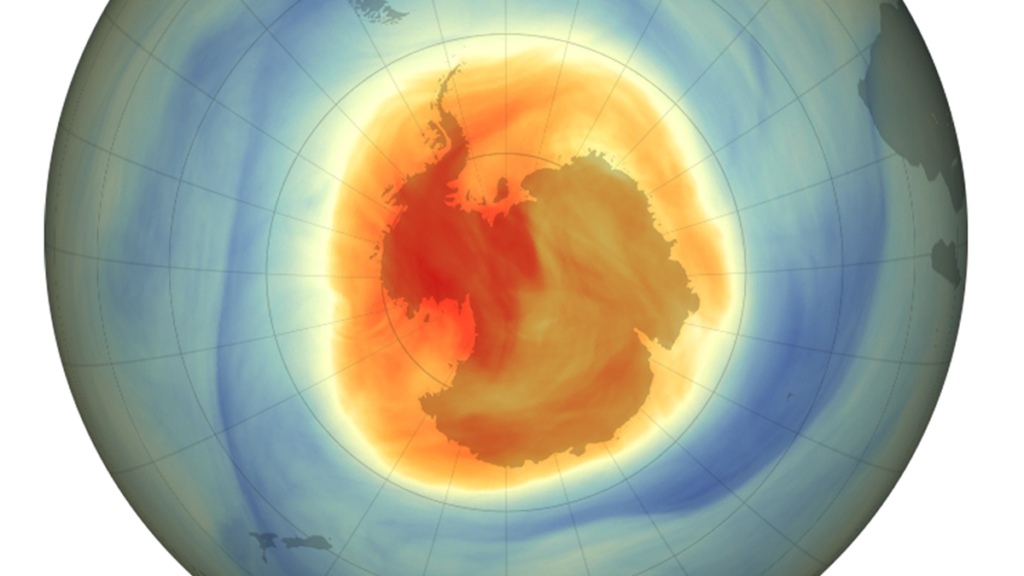
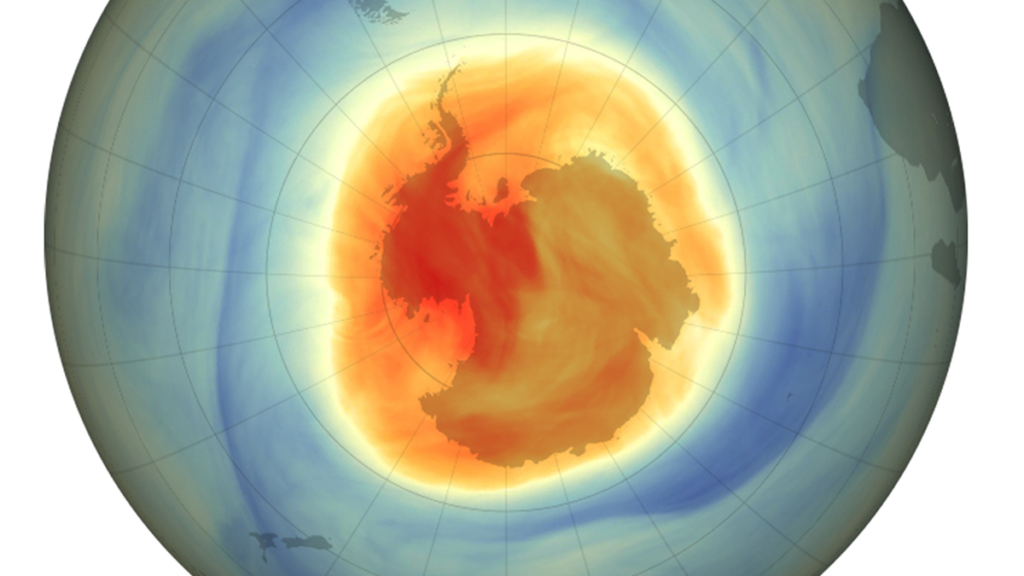
The Antarctic ozone hole on September 18, the day it reached its peak size. Credit: NASA Earth Observatory / Lauren Dauphin
The hole in the ozone layer above Antarctica has grown to its biggest size in 10 years, covering an area larger than the whole of North America at its peak. NASA and NOAA have now laid out what caused it, how scientists measured it and how far the long road to recovery has come.
The ozone hole peaked at 27.1 million square kilometres
Scientists at NASA and the US National Oceanic and Atmospheric Administration (NOAA) said the hole over the South Pole reached its maximum on Friday September 18, covering 27.1 million square kilometres (10.5 million square miles). That’s bigger than the whole of North America, and it makes this the largest ozone hole for a decade.
Across the whole stretch from September 7 to October 13, it averaged 25 million square kilometres (9.6 million square miles), which is more than twice the size of the United States. At its peak it reached about 90 per cent of the biggest hole ever recorded, which came on September 9, 2000.
It’s now the seventh biggest in 48 years of monitoring, though it wasn’t as deep as the record holes of 10 to 20 years ago. It’s also a sharp jump from last year, when the hole ranked as the fifth smallest since 1992, so the swing has been enough to catch plenty of people off guard.
How scientists keep watch from the bottom of the world
Teams at the South Pole Baseline Atmospheric Observatory launch weather balloons carrying ozone-measuring instruments, known as ozonesondes, up through the sky, with one such launch carried out on October 18. A Dobson spectrophotometer, an optical instrument, also measures the total amount of ozone overhead.
Scientists count the hole as the area where ozone falls below 220 Dobson units, which is why the map NASA released shows it in warm colours against the paler surroundings.
Satellites have been tracking the ozone layer since 1979, with NASA’s Aura, NOAA-20, NOAA-21 and the joint NASA and NOAA Suomi NPP satellite among those named in the latest findings.
Those readings showed the thinnest point directly above the pole was 105 Dobson units on October 17. That’s the scientists’ standard measure, where 100 units would squash all the ozone overhead into a layer just one millimetre thick at ground level, and it sits well above the lowest value ever recorded over the South Pole, 92 units in October 2006.
Weather helped the hole stay open
Every southern spring a hole opens in the ozone layer above Antarctica, and this year scientists say it simply refused to close up as quickly as usual.
The damage starts with human-made chemicals containing chlorine and bromine, which drift up into the stratosphere (the layer of atmosphere high above the weather). There, ultraviolet light breaks them down, and the freed atoms attack ozone on the surface of clouds that form in the freezing Antarctic air.
Paul Newman, a longtime leader of NASA’s ozone research team, said an unusually powerful polar vortex had “extended ozone depletion in the Antarctic this season”. NOAA’s Amy Butler explained that weak weather waves in August and September kept the strongest winds several degrees of latitude further from the pole, which let the vortex stay large and widened the area where ozone is destroyed.
Newman added that the hole could have been 1 to 2 million square miles bigger still if ozone-damaging chemicals were as common as they were at their peak in 2000.
The long-term recovery is still on track
So why aren’t scientists sounding the alarm? Because the chemicals behind the damage, including chlorofluorocarbons (CFCs) once used in aerosols, fridges and air conditioners, were replaced under the 1987 Montreal Protocol, an international treaty. NOAA‘s Stephen Montzka said chlorine from those chemicals in the Antarctic atmosphere has now fallen by about a third from its 1980s peak.
NASA and NOAA say the layer is still expected to recover by the 2070s. That long wait is down to how stubborn the old chemicals are, as they can linger for decades in the atmosphere and inside old products and landfills. Newman also pointed out that in recent years the hole has been forming later in the season, which he said shows the ozone layer is healing. Last year’s fifth-smallest hole and this year’s big one show how much a single season’s weather can swing the picture, even as the chemistry underneath keeps improving.
Why the ozone layer is worth guarding
High up in the stratosphere, the ozone layer acts as a shield that soaks up much of the sun’s harmful UV radiation before it reaches the ground. Thinner cover lets more through, which raises the risk of skin cancer and cataracts in people, and of damage to animals, plants and crops. That’s why scientists track the hole’s size every year, and why a swing as big as this year’s gets so much attention.
It’s also worth knowing this is a different thing from the ozone that turns up in air pollution reports. Ozone in the stratosphere protects life, while ozone at ground level is a pollutant, so the two shouldn’t be mixed up.
The findings from NASA and NOAA concern the Antarctic and don’t address any change in UV levels elsewhere. So the next test comes when the hole reforms next southern spring, when scientists will be watching to see whether it starts forming later in the season again.