
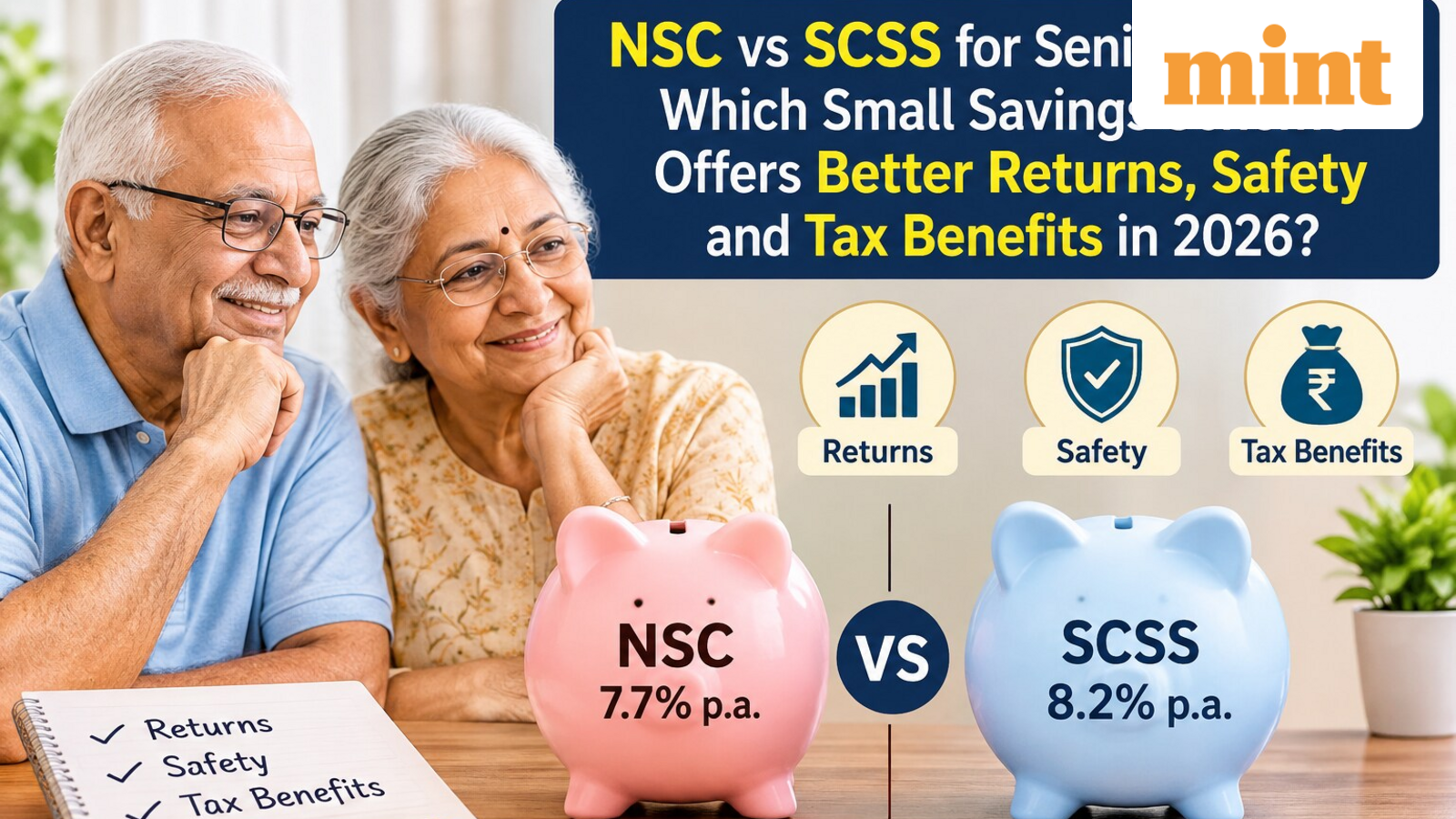
NSC vs SCSS for senior citizens: Which small savings scheme offers better returns, safety and tax benefits in 2026?
If you are a senior citizen looking to invest your retirement savings, you can definitely consider popular small savings schemes such as the National Savings Certificate (NSC) and Senior Citizens Savings Scheme (SCSS).
These schemes have the potential to offer you predictable returns, peace of mind, and capital security, even in a volatile economic environment. Now, both of these investment options offer investors fixed returns and sovereign backing; they differ in interest rates, payout frequency, investment limits, and tax treatment.
Having a clear understanding of the salient features of these schemes and the returns they offer, along with the tax benefits, can help you make wise investment decisions.
For the October-December 2026 quarter, SCSS offers a higher interest rate of 8.2%, compared with 7.7% for NSC. Still, the better investment option doesn’t depend solely on the headline rate an investment offers; it depends on whether investors prioritise a regular income stream or long-term wealth accumulation.
The eventual decision, hence, depends on the kind of investment strategy one has and what they aspire to achieve in the years to come.
Keeping these basics in mind, let us discuss the salient features of NSC and SCSS schemes and which scheme can ultimately provide a senior-citizen investor with better returns.
Which scheme offers better returns and tax benefits?
It is clear that the SCSS scheme offers a higher interest rate than the NSC scheme. The SCSS scheme is also designed especially for senior citizens. For example, a ₹30 lakh SCSS investment at 8.2% can generate about ₹61,500 per quarter, or about ₹2.46 lakh annually, before taxation.
The NSC scheme, on the other hand, is suitable for investors who do not need periodic income and prefer to accumulate interest until maturity. A ₹1 lakh investment in this scheme grows to approximately ₹1.45 lakh in 5 years at 7.7%.
Both the schemes qualify for tax deductions on eligible investments under the old tax regime, subject to the overall limit of ₹1.5 lakh. Still, their interest income is taxable at the investor’s applicable tax rate.
The verdict: Which scheme should senior citizens opt for?
To explain this, let us take a simple example: an investment of ₹5 lakh each in the Senior Citizens Savings Scheme and the National Savings Certificate for 5 years will yield a total interest of ₹2,05,000 paid out regularly in SCSS, and a lump-sum maturity value of approximately ₹7,24,517 in NSC.
Furthermore, the total cash received in the SCSS scheme will be ₹7,05,000 over 5 years (regular payouts) and in NSC it will be ₹7,24,517 as a lump sum at 5 years.
After considering all factors, it is clear that SCSS is generally the better investment choice for a senior citizen seeking higher returns and predictable quarterly income, rather than locking in funds for half a decade for a relatively lower interest benefit in NSC of about ₹19,500 on an investment of ₹5 lakh for 5 years in both schemes.
Another important consideration is that the SCSS quarterly income can be reinvested to generate more money; thus, with strategic planning, it can even eclipse the returns of the NSC scheme.
Further, the NSC scheme can be beneficial for investors willing to wait and lock away funds without needing regular payouts. Hence, investors should seek professional advice and consider their income requirements, tax bracket, and liquidity needs before opting for any investment scheme between the two, to ensure a meaningful investment decision.
Disclaimer: Interest rates are based on October–December 2026 rates and are subject to government rules. Interest income is taxable at the applicable slab rate. Tax deductions are available under the old tax regime, subject to prescribed limits. Investors should verify the latest rules and consider their financial goals and tax liability before investing.