Why the French are going crazy for chocolate marshmallow bears

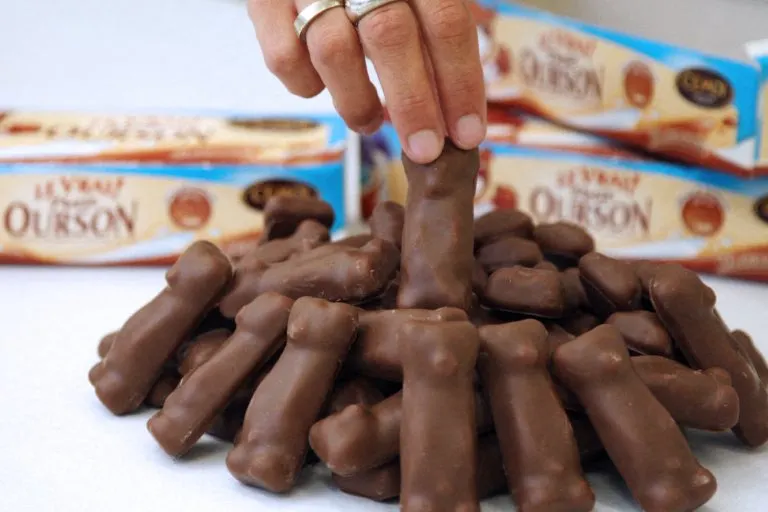
A cheap sweet snack beloved by French children, the marshmallow chocolate teddy bear has been given a luxury makeover by French pastry chefs, one of whom even touts it as ‘the new macaron’.
You’ll see bags of them on the shelves of every French supermarket – ourson en guimauve enrobé de chocolat, but now the chocolate-covered marshallow bear has been given a luxury makeover.
Pastry chef Christophe Michalak first introduced chocolate bear at the Plaza Athénée in the early 2000s. Since then, the trend has taken off and social media has seized upon it: pop-up shops are springing up everywhere, and no chocolatier or pastry chef seems able to do without them.
A far cry from the supermarket version – cheap chocolate over factory-produced marshmallow – in the world of luxury bears, anything goes.
From fine-quality chocolates to marshmallow at Michalak’s, passion fruit confit at Pierre Hermé, ‘poured’ rather than moulded teddy bears at La Maison du Chocolat, and flaky praline at Caffet, which has even registered the trademark ‘Undoubtedly the best teddy bears in the world’.
The original bears first hit the shelves in 1962 from the Bouquet d’Or chocolate factory – since acquired by Cémoi – in Villeneuve-d’Ascq, north east France, who still produce them today.
The product rapidly took off and the factory opened several new production lines.
So is it threatened by the new high-end versions?
Boss Armando Mendes, interviewed by AFP, does not speak of competition but of “emulation”.
“Generally speaking, it is usually the manufacturers who copy the artisans, but in this case it is the artisans who have taken up the idea of the teddy bear,” said Sylvie Douce, founder of the Salon du Chocolat and owner of Le Boissier, a specialist in traditional confectionery.
For her, its success is down to psychology. “The bear is the quintessential transitional object. The chocolate-marshmallow teddy bear has a comforting, taste-based aspect.”
“The chocolate represents the reassuring, firm side, and the marshmallow the soft, fluffy side. With the teddy bear, there’s also an element of impulse, because you eat it whilst trying to tear off its head or a foot first – it’s a real treat,” she said.
“These days, consumers need reassurance,” agrees chef Pascal Caffet, who claims to have sold over 400,000 teddy bears in a year.
“Chocolatiers need entry-level products,” and these impulse buys offer customers a taste of luxury at a reasonable price, says Patrick Morlière, managing director of La Maison du Chocolat, which launched its teddy bear in September, achieving “incredible (sales) figures”.
The bear remains a French speciality and is rarely exported: its marshmallow – sugar paste that has been gelled and then oven-dried – does not have the same consistency as American marshmallow.
“In the United States, this market doesn’t exist yet, but it’s only a matter of time,” predicts Patrick Morlière.
In Asia, “it’s more complicated”, as sugar is less widely accepted in confectionery.
It does, however, have cousins abroad: the Norwegian Bamsemums, also bear-shaped; the Danish flødeboller; the German Schokokuss; the Israeli Krembo; and the British Tunnock’s teacake.
The little bear also features throughout the marketing calendar: Halloween at Lignac, gift boxes for teachers at Caffet, Valentine’s Day, Advent calendars, Easter.
Stéphane Jitiaux, CEO at Michalak, said the bear might even be on course to overtake the beloved French staple the macaron, saying: “For years, everyone has been looking for the macaron’s successor.”
One of France’s leading macaron makers, Pierre Hermé, is the latest to be won over by the bears, offering a chocolate and praline-filled version in his shops.
He nevertheless added that he is tired of “hearing for the past 10 years that the macaron is dead”.