Study says Red Knots mostly skip Delaware beaches during migration
Red Knot Numbers
Listen to the full interview with Jon Hurdle discussing his latest reporting on Red Knots and their migratory patterns.
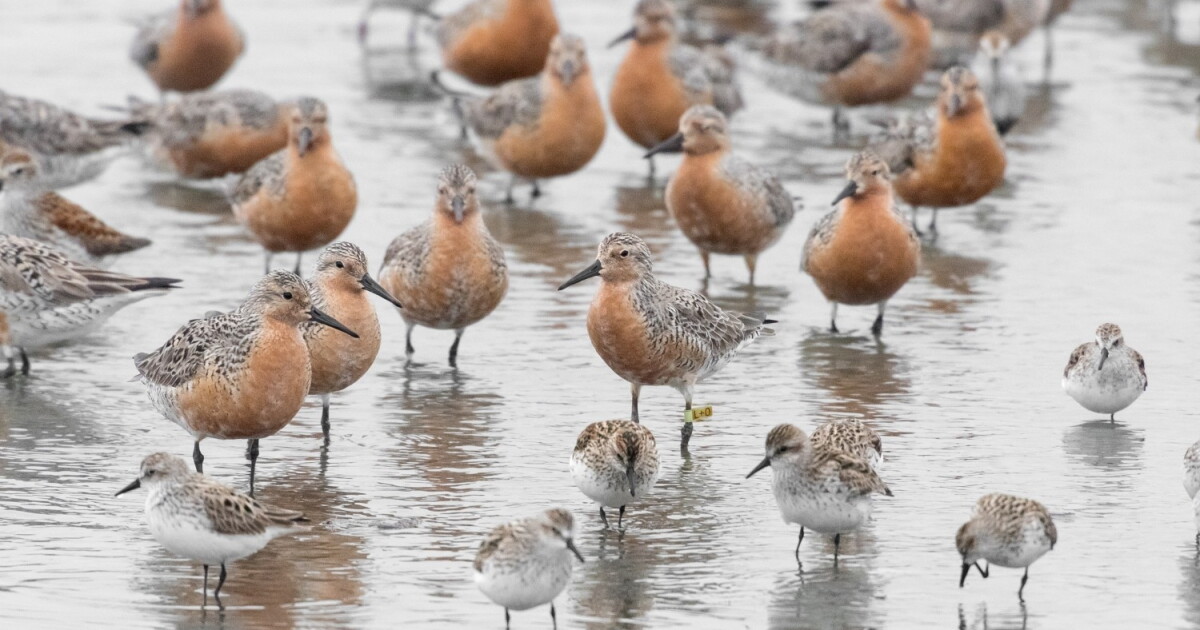
The Red Knot shorebird is largely bypassing Delaware during its globe-spanning migration each spring because the state doesn’t protect crucial beaches from human disturbance, and hasn’t done enough to create good conditions for horseshoe crabs, whose eggs feed the birds, according to a new study on the bird’s habits over the last 40 years.
Instead of spending a week or two at the Delaware shore to put on weight for its ongoing migration to Arctic breeding grounds, the robin-sized birds stop off mostly on the New Jersey side of the Delaware Bay where more beaches attract the crabs, and where the fishing industry is banned by state law from catching the creatures for bait.
Despite being named the official state migratory bird by a Delaware law in 2025, a declining number of the birds have been in seen in Delaware during its brief migratory season in the second half of May since the mid-1980s, says the study, by researchers including Stephanie Feigin and Larry Niles, who have both long worked on conservation of the Red Knot and other shorebirds.
From 2019 to 2025, more than 85 percent of the birds flew via New Jersey. The number exceeded 97 percent in four of the last five years, following more equal shares in the 1980s and early 1990s before horseshoe crabs were decimated by over-harvesting on beaches on both sides of the bay, said the peer-reviewed study, titled “Long Term Population Trends and Spatial Redistribution of Shorebirds at a Critical Migratory Stopover.”
It attributed the trend to stronger protections for the birds and more effective habitat restoration on the New Jersey side of the bay.
But another study of Red Knot migration through Delaware this year found more of the birds visited the bay shore, stayed longer, and gained weight at or above expected weights. Delaware’s Department of Natural Resources and Environmental Control (DNREC) said the number of Red Knots visiting the Delaware side of the bay increased in 2026 after several seasons of decline. The Delaware Shorebird Project counted at least 1,000 of the birds per day at Kent County’s Mispillion Harbor – long a magnet for migrating shorebirds — peaking at some 3,000 on May 20.
The Delaware study, issued in July, noted the birds’ recent preference for New Jersey, and attributed that to more suitable habitat, including protected roosting marsh next to foraging beaches. Relatively warm and shallow coastal waters may also have helped attract the birds to New Jersey again this year, DNREC said.
This season could have been poor for the birds because early cold limited crab spawning, but favorable conditions at Mispillion Harbor increased the numbers visiting the Delaware side.
“In a year which could have been potentially disastrous for Red Knot with delayed horseshoe crab spawning, Mispillion Habor seems to have provided a safe haven for these birds and the horseshoe crabs they depend on,” DNREC said.
Globally, the population of many shorebirds has declined significantly in recent decades because of habitat loss, coastal development, and rising seas flooding breeding and staging areas. The Red Knot has received special attention in part because of its federally-threatened status, and its designation as an endangered species in Delaware and New Jersey.
The Red Knot has drawn the attention of naturalists also because of its very long migration from as far south as southern Argentina to Arctic Canada – making it one of the longest migrations in the avian world – and some predictions that so-called long-distance birds that migrate the farthest have declined so much that they cannot be saved, and will eventually become extinct.
Although the number ofRed Knots migrating through the Delaware Bay has risen from a low of some 6,800 in 2021, according to a count by Niles and his team, the latest level of around 30,000 is still only about a third of its population before the overharvesting of horseshoe crabs in the late 1990 and early 2000s caused the shorebird population to crash.
A quarter-century later, the harvest of horseshoe crabs, partly for bait, is still allowed by the Atlantic States Marine Fisheries Commission, a federal regulator, which issues quotas to states for the catch of horseshoe crabs and other marine species.
Seeking to balance commercial fishery needs with those of migrating shorebirds, the commission banned the harvest of female horseshoe crabs in the Delaware Bay starting in 2013 – a policy that won’t be reviewed until the fall of 2027. The regulator says the population of horseshoe crabs in the bay is increasing but conservationists say the species, and all that depend on it, can’t fully recover unless the harvest is completely banned.
The harvest is also driven by demand for horseshoe crab blood used by the pharmaceutical industry for the manufacture of LAL, a reagent that detects toxins in medical products. Although a synthetic alternative is now available – and has been endorsed by the industry’s scientific standards group, USP – big pharma as a whole is being slow to switch, sustaining demand for crab blood, and resulting in the needless deaths of at least 15 percent of the crabs, conservationists say.
By continuing to rely mostly on the crab-based product, the pharma industry is unnecessarily exposing itself to a supply interruption at a time when a man-made alternative is equivalent in cost and effectiveness and is easily available, Niles said.
“The pharma companies around the world are taking a huge risk by accepting agency numbers and relying on horseshoe crab blood when they can easily switch to a more reliable synthetic product,” he said in an interview.
In the Delaware Bay, the Red Knot has become an indicator species of what some conservationists see as a broad ecological decline, based on the continued harvest of horseshoe crabs, leading to a shortage of eggs for Red Knots and other migrating shorebirds, as well as the depletion of other marine species such as eels and whelks that feed on crab eggs.
The density of crab eggs on New Jersey’s migration beaches has not recovered from the crash caused by overharvesting a quarter century ago and is still only about a fifth of its level before that, Niles says.
After Superstorm Sandy destroyed some 70 percent of New Jersey’s horseshoe crab spawning habitat in 2012, naturalists rebuilt crab-friendly habitat in more than a mile of coastline there. Although Delaware also rebuilt parts of its coastline after the monster storm, that work resulted in beaches that were less useful for crab spawning and bird foraging, the study said.
Still, the Feigin/Niles study is a “roadmap rather than a rebuke” for Delaware, the authors said. They urged the state to re-make beaches with the same sand specification as those in New Jersey that attract horseshoe crabs, and to restrict crucial beaches from human disturbance, a low-cost technique that has helped Red Knot conservation on the eastern side of the bay.
“If we want Red Knots to actually recover, not just crowd into fewer and fewer beaches, we need to rebuild horseshoe crab habitat at that same level of quality across the whole bay, including on the Delaware side,” Feigin said in a statement.