What we know so far about the deadly train crash in central Spain
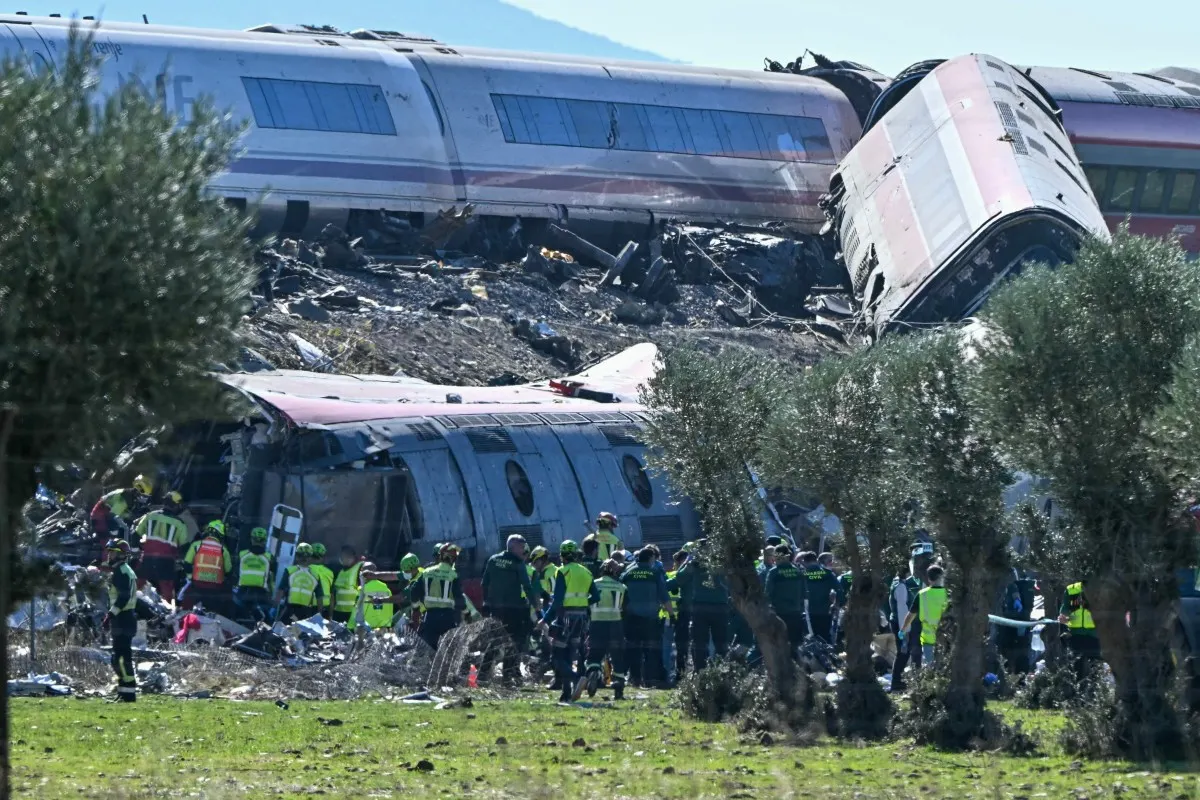
Two high-speed trains collided on Wednesday in the province of Toledo. Here’s what we know so far about the number of fatalities, why the accident occurred and what’s currently happening on the ground.
Q: What exactly happened?
A: Two high-speed trains collided at 8:54am on Wednesday morning in central Spain. The accident involved a Renfe AVE train and an Iryo train, which were both travelling from Madrid to Seville.
According to sources from Spain’s 112 emergency services, two carriages derailed and fell into an embankment after one train crashed into the back of another train – which wasn’t moving – “at a speed of up to 200km/h” according to Spain’s transport minister.
Q: Where exactly did it take place?
A: The accident occurred in the province of Toledo in Castilla-La Mancha, between the towns of Mora, Orgaz, and Urda, about 1 hour and 40 minutes’ drive south from the Spanish capital.
READ ALSO: Death toll rises to 68 as two trains collide in central Spain
Q: What caused the collision?
A: The exact cause of the crash is still being determined, although initial theories are pointing to a “human error by an Adif operator” following the detection of a “failure in the main signalling system”. That’s according to Spain’s Ministry of Transport and Adif itself, the country’s rail infrastructure manager.
This malfunction led to the signalling system being switched to manual operation at Madrid’s Atocha station and trains on that line were stopped for several minutes.
The theory is that the Renfe train was instructed to continue as normal, even though a few kilometres ahead an Iryo train remained stagnant on the tracks.
Q: How many people have been killed?
A: The exact number of fatalities is not yet known, and the number is continuing to rise. The regional government of Castilla-La Mancha has said that at least 68 deaths have been confirmed as a result of the accident, a figure that’s kept rising throughout the day.
The president of Castilla-La Mancha, Emiliano García-Page, has indicated that 12 forensic experts have been deployed to the area and that “unfortunately, we expect more fatalities”.
Q: What about those who have been injured?
A: Page has stated that 30 people have been treated for minor injuries while approximately 50 others have injuries with varying degrees of severity. He indicated that some are in a “very serious” condition. The number of people injured has since surpassed 100, according to the latest reports by regional authorities
There was an estimated total of 544 passengers on board the two trains.
Q: What is currently happening at the crash site?
A: Sources from the Civil Guard report that officers are currently deployed within a 500-metre radius of the accident site to search for people, given the huge force of the collision.
They are also attempting to recover passengers’ personal belongings and any evidence that may aid in the investigation to determine the cause of the accident.
Residents in the nearby town of Los Yébenes (Toledo) have organised an urgent collection of water and food to be delivered to people near the trains, while the sports pavilion in Urda has been converted into a field triage and reception centre.
The president of Renfe, Álvaro Fernández Heredia, has also travelled to the site of the accident.
Q: I am worried that someone I know may have been on board, how can I find out more information?
A: The Plan for Assistance to Victims of Railway Accidents and their Families has been activated. You can call the special telephone helpline for more information on 900 10 10 20.
Iryo has also established a separate assistance number on 900 001 403 for those affected.
Q: What has happened to rail services in the area?
A: Adif has suspended all rail traffic between Madrid and the south of Spain until further notice.
Q: What should I do if I’m due to travel along this route today?
A: The Ministry of Transport has asked passengers with tickets for this route not to go to the stations. It is unlikely you will be able to travel any time soon, but it’s best to check with your rail operator and find out about getting a refund. Buses and regional air carriers are adding emergency routes.