Across Connecticut, anxiety fuels data center backlash
Local officials in many parts of Connecticut are not waiting for the national data center boom to come to them.
Earlier this month, for example, the East Lyme Zoning Commission voted unanimously to adopt an indefinite ban on all data center development, one of the first such blanket prohibitions in Connecticut. The ban, which goes into effect on Saturday, came before anyone had announced even the faintest plan to construct a data center in the coastal town.
“It seems like all over the country, they’re trying to figure out the effects of pollution, energy consumption, chemical runoffs,” Anne Thurlow, the chairwoman of East Lyme’s Zoning Commission, said during an August meeting.
“I think it’s a good thing to ban them until we know more about them,” Thurlow added. “It could always be reversed if the town wanted to.”
East Lyme is one of around half a dozen municipalities that have taken preemptive action to block data center development, either through temporary moratoriums or a complete ban, according to a review of public meetings and records by the Connecticut Mirror.
Moratoriums have been passed in communities big and small, suburban and rural. New Haven passed a one-year moratorium in September, with an exemption for the city’s existing quantum computing hub. Morris, a town in the Litchfield Hills with fewer than 3,000 residents, has a two-year ban.
“The Connecticut case is quite interesting because many other places in the country, when we see these protests and opposition, either something has started or something is already there,” said Subodha Kumar, a professor statistics, operations and data science at Temple University’s Fox School of Business.
But in Connecticut, he said, political pushback has formed well ahead of actual plans for development.
“Connecticut has never been that attractive, frankly speaking, for data centers,” Kumar said.
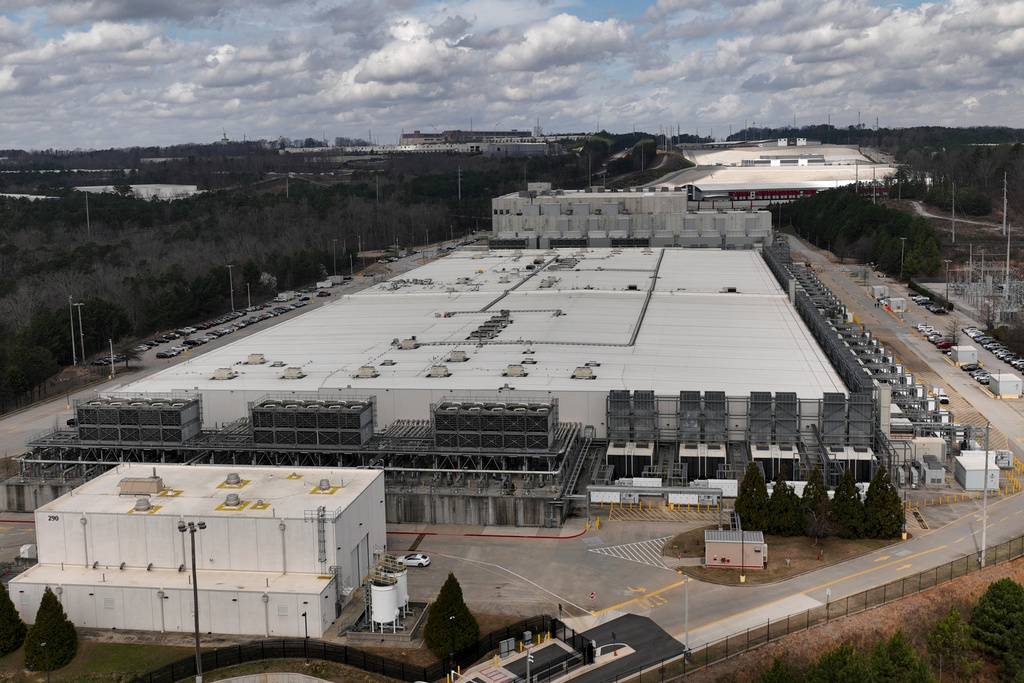
The development of large “hyperscale” data centers in Connecticut, and to a greater extent in New England, has been stymied by the high cost of electricity, along with the need to access to utility infrastructure and large plots of land to house thousands of servers, which can easily cover several football fields.
In 2021, Connecticut lawmakers fast-tracked legislation to lure data center developers by promising to waive sales and use taxes for projects that invest at least $200 million in the state (or $50 million for projects located within certain state-designated enterprise zones). To date, the only project to take advantage of that exemption: Cigna’s $386 million renovation of an existing data center in Windsor.
Thurlow said that the effort in East Lyme was driven, in part, as a reaction to a proposal to erect a massive new data center facility next door in Waterford, which is home to the Millstone Nuclear Power Station. The planned facility would have drawn its power directly from Millstone, a setup known as co-location.
But local pushback and years of delays ended up killing that project, according to Waterford First Selectman Robert Brule, who told the Connecticut Mirror last month that he and the town were no longer interested in hosting data centers.
“We’d rather produce the energy now than produce a project that sucks up the energy,” Brule said.
The Department of Economic and Community Development, which oversees the data center tax incentive program, said it has reviewed only two applications under the program since it began and none this year. The credit has become an issue in the gubernatorial election, with Republican candidate Sen. Ryan Fazio arguing that the tax incentive should be ended.
A spokesperson for Gov. Ned Lamont said that the governor was open to discussing changing or eliminating the credit, adding that the tax incentive was never intended for large AI data centers and “should be clarified to ensure it is never used by a hyperscale data center and that data centers bring their own power.”
The law also exempted qualified projects from local property taxes but requires developers to enter into a host fee agreement with any municipality in which a data center is located.
Randy Collins, a lobbyist at the Connecticut Conference of Municipalities, said developers argued that it would be “economically unfeasible” to invest millions of dollars into the necessary equipment for data centers without offsetting some of the taxes.
But despite a handful of towns successfully negotiating host fee agreements, Collins said developers have been slow to actually take advantage of the tax breaks.
“If you look at the resources and requirements going in, they’re not just going to be popping up everywhere,” Collins said.
Still, the issue has drawn considerable attention. Democrats in the state Senate say the moment requires new policy, with Senate Majority Leader Bob Duff announcing this week that he intends to introduce legislation next session that would create a statewide moratorium on new data centers. The proposal was initially outlined in a CT Mirror op-ed in September.
“We think there should be rules of the road. We think there should be a moratorium,” Duff told reporters during a Thursday morning press conference in Groton. “We think we should better understand what electric and water and other types of problems are.”
The public concern around data centers, he added, is something worth listening to. “We’re seeing people across our state and across our country who are really upset over the proliferation of data centers coming in, literally in people’s neighborhoods,” Duff said. “We should not have these in people’s neighborhoods.”
Duff argued that there is a clear partisan divide over data centers. Senate Minority Leader Stephen Harding, R-Brookfield, challenged that assertion, saying that he also would support some sort of pause on data center development and would support repealing the 2021 tax incentive for data centers.
“Clearly, there’s a lot of questions that are unanswered regarding data centers,” Harding said in a brief interview on Friday. “I don’t think we should be siting them currently without further information on the energy they’re going to use and how they’re going to impact the communities where they’d ultimately be sited.”
That bipartisan agreement is perhaps a sign of how quickly public sentiment toward data centers has turned negative, a trend that is unfolding nationally. So far, public backlash to the mere mention of prospective data centers has been swift, vastly outpacing actual construction or even applications.
In interviews with the Connecticut Mirror, state residents said that even if a large number of data centers is unlikely to emerge, communities cannot afford to wait for more projects to be introduced. And they argue that their concerns about the potential impacts of data centers, no matter the size, should be taken seriously.
Developers, meanwhile, counter that their projects, many of which are less than 40,000 square feet, are being unfairly lumped in with larger data centers, arguing that the facilities they intend to build will have minimal environmental impact and, in some cases, will support the redevelopment of formerly blighted properties and previously contaminated sites.
Collins said that while the CCM has not taken a formal stance on the issue of data centers, the group generally favors more local control.
The tension is fueling intense debate in communities, not only about data centers but about the pace of technological growth, the advent of artificial intelligence technology and the role communities should play in economic development.
And in some places, the backlash against data centers has followed realistic plans for development.
Cromwell
One of the fiercest debates over the construction of data centers is taking place in Cromwell, where energy developer Global Common has publicized plans to construct a 300-megawatt facility, about 550,000 square feet, on land currently occupied by agricultural fields and a former gravel distributor.
Bob Foxen, the chief executive of Global Common, said the site was chosen to take advantage of a buried gas transmission pipeline to power fuel cells that he said will provide all of the electricity to run the data center. He said the size of the property, more than 150 acres, would also allow for setbacks to alleviate visual and noise issues, and to preserve some land for farming.
“I’ve seen the pictures of some data centers, and I think maybe some of them don’t look very pretty,” Foxen said. “But I think ours, you really are not going to see much of anything from the road.”
But before Global Common filed formal site plans with town officials, opposition erupted from residents who said the project was out of scale with the surrounding neighborhood of mostly single-family homes. Social media posts accused officials of having secretly agreed to “fast track” the project, and an online petition against the development drew more than 1,500 signatures.
Cromwell Town Manager Anthony Salvatore said in an interview this week that he’d been introduced to Foxen on one occasion following a meeting with the town’s economic development coordinator.
“The bottom line is, I really don’t have enough info regarding them, and it would not be my approval they need, it’s planning and zoning,” Salvatore said.
In September, the Cromwell Planning and Zoning Commission considered and ultimately rejected a proposed one-year moratorium on data centers.
One of the residents who spoke up against the idea of a moratorium at that meeting, Allan Wilson, said that some of his initial concerns about data centers had been mollified by researching the ways in which developers can limit water usage and air pollution, including through the use of fuel cells. He said town officials should have the discretion to approve individual projects in the future, if they take appropriate steps to limit negative impacts in the town.
But Wilson added that he remained opposed to specific project being proposed by Global Common just down the street from his home, close enough that he is worried about the potential noise.
“The only benefit to the town is taxes. It’s not like a store you can get anything at,” Wilson said.
While Foxen declined to provide specific figures, he said that any host-fee agreement with the town would provide “millions” in annual revenues and would likely make the data center Cromwell’s biggest taxpayer. He also sought to address residents’ broader anxiety over artificial intelligence and its impact on society.
“I don’t know enough to know if data centers are going to cause the end of the world. That’s beyond my knowledge,” Foxen said, adding that the U.S. faces global competition from countries such as China in the race to develop AI.
“Even if we ban data centers, our adversaries are not going to ban them,” he added. “So there’s that side, and I think they need to be designed in a way that is consistent with the local community and local needs.”
Colchester
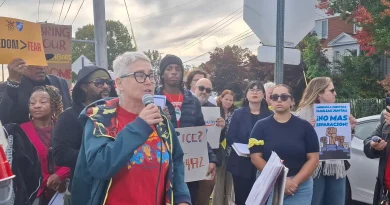
In the days before the Colchester Planning and Zoning Commission held its regularly scheduled meeting on Oct. 21, rumors swirled online that the meeting would focus on approving two data centers proposed for Old Amston Road, a remediated brownfield that once served as an auto parts salvage site.
Residents were encouraged to show up in force to let the city know that a data center was not wanted.
Liv Pike was one of the residents who answered that call.
Pike lives on the road where the proposed data centers could be placed. She cares deeply about the environment and believes that a data center, and the artificial intelligence technology that it could support, would create new harms.
And the research she’s been doing in recent days has only added to her fears.
“I found out that most of the water that is used to cool down these AI data centers we cannot reuse because they have salt and other chemicals in it. It doesn’t go back into the river system,” she said. “If we did that, we are bringing not just Connecticut and Colchester — we are bringing the world closer to ending, in my opinion.”
Other residents came prepared to speak too, citing worries about noise and quality of life. Some said that a local moratorium on data centers is needed.
But when the meeting began on Wednesday evening, members of the commission were quick to emphasize that the project is nowhere near that far along. An application for the facilities, the first step before any further planning, zone change, or public hearing discussions are held, has yet to be filed.
Colchester First Selectman Bernie Dennler says that the project currently raising concern has been around for years, and predates his time in office. “It’s important for people to understand this is not a Town project,” Dennler said in an email. “Private applicants have the right to submit their proposals to the town, but the town is not a party to this private proposal.”
Should an actual application be filed in the future, “both the applicant and residents have a right to be heard in the process,” he added.
John Matheson, the CEO of ReNew Developers, a real estate firm that lists the two Colchester sites and a third property in Bristol as “available listings” on its website, says that the public outcry over the project has misconstrued the role his company is playing in the development process. ReNew, he says, is only responsible as a power provider for the properties, adding that they are owned by other parties and that his company would not actually be involved in any construction of a data center.
Beyond that, Matheson argues that the projects he is involved in differ greatly from the sorts of hyperscale data centers that have drawn national backlash.
“They’re the size of a garden variety Tractor Supply building, or even a CVS,” he said, noting that the owners intend to operate the sites in ways that are environmentally safe. “These are not big, large, impactful buildings that are being suggested.”
Bristol
In Bristol, a long-simmering proposal for a facility on Riverside Avenue has rankled local residents, with tensions reigniting this spring. The proposal, which like the proposal in Colchester, counts ReNew Developers as a power provider, faced public backlash as residents raised concerns about its construction in the city, citing concerns about its placement so close to the Pequabuck River.
The backlash grew so intense that Bristol’s Mayor released a statement that aimed to clear up public perceptions of the project. In the statement, Mayor Ellen Zoppo-Sassu explained what administrative steps the project had already cleared, while also aiming to describe what the proposed facility would do.
The proposed center, she said, is far different from a hyperscale data center, instead referring to the project as a “micro-cloud building” designed to do something different than an AI-supporting data center.
“Smaller data centers that bring their own power can be designed for greater sustainability, resulting in a lesser environmental impact and serving as a productive building within the community, which is a goal in Bristol,” she wrote.
The building, she added, would use less water than local grocery stores or high schools.
Still, the backlash has been intense, prompting Zoppo-Sassu to support changing local zoning ordinances to prevent the construction of large data centers in the future.
Beacon Falls
As in other communities, local officials in Beacon Falls — an old manufacturing center along the Naugatuck River — say that the furor over a proposed 100-megawatt data center has gotten ahead of reality.
“There is absolutely nothing pending, in conversation, on the table, nothing at all for Beacon Falls,” Beacon Falls First Selectman Gerry Smith said in a recent interview.
The confusion, Smith said, stems from a four-year-old memorandum of understanding between the town and a local developer, O&G Industries, to facilitate the construction of a smaller 32-megawatt data center on a former gravel quarry adjacent to Route 8. Under the terms of that agreement, the data center owners would have paid $2.5 million a year in taxes, with annual increases for inflation.
That additional revenue would have allowed the town to reduce its tax rate on other properties by more than 13%, according to a copy of the agreement shared with the Connecticut Mirror.
In the end, the project never came to fruition because the developers were unable to find a buyer for the project, Smith said. The tax agreement expired in 2023, before the town could formalize a host fee agreement.
Smith said he last heard from O&G Industries over the summer, when they reached out to ask whether the town would be willing to entertain a second agreement over a revised proposal. Smith said he responded that he was open to the idea but has yet to hear back with any specific plans.
“The last time they had serious conversations was four years ago,” Smith said.
In the meantime, marketing materials published online by a New York real estate firm, the Agency, have begun advertising the O&G project as an upgraded 100-megawatt facility, about 294,000 square feet, powered by on-site fuel cells.
“The development is designed to accommodate the rapidly evolving requirements of artificial intelligence, machine learning, GPU-intensive computing, cloud infrastructure, and enterprise digital workloads,” a website for the project states.
Representatives from O&G Industries and The Agency could not be reached for comment this week.
During a Beacon Falls Planning and Zoning meeting held in August, about a dozen residents showed up to raise concerns about data centers and call for a moratorium, according to minutes of the meeting.
In an interview, Smith expressed frustration at both the protests and the developers, who he said had failed to be proactive in their outreach with the town. And while he said he still sees potential benefits in data center development, he added that obstacles may outweigh any incentives.
“I was told Connecticut wanted to be the data center capital of the world because all these lucrative developers were moving south and west,” Smith said. “It sounded fantastic — but the cost of doing business in the state of Connecticut is still high. Even if you waive all the taxes, it’s still too expensive.”
Editor’s note: Artificial intelligence was used in the process of researching this story. CT Mirror reporter Angela Eichhorst contributed to this story.