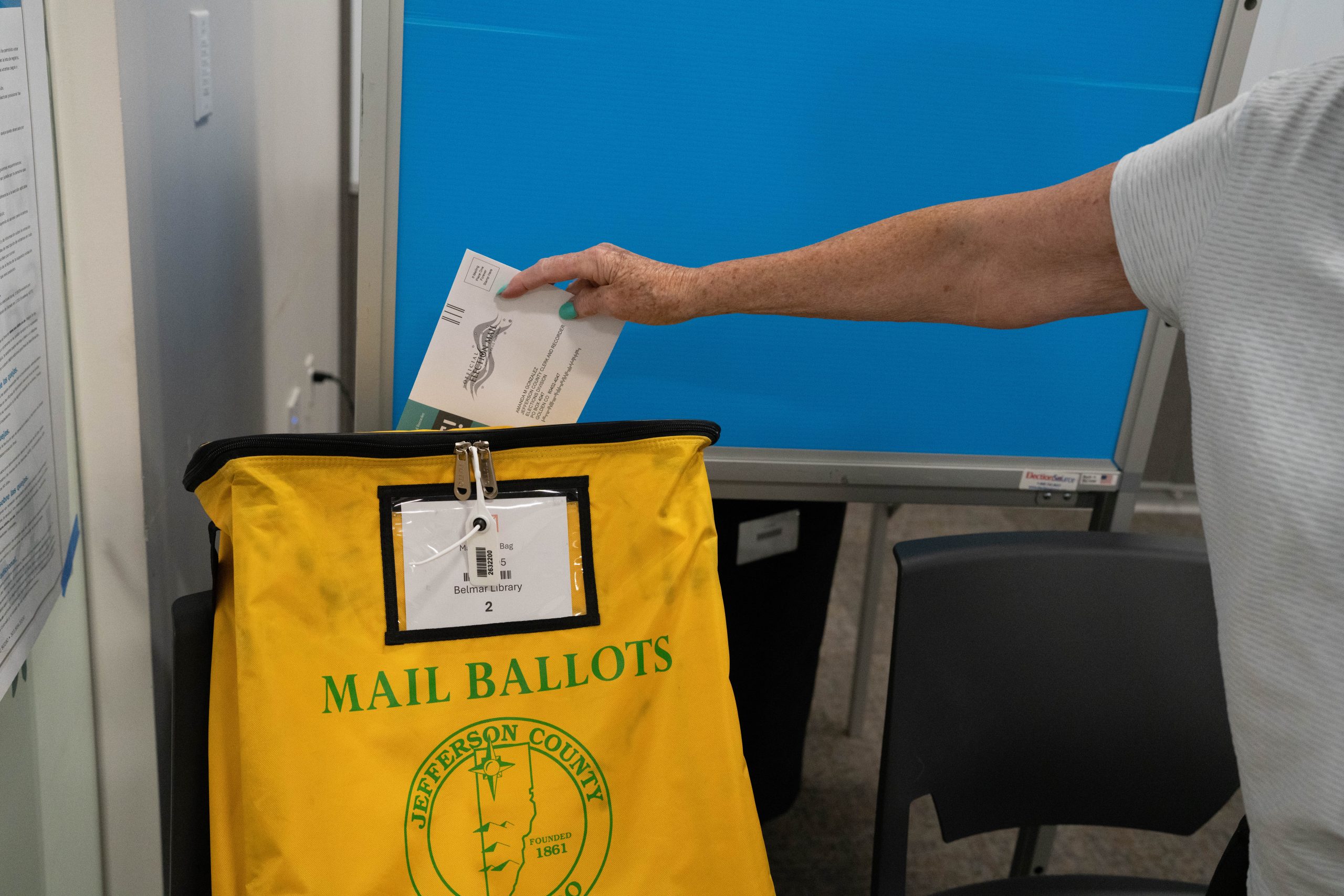
Amendment 84 rules caused spike in rejected ballots elsewhere
Other states that passed identification requirements similar to what Colorado voters are being asked to approve this November led to an initial spike in rejected mail ballots.
Colorado voters are deciding whether to pass Amendment 84, which would require them to provide the last digits of their Social Security, driver’s license or state identification cards, in addition to their signatures, when returning their mail ballots.
Three states that have passed laws requiring more identification to vote by mail in recent years saw an increase in the number of ballots that were rejected.
Rejection rates in Georgia, Texas and Virginia eventually decreased, but only Virginia saw its rejection rate return to where it had been before the ID requirement was added, according to data from the Voting Rights Lab, a nonpartisan nonprofit.
Texas provides the best, though imperfect, comparison to what Colorado is considering despite big differences in the states’ mail voting systems.
The mail-in ballot system is Colorado’s primary method of voting while mail ballots in Texas are mainly limited to people who are over age 65 or disabled. But the identification requirements to vote by mail in Texas are similar to what Amendment 84 is proposing in Colorado.
Since 2022, Texas mail voters have had to include identification numbers from their driver’s license, personal state identification card, election identification certificate or the last four digits of their Social Security number on their ballot envelope. Texas also kept a requirement for voters to sign the envelope and for that signature to be checked by election officials. Colorado has the same requirement, and it would not change if Amendment 84 passes.
Virginia and Georgia got rid of previous signature requirements and now require voters to provide ID numbers.
Texas’ experience
After Texas adopted its ID requirements, the rejection rate for mail ballots surged to 11.6% in the 2022 primary election, up from 0.9% in the 2020 election, the Voting Rights Lab said. After the ballot envelope was redesigned to better highlight boxes requiring ID numbers and signatures, the rejection rate dropped to 3.4% in the 2022 general election, it said. The rejection rate in the 2024 general election was 3.5%.
In the 2024 election in Colorado, 1.4% of mail ballots, nearly 39,000, were rejected and not counted.
Former El Paso County Clerk Chuck Broerman, who proposed Amendment 84 along with Suzanne Taheri, a former Colorado deputy secretary of state who now works as a lawyer at West Group, a Colorado law firm that works for conservative candidates and causes, said Colorado can’t be compared to Georgia, Texas or Virginia because mail voting is so different there.
In Texas, for example, voters only have three days to fix any problems flagged with their ballot, Broerman said. Colorado voters who need to follow up not only have more time but would have multiple ways to provide their ID information, including by text message, he said.
“Education is the key in this matter,” Broerman, a Republican and current El Paso County treasurer, said of the proposed change. “I do not see an impediment to voting with this addition.”
Up to 50% rejection predicted
Opponents of Amendment 84 estimate between 10% to 50% of Colorado mail ballots could be set aside for “curing” if the measure passes.
Currently, voters whose ballots are flagged by elections workers for missing signatures or signature discrepancies can resolve those issues with their county clerk within eight days of the election.
If Amendment 84 passes, voters would have the same length of time to “cure” their ballots of any flagged issues involving missing ID numbers or discrepancies. If they don’t, their ballots would not be counted.
Opponents of Amendment 84 questioned whether many people would resolve ID issues if their ballots got flagged.
Scott Martinez, Denver’s former city attorney and an election lawyer working with Defend Our Ballots, the committee opposing Amendment 84, said the figure is based on conversations with county clerks and election officials across the state.
Even if the number is 10%, that would be a lot of voters, Martinez said, given that 92% of Colorado voters used mail ballots in the 2024 election.
“It’s inviting a chance to have half of our votes rejected when we don’t need to have this new process in place,” he said.
Defend our Ballots says people may not want to include a partial ID number because they will be worried about the risk of identity theft.
Denver Clerk Paul Lopez thinks the rejection rate could be high because people would be hesitant to include their identification numbers.
“This would unduly harm voters’ confidence in election security,” he said.
Broerman dismissed such concerns, saying banks and doctors’ offices already use the same partial ID numbers to verify people’s identity without meaningful risk.
The Colorado County Clerks Association has not taken a position on Amendment 84.
However, the association’s executive director, Matt Crane, a Republican who served as Arapahoe County’s clerk, said the estimate of 50% rejection rate was “ridiculous.” He declined to provide a figure or projection of his own.
If the measure passes, Crane said voters would have to be educated about the change, just like they were in 2018 when Colorado began mailing both Republican and Democratic ballots to unaffiliated voters so they could vote in the primary. Voters were only allowed to cast one of the ballots to have their vote counted.
If Amendment 84 passes, Crane said he would encourage clerks to tell voters to check their voter registration records and make sure both their driver’s license and Social Security number are listed in the state’s registration database. About 99% of voters already have a number listed in the system now, he said.
Utah is making the switch slowly
There’s another more gradual approach to requiring ID information on mail ballots that’s being used in Utah, one of the eight states, like Colorado, that mainly relies on mail voting to conduct its elections.
Utah already required mail ballot voters to sign their ballot envelopes, like Colorado. But under legislation approved by the Republican controlled legislature, Utah also began asking voters to provide the last four digits of their driver’s license, state ID or Social Security number on the mail ballot envelopes starting in this past June’s primary election.
Ballots without ID information can still be counted for now but, starting in 2029, voters must provide both a signature and an ID number for their ballot to be counted.
“We made it more secure without making it more difficult,” Utah State Sen. Michael McKell, a Republican, said.
He doesn’t think anyone will be disenfranchised because of the change but he said there will be time to make adjustments before 2029 if problems arise.
Colorado’s proposed change would be added to the state constitution so any modifications would require another constitutional amendment. However, election officials can decide how to implement the measure, such as changing the envelope design like Texas did, Broerman said.
However, she said there’s no automated way to check ID information, like signatures, which slowed down the verification process.
Both ID and signatures were manually checked at the same time, which took about 12 seconds per ballot, rather than about two seconds when a machine was able to verify just the signature, she said. Over the course of an election, that can add hours to the processing time, she said.
Requiring ID numbers for mail ballots has become more common since the 2020 election, when mail voting surged during the pandemic.
It also became a partisan issue, Kyle Saunders, a political science professor at Colorado State University, with President Donald Trump attacking mail voting during the 2020 campaign. Last year Trump said on Truth Social that elections “can never be honest” with mail ballots, even though he has voted by mail himself.
Before 2020, only Alaska, Minnesota and Ohio required them, according to the Voting Rights Lab. Since 2020, seven states have changed their laws to require either ID numbers or ID copies for mail voting.
ID requirements for voting in person and by mail are also on the ballot in five states besides Colorado this year — Arizona, California, Nevada, North Carolina and Ohio.