Where in France have curfews been imposed?

France will impose new curfews in areas where needed on Tuesday, the prime minister said after a first night of partial curfews in major cities including the capital Paris.
France was rocked on Saturday by some of its worst rioting in recent years, just six months before the country elects a successor to President Emmanuel Macron.
Accused of failing to anticipate and contain the street violence, the government has pledged to restore order, and had announced partial curfews in Paris and some other cities on Monday.
“Targeted curfews have contributed to calm overnight,” Lecornu wrote on X.
Don’t miss our journalists’ daily news roundup from France
“Tonight new curfews will be decided where the situation requires it. These decisions will be made on the ground, by the prefects, in coordination with the mayors,” he said.
Police confirmed the night had passed without major incidents across France.
Several cities, including Paris, the southwestern city of Bordeaux and Nice on the French Riviera, introduced partial curfews on Monday in response to urban unrest that followed weeks of student demonstrations over poor learning conditions in high schools.
While some restrictions, such as those in Paris, initially applied only for the night from Monday to Tuesday, others, particularly in Bordeaux and Nice, were set to remain in force for several days.
During the night, a helicopter flew over the French capital’s Place de la République, one of the epicentres of the unrest, sweeping a powerful searchlight across the square to monitor compliance with the curfew.
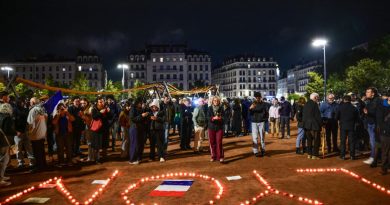
In Lyon, despite a ban on demonstrations, around 500 people gathered on Monday evening outside the tourism office that was set on fire, to show support for shopkeepers affected by looting, according to organisers.
The word “LYON” had been spelt out on the ground with candles.
People lit candles in front of the Lyon tourist office before a partial curfew in Lyon on October 19, 2026. (Photo by OLIVIER CHASSIGNOLE / AFP)
A banner hung on a fence nearby read “Anti-Rioters Lyon” and “Doucet Resign”, referring to Green mayor Gregory Doucet, an AFP journalist said.
Under pressure, the government scheduled another series of emergency meetings on Tuesday, including talks involving representatives of major social media platforms.
Finance Minister Roland Lescure pledged support measures for shopkeepers and craftspeople.
Patrick Martin, the head of France’s Medef business lobby group, on Tuesday accused the state of having “failed” during the urban unrest that hit at least 3,000 businesses, according to preliminary estimates.
Tourists in Paris had a taste of the disruption on Monday when they found the Louvre closed because of a small group of student protesters, while the US embassy in Paris urged American citizens to avoid the demonstrations.
READ MORE: Protest violence: Is it safe to come to France this autumn?
Facing accusations that it failed to anticipate and respond to the violence, the government has vowed to re-establish order, while officials scrambled to contain public anger.
Other European countries have also seen demonstrations over rising prices, with smaller clashes breaking out in Milan and Belgium over the weekend and protests simmering in Spain and Portugal.
Some half a million people turned out across France on Saturday to denounce the surging cost of living, a culmination of four weeks of protests that began with students demanding better conditions at high schools.
What started as peaceful demonstrations descended into violence in many cities, as masked groups attacked law enforcement, broke into public buildings and set some ablaze, looted shops, and set fire to cars, bicycles and scooters.
On Monday, France’s digital minister, Anne Le Henanff, urged online resale platforms to remove listings for “stolen items” following Saturday’s looting and summoned representatives of companies including Vinted and eBay.
After the weekend scenes of chaos, Interior Minister Laurent Nunez offered his resignation, but Macron refused to accept it.
More than 2,500 people were arrested and nearly 1,000 members of the security forces injured. Protesters were also hurt, with one demonstrator’s hand blown off by a police crowd-control grenade.
READ ALSO: ANALYSIS: Who are France’s ‘casseurs’ and why can’t police stop their violence?
Macron acknowledged failures in the government response, which had seen 60,000 law enforcement personnel deployed on Saturday.
Nationwide, more than 2,513 people have been taken into police custody since the weekend, Justice Minister Gerald Darmanin said. He added that 67 had been jailed and “dozens” of criminal cases opened.
Darmanin also said authorities would use facial recognition on social media to identify perpetrators.
At least 3,000 shops were damaged, with the cost running into hundreds of millions of euros.
In an address to the nation Sunday, Macron slammed the “unbridled” violence. The European Union called the violence “unacceptable” but warned that the right to peaceful protest “must be protected” in France.
Germany condemned the violence and updated its travel advice for France, saying “further outbreaks of violence in the coming days cannot be ruled out”.
China has warned citizens travelling to France to be aware of risks and take safety precautions, state broadcaster CCTV reported.
The unrest has flared before presidential elections in April and May that will elect a new French president after a decade of centrist Macron.
Marine Le Pen, the far-right presidential candidate, is riding high in the polls. The government has accused ultra-left groups of stoking the violence to boost the chances of the far-left firebrand Jean-Luc Mélenchon in the presidential polls.