State lawmakers unmoved by Entergy explanations after farmers plead their case
Sad stories from four farmers and a legislator’s analogy about socks seemed to trump the numbers Entergy executives used Monday to defend a law that allows the utility to start charging customers for power generation before the power is available.
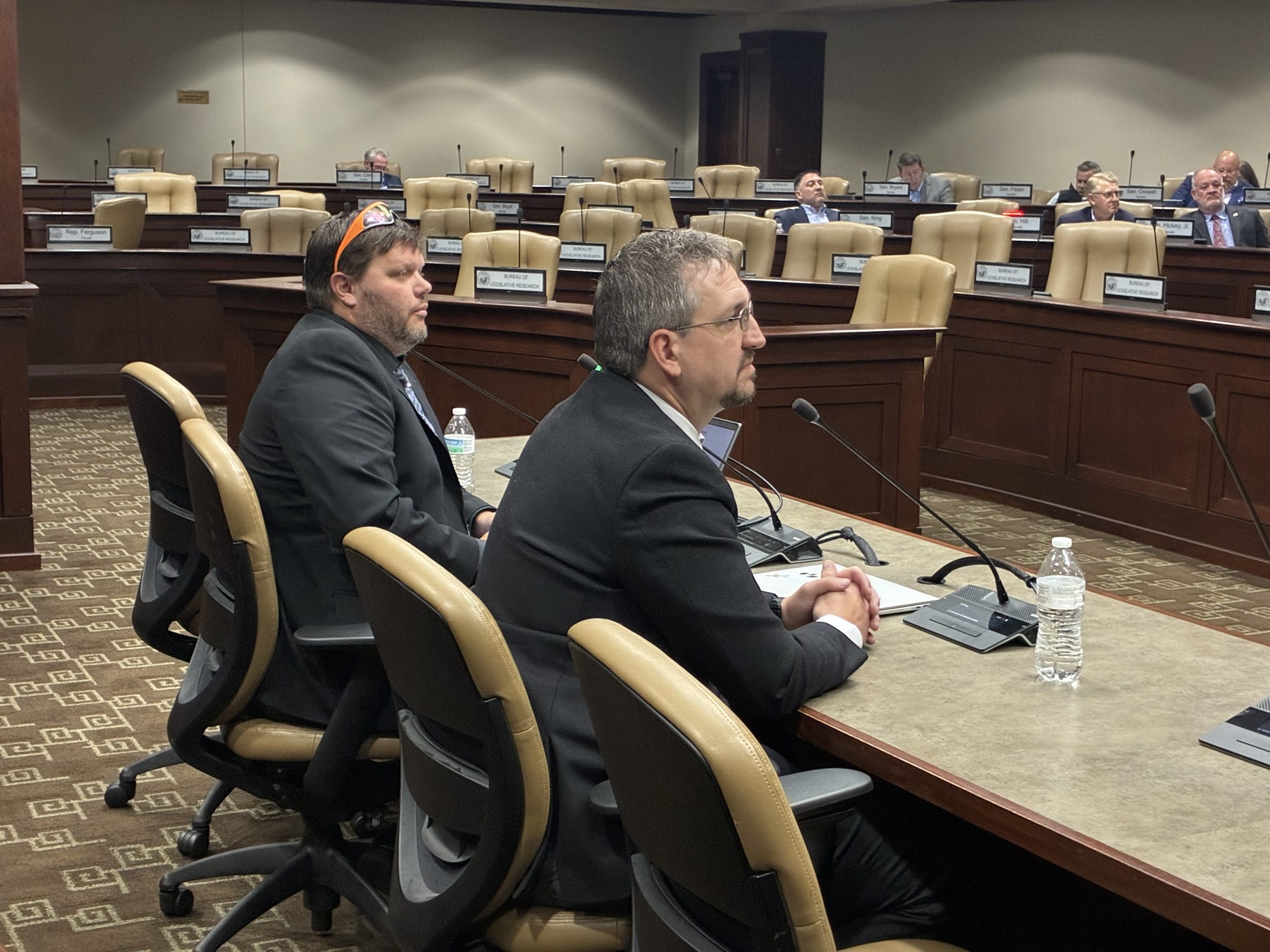
This month’s Joint Committee on Energy was devoted to exploring the Generating Arkansas Jobs Act, which was largely written by Entergy and, starting in June, placed an additional $5.77 on customers’ bills for every 1,000 kilowatt hours of electricity used. That doesn’t sound like much, until a farmer describes how those kilowatt hours add up.
Lori Caveness, a farmer from Carlisle, said she saw a $3,000 addition to one of her many electric bills – she has several wells, grain bins and homes for workers that she has separate accounts on – and then started adding them up.
“It was $25,000,” she said, “and that’s not even all my bills. With $6 diesel and low (commodity) prices, it’s a blow. It’s a real blow. It’s very upsetting. I thought, ‘What is this?’ It’s like they slipped it under the door.”
Wendi Stacks said her family farms about 1,700 acres near Hazen and that the Generating Arkansas Jobs Act would amount to an additional $12,000 a year charge for her.
“Some people will say that’s not that many dollars, but it is,” Stacks said. “We don’t have any more dollars to give. Next year, this starts in April. There’s not any more dollars to go around. We’re Arkansas’ largest industry. We don’t get a tax break. We don’t get anything. We’re not a data center. We’re taking the brunt of everything.”
The act is having a tough go these days as ratepayers, also known as voters, are starting to become aware of a new line item on their electric bills and calling their legislator to ask what it is.
Sen. Mark Johnson (R-Little Rock), co-chair of the committee, said at a recent energy conference he thought the act inappropriately shifted the burden and risk away from Entergy’s investors and onto its ratepaying customers.
That was the theme of the meeting, with one after another person testifying that the act wasn’t working.
To make his point, Johnson told the story of being a youngster and becoming a Walmart customer. He said Sam Walton had come to Conway and built a store, outfitted it, stocked it and hired employees.
“I went in and bought a pair of socks,” he said. “I didn’t realize that I was not only buying the socks but also paying for the land and building and employees.” Walton and Walmart shareholders, he said, took the risk of building the store and didn’t charge would-be customers in advance of the store being in operation. That was the way customers used to be charged for new power plants – after they had come online – instead of having to pay for them upfront, as allowed by the act.
When Steve Chriss, an energy executive with Walmart, was at the microphone, Johnson asked him if his analogy was accurate.
Yes, Chriss said. “When we build a store, if customers show up, that’s great,” he said. “If not, those are the risks we take. We don’t precharge customers.”
Lauren Waldrip, executive director with the Arkansas Advanced Energy Association, a trade group, said that despite all of the power production on Entergy’s horizon, Arkansas, with the retirement of three coal-fired plants, would have less electricity after that power production is completed than it has today. “And that’s using Entergy’s numbers,” she said.
Two economists also spoke, putting the act in easy-to-understand terms. Eric Olson, who holds a doctoral degree in economics and works at the Institute for Governance and Civics and Florida State University, and Jason Walter, an associate professor of economics at the University of Tulsa, took turns bashing the state’s act, saying the way the law is written monetarily rewards a company – in this case, Entergy – for being slow to build electric generating plants because of the interest they get while a facility is under construction.
They also said that ratepayers become Entergy’s bank, except that they don’t get the benefits that a bank gets. Delays and cost overruns are both borne by ratepayers, they said.
“Right now, the ratepayer is on the hook if there are any hiccups that happen along the way, “ Walter said. “That’s noteworthy and should be concerning.”
Walter said the “tried and true” method for financing the cost of building power generation is that customers start paying for the facilities “when they get the benefits and they are finished.”
In today’s world, Olson said, the huge electricity needs of data centers are front and center, but that could change quickly.
“At buildout, that might not be needed or technology has changed,” he said, describing a situation in which customers would be on the hook for an overabundance of electrical generation. “It’s hard to predict the future.”
Olson concluded by saying that other states do have laws in place like the Generating Arkansas Jobs Act, but they are typically used for hugely expensive and long-term business propositions such as nuclear energy, which can take many years to get permitted and built and can incur large cost overruns – and not used for the natural gas-fired power plants and solar farms that Entergy is using the money to build.
At the end of the more than three-hour meeting, three Entergy executives spoke. John Bethel, director of public affairs, stayed close to the company’s previous messaging – that the act was being used in such a way that energy customers were better off in the long run. But it was almost as if the lawmakers weren’t even listening to him or his two associates, David Palmer, vice president of regulatory affairs, and Ventrell Thompson, vice president of customer service.
More than one legislator complained that there was a special secret rate that Entergy had agreed to with Google for the construction of a solar farm in Jefferson County and that without that detailed information, it was going to be difficult for customers to accept costs going up on their own bills. Others said the state was sacrificing its farmers in exchange for electrical production for data centers that would need few workers.
“You say this is a benefit,” said Sen. Jimmy Hickey Jr. (R-Texarkana). “But this is not beneficial to people that can’t afford these bills. They’ll go bankrupt. We can’t allow this to happen. There’s a flaw in this bill.”
One of the farmers, Cory Skarda, a third-generation farmer from Des Arc, said he had estimated that the new charge on his electric bill would cost him between $35,000 and $40,000.
“I took home less than that last year,” he said.
Hickey went so far as to apologize for voting for the bill.
“It’s a horrible bill,” he said, “I wrote a 12-to-15-page amendment. Sometimes you have to be a man and say you made a mistake because it’s still a horrible bill.”
Source link