
Discover local heritage through kaya toast and ice cream bread
SINGAPORE – Many children love a good plate of chicken rice or a slice of kaya toast, but few know the story behind them – that these familiar dishes were introduced by Hainanese immigrants who made Singapore their home.
To help kids explore the roots of these beloved dishes, Koh V-Nying, 24, Ng Wee Liang, 27, and Yong Chuen Shin, 25 – collectively known as The Hainanese Cooked – have released Bo’ Hou And The Grand Feast, a picture book celebrating Hainanese culture and cuisine.
Available to read for free online at hainanesecooked.netlify.app, the story follows two animal characters, Bo’ Hou and Mai Tin, inspired by the traditional Hainanese tiger and lion dance.
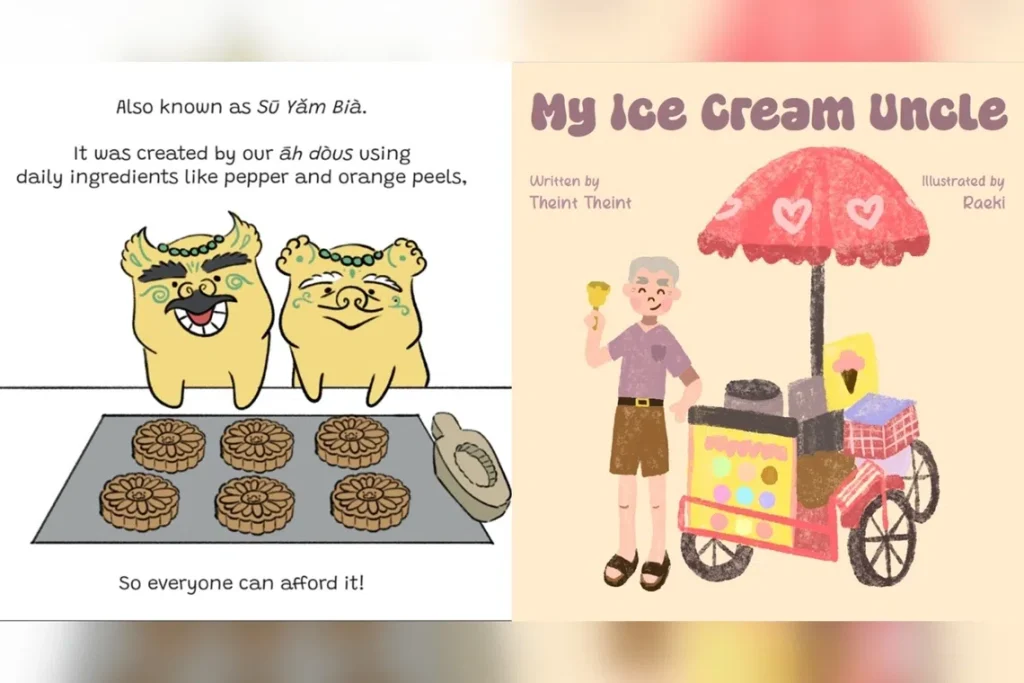
Through their adventures, young readers are introduced to dialect phrases and lesser-known delicacies such as ge bia, a Hainanese-style mooncake made with orange peel and pepper.
“We hope young readers can learn Hainanese phrases and about delicacies they may not encounter in everyday life,” says Yong, who is of Hainanese heritage. “We want to spark their curiosity to explore more about our culture.”
To help families turn learning into a fun outing, the team has also created a web map. It highlights local eateries serving traditional fare, an 1853 heritage temple and a troupe keeping the art of Hainanese tiger dance alive.
(From left) Ng Wee Liang, Yong Chuen Shin and Koh V-Nying of The Hainanese Cooked hope to share Hainanese culture.
PHOTO: NUS LIBRARIES
Bo’ Hou And The Grand Feast is one of 10 student-led community heritage projects developed under the inaugural Temasek Foundation-National University of Singapore (NUS) Heritage Champions programme.
Children’s book Bo’ Hou And The Grand Feast introduces traditional Hainanese food such as mooncake ge bia.
PHOTO: THE HAINANESE COOKED
Over two years, 125 tertiary students across two cohorts participated in the initiative, supported by NUS Libraries, Temasek Foundation and the National Heritage Board. The top five teams from each cohort received up to $7,000 to bring their projects to life.
Scoops of Memory members Totaan Aljean Choong (far left) and Lai Xin Yu (far right) with roadside ice-cream hawkers.
PHOTO: NUS LIBRARIES
Another project to emerge from the programme is My Ice Cream Uncle, a children’s picture book spotlighting roadside hawkers selling ice cream wrapped in bread.
Created by Scoops of Memory – comprising Totaan Aljean Choong, 20, Lai Xin Yu, 20, and Theint Theint Zaw Tun, 23 – the project also includes a YouTube documentary exploring the trade, titled Where Are Singapore’s Ice Cream Hawkers Going?.
“Ice-cream hawkers were a familiar part of many Singaporeans’ childhood, but they are slowly disappearing,” says Theint Theint Zaw Tun.
“Each cart represents years of hard work and community connection. We wanted to preserve these stories and make them accessible to a new generation.”
Families can look out for the e-book release on their Instagram page (@scoopsofmemory) by year-end.
Physical copies of the picture books from both teams will also be available at selected public libraries.
Children’s book My Ice Cream Uncle spotlights roadside ice-cream hawkers.
PHOTO: SCOOPS OF MEMORY
For NUS university librarian Natalie Pang, these projects highlight how important young voices are in keeping heritage alive.
“Singapore’s heritage is not only found in monuments and historic buildings,” she says. “It also lives in everyday experiences, memories, food, places and the stories of communities.
“When young people take ownership of these stories and find new ways to share them, they help ensure that our heritage remains relevant and meaningful to future generations.”