Why CT is more expensive than it needs to be
Connecticut loves its towns, and for good reason. Our local identities are part of what makes this state special. Old Saybrook feels different from Hartford. New Haven feels different from Shelton. Nobody is suggesting otherwise.
But here’s a question we don’t ask nearly enough: Does Connecticut’s economy still operate the way Connecticut’s government is organized?
I don’t think it does. And nowhere is that disconnect more obvious than property taxes.
Let’s do a simple thought experiment. Imagine a manufacturer is considering a $10 million facility somewhere in Connecticut. Same company. Same building. Same products. Same employees. Same customers.
The only thing we’ll change is the town where the facility is located.
Using Connecticut’s standard assessment methodology, the property would have an assessed value of approximately $7 million. Apply current municipal mill rates and the annual property-tax bill changes dramatically.
In Shelton, the tax might be about $132,000. In Hartford, nearly $483,000.
Nothing about the company changed. Nothing about the business changed. We changed the ZIP code. The difference is roughly $351,000 every year, or about $3.5 million over a decade. Same factory. Same state. Very different economics.
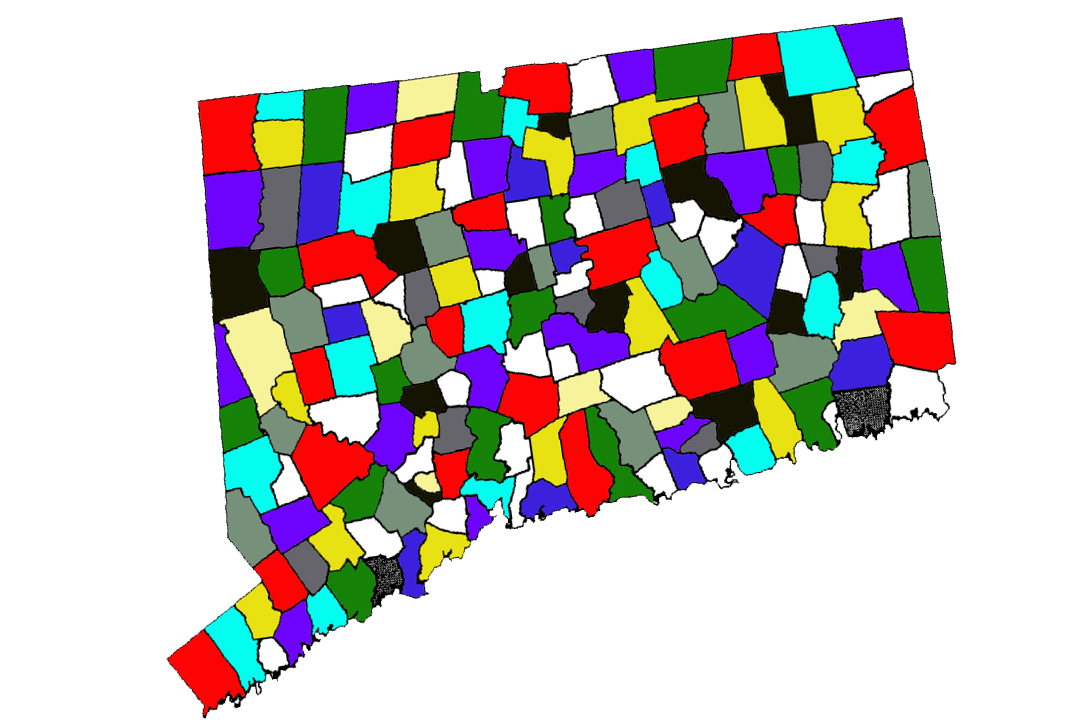
That’s what I call the 169 Problem.
The challenge is that policymakers often talk about taxes in separate buckets: state taxes, local taxes, corporate taxes, sales taxes, property taxes. Businesses don’t see it that way.
A CEO or CFO looks at one number: What does it cost to operate here?
Taxes are part of that calculation, but so are energy costs, workforce availability, housing, transportation, permitting, healthcare, and infrastructure. Increasingly, another cost belongs on that list as well: Fragmentation.
Think about how we actually live today. Someone may live in Manchester, work in Windsor, shop in West Hartford, visit a doctor in Farmington, and attend an event in Hartford. A company’s workforce, suppliers, and customers rarely stop at municipal boundaries.
Our economy is regional. Yet much of our tax structure remains intensely local. The result is that towns often end up competing for tax base instead of collaborating on regional growth.
Instead of asking, “How do we grow Connecticut’s economy?” we can end up asking, “How do we grow our grand list?” Those aren’t always the same thing.
There is another side of the 169 Problem that deserves attention.
Every municipality performs many of the same functions: purchasing, finance, technology, assessment, human resources, planning, economic development, and administration.
Some of those functions should absolutely remain local. But do all of them need to be performed independently 169 times? [
Connecticut businesses figured out long ago that duplication is expensive. They share services, centralize purchasing, deploy common technology, automate routine work, and continuously improve operations.
Not because it’s fashionable. Because scale matters.
So here’s a modest proposal.
Forget municipal consolidation. Forget redrawing maps. Forget eliminating local government. Instead, start with a simple question: Could Connecticut find 5%?
Could regional purchasing, shared technology platforms, cooperative public works, or joint administrative services reduce costs by even 5%? If the answer is yes, return the savings to taxpayers through lower property taxes. If 5% isn’t achievable, prove it. If 10% is achievable, pursue it.
But let’s measure it.
This isn’t about eliminating towns. It isn’t about forcing regionalization. Connecticut can preserve local identity while embracing regional systems where they make sense. Those ideas are not mutually exclusive.
More importantly, Connecticut towns aren’t really competing with one another. Connecticut is competing with Massachusetts, North Carolina, South Carolina, Texas, Florida, and increasingly the rest of the world. When a company chooses one Connecticut town over another, Connecticut hasn’t necessarily won.
Connecticut wins when that company chooses Connecticut.
Maybe we’ve been asking the wrong question. Instead of debating whether Connecticut’s business taxes are too high, perhaps we should be asking why Connecticut remains so expensive in the first place. That question forces us to look beyond tax rates and examine the system itself
Because our workforce is regional. Our housing markets are regional. Our supply chains are regional. Our transportation systems are regional. Yet much of the government supporting that economy remains organized locally.
Our economy is regional. Our tax structure is local. And that mismatch is costing us.
Connecticut doesn’t need 169 economic-development strategies. It needs one growth strategy supported by strong communities and strong regions. And the most important competitiveness initiative we can pursue may not be another incentive program.
It may be redesigning the system that makes Connecticut expensive in the first place.
Paul Lavoie is Vice President of Corporate Partnerships & Innovation and Executive Director of The Elevation Center at the University of New Haven. He previously served as Connecticut’s Chief Manufacturing Officer, where he led statewide efforts to strengthen the state’s manufacturing sector and workforce pipeline.